Anouncement

Anouncement

For audio, listen here
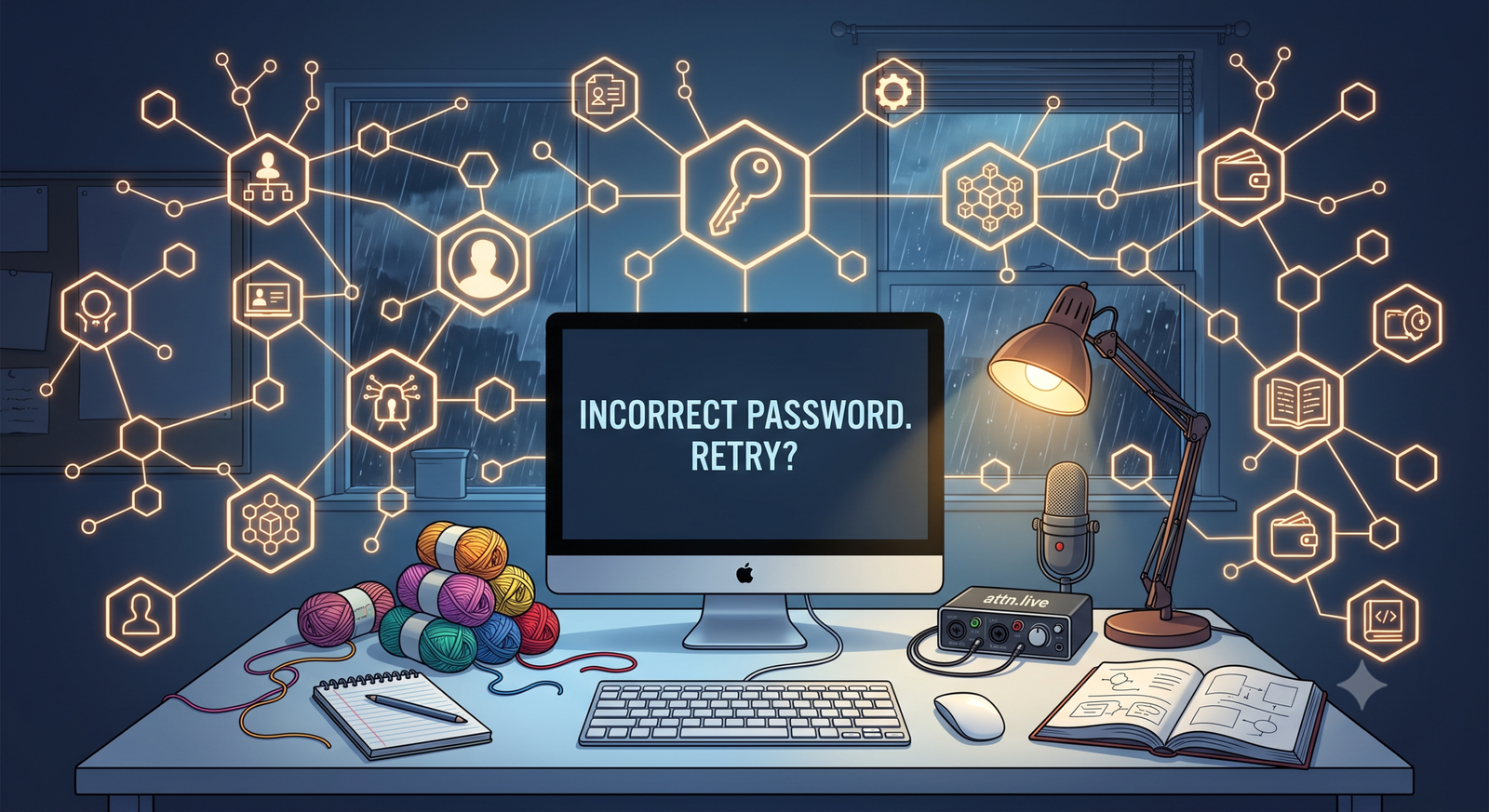
The glowing blue text read exactly three words: Incorrect password. Retry?
It was 11:42 PM on a rainy Tuesday. I’d just spent four grueling hours recording and mastering the final vocal tracks for my newest audio story on attn.live. My voice was hoarse, but the narrative was perfect—the kind of immersive storytelling that hooks a listener from the first sentence. Now I needed to log into my custom web app and upload a brand-new crochet pattern before the morning rush.
Capital I, lowercase a, exclamation point, my childhood dog’s name, the year I graduated.
Denied.
Maybe the one where I swapped the ‘E’ for a ‘3’?
Denied.
Did I change it last month after that hotel data breach? Let’s try the long one with the percentage sign.
Account locked for 60 minutes due to multiple failed login attempts.
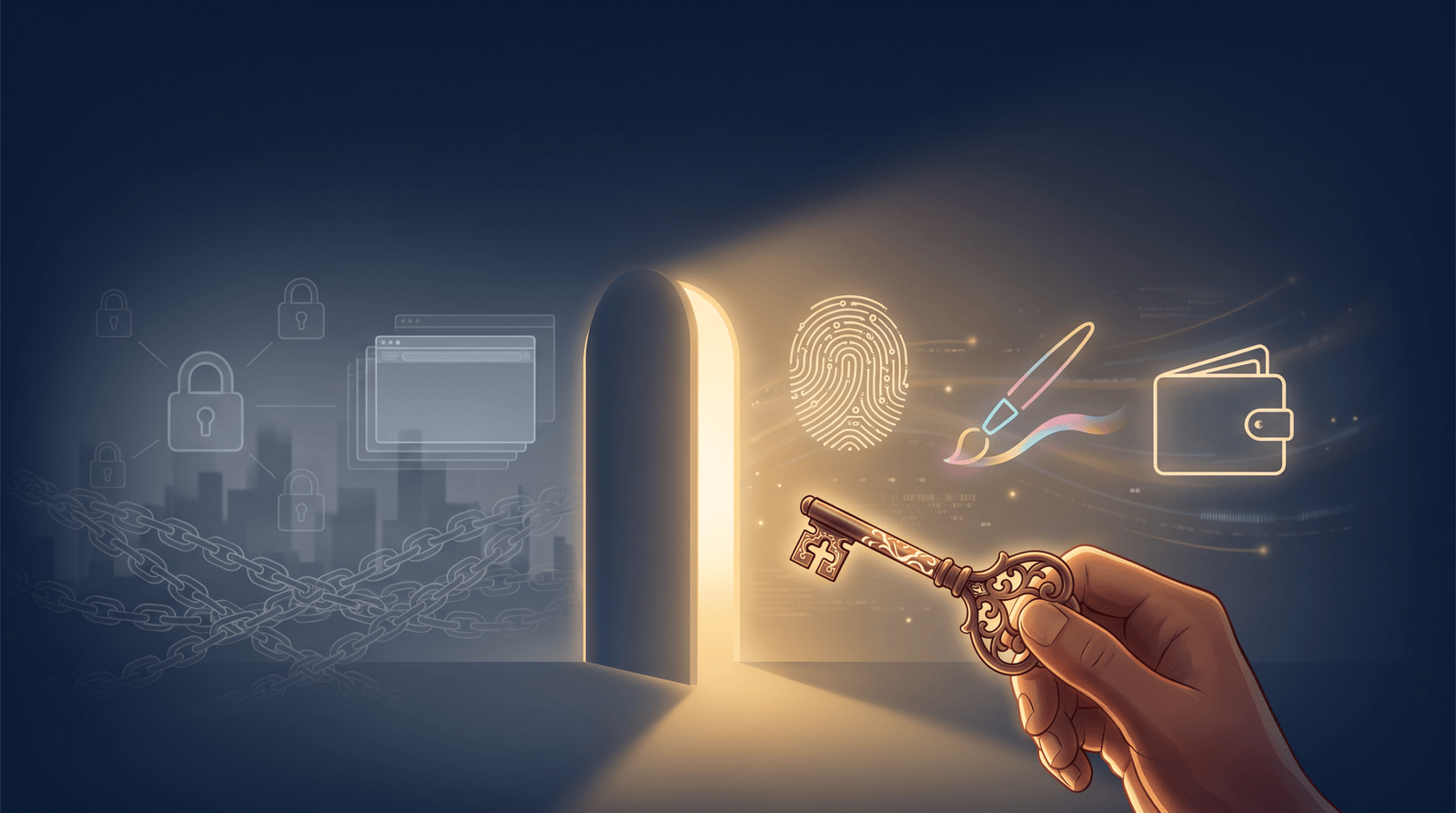
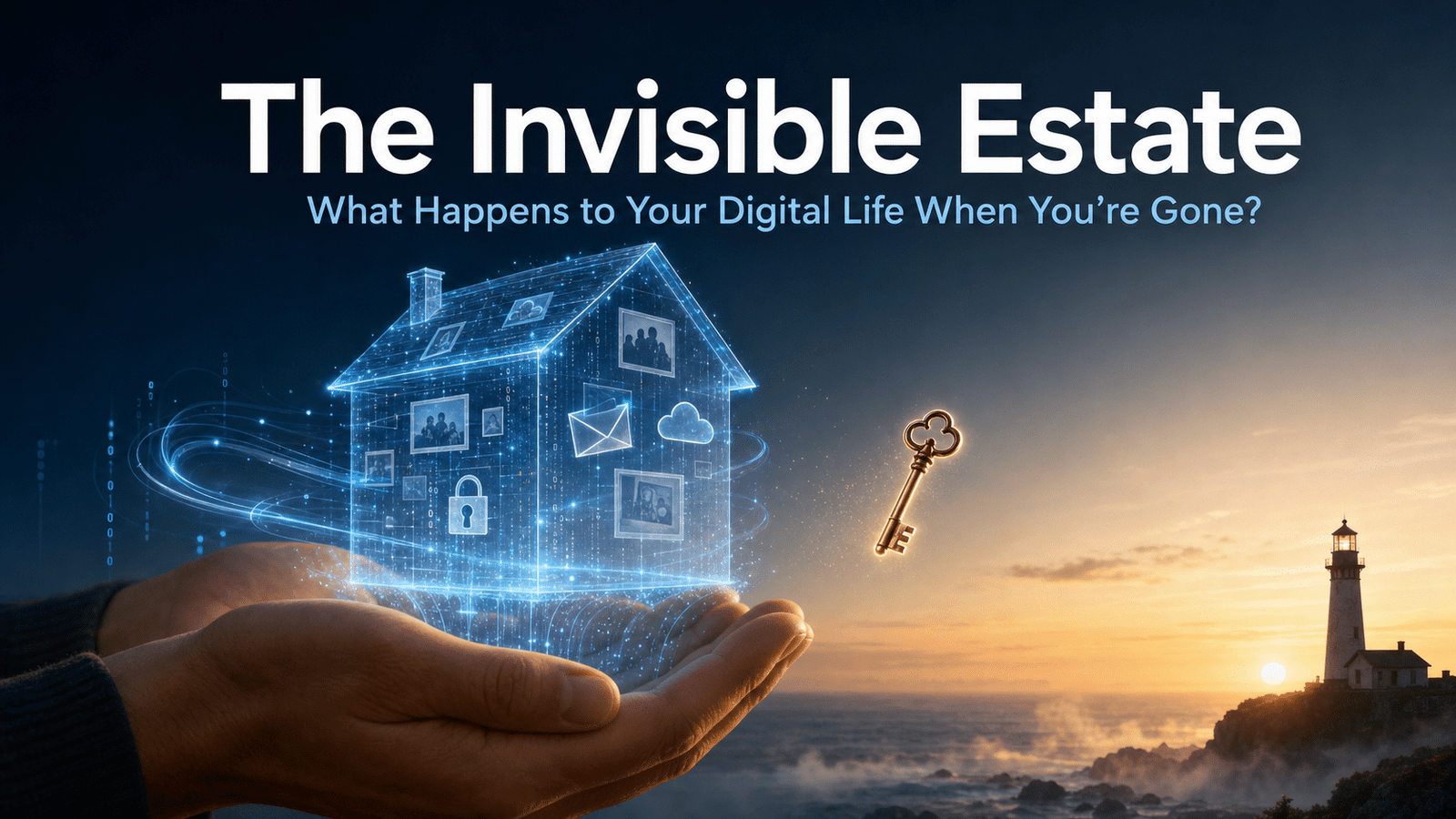
I sat back, the pale light of my monitor washing over the yarn skeins stacked on my desk. And a chilling thought landed: I didn’t actually own my digital life. My audio masters, my proprietary crochet designs, my storefront—the entire livelihood I’d built with my own hands was locked behind a digital velvet rope. I was a tenant, rattling a ring of rusty, invisible keys, begging a server halfway across the world to recognize me through a string of arbitrary characters.
We’re forced to act like espionage-level security experts just to protect our creative work, run our side hustles, or check a bank balance. But the truth is unfolding right under our noses: the password is a relic. It’s broken, it’s dangerous, and within a generation our kids will laugh that we once typed secret words to prove who we were.
Welcome to the dawn of Web3 and decentralized identity. Here’s how we take our control back.
Imagine your locksmith says you can no longer use a normal brass key. Instead, every door requires a 16-step handshake, a secret phrase in a specific dialect, and a physical token from your back pocket—every single time.
Now do that for two hundred doors a day.
You’d cut corners. You’d reuse the same handshake on fifty doors and scribble the phrases on a sticky note under the mat. That’s exactly what we do online. Experts tell us to build unique, complex passwords for every site and rotate them every ninety days. But the human brain can’t warehouse hundreds of random strings, so we recycle variations—creating a domino effect where one breach at a minor shoe retailer can crack open our email and bank.
[Shoe Store Hack] → exposes “BlueSky2026!” → hacker tries it on your Gmail → Access Granted → entire digital life compromised
The deeper flaw isn’t memory, though—it’s architecture. When you type a password into a traditional Web2 site, you hand your secret to a centralized database and trust that company to store it, hash it, and shield it from attackers.
Spoiler: they often don’t.
Consider Sarah, a freelance accountant who uses a top-rated password manager for her clients’ portals. Her master password is a work of art—long, random, flawless.
One morning she logs in to find the servers hosting that manager were compromised through a supply-chain attack. Hackers never touched her computer; they simply cracked the vault where millions stored their keys. Within hours, unauthorized logins spike across her clients’ financial accounts.
Sarah did everything right. The system was the failure point.
If passwords are the broken keys, who owns the doors? Right now, a handful of multi-trillion-dollar companies own the whole neighborhood.
Think about the last app you joined. You probably saw those friendly buttons: Sign in with Google. Log in with Facebook. Continue with Apple. One click, no new password, no confirmation email. It feels like freedom. It’s a velvet trap.
Picture a corporate handler walking beside you everywhere you go. At each shop they lean in and whisper, “She’s with us—let her in.” In exchange, they take notes: bought coffee at 9:02, browsed fiction for twenty minutes, eyed a personal-trainer flyer. They carry that data back to headquarters, package it, and sell it to advertisers who then target you with unsettling accuracy.
Worse, if that corporation flags your account—by policy or by automated glitch—they lock you out of their whole ecosystem. Suddenly you can’t reach your doctor’s portal, your fitness app, or your work dashboard, because your handler abandoned you. That’s centralized identity: your data, history, and access rights are commodified and held by strangers. You don’t own your identity. You rent it.
Web3 isn’t only about cryptocurrency or digital art. At its core it’s a shift in ownership.
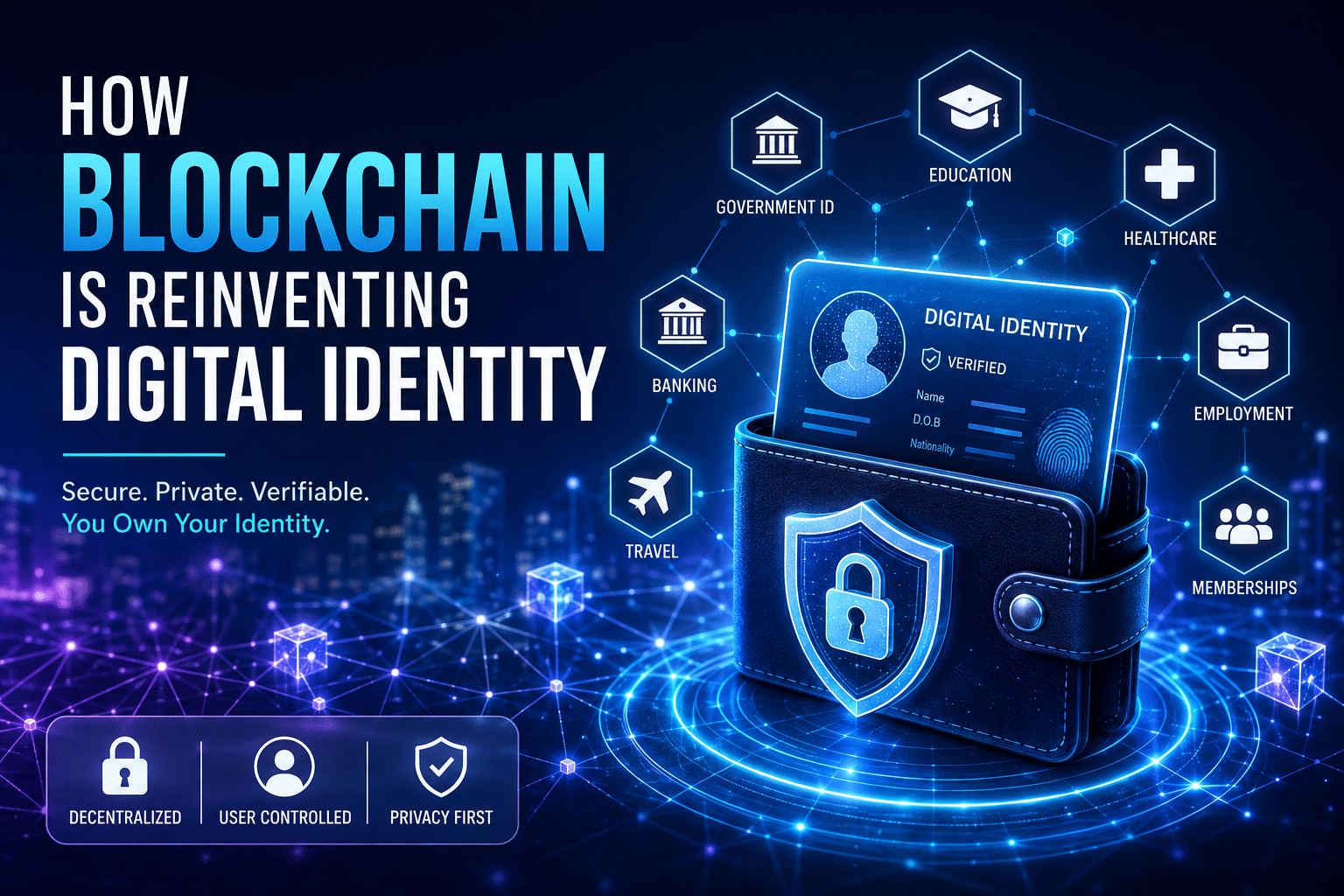
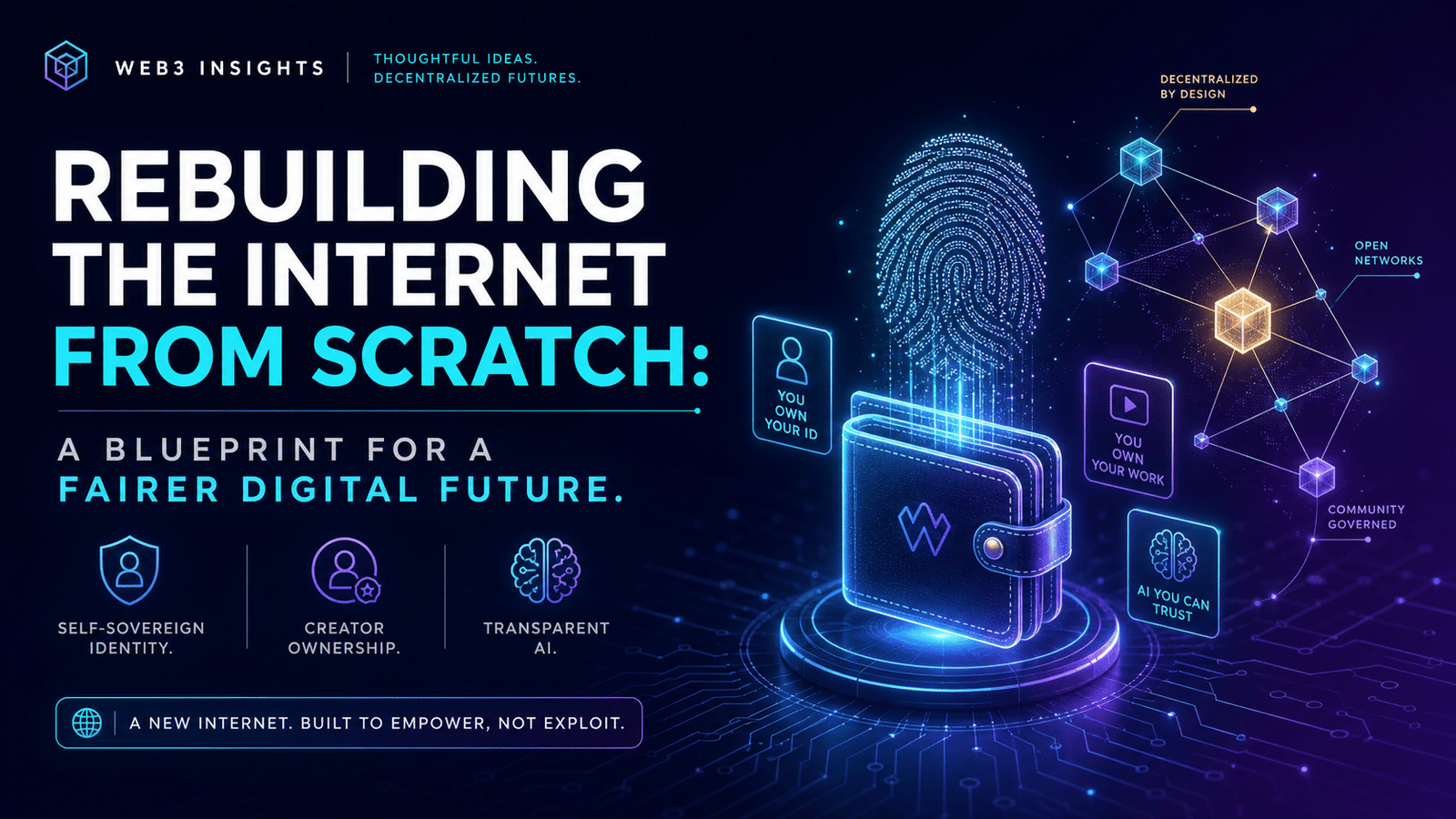
The model moves from centralized identity to decentralized identity (DID)—often called self-sovereign identity. Instead of your identity sitting on a mega-corp’s server, it lives in an encrypted cryptographic wallet you control locally, on your own device.
Here’s how that flips the power dynamic:
| Feature | Centralized (Web2) | Decentralized (Web3) |
| Who holds the key? | The platform’s server | Your private local key |
| Data privacy | Logged and monetized | Encrypted, shared conditionally |
| Vulnerability | Single point of failure | Distributed, no central target |
| User control | Account bannable instantly | Absolute, un-bannable ownership |
To log into a Web3 platform, you don’t type a password or click a Big Tech button. The site sends a cryptographic request to your wallet; your wallet signs it with your private key and returns a secure verification token. The website never sees a password because there is no password to see—it just checks the mathematical proof on the blockchain.
If a hacker raids that site’s servers, they find nothing worth stealing. No master list of passwords, no honeypot of unencrypted data. The treasure chest has been dismantled entirely.
One of the most elegant tools driving this shift is the Zero-Knowledge Proof (ZKP)—cryptography that lets you prove a statement is true without exposing anything beyond that fact.
Take entering a 21-and-over venue. The old way: you hand the bouncer your driver’s license, revealing your full name, home address, height, weight, and organ-donor status—all to prove one thing: I’m over 21.
Now imagine a Web3 identity app powered by ZKPs. You scan a QR code. Your wallet generates a certificate proving, with cryptographic certainty, that you’re over 21. The bouncer sees a green checkmark—not your birthday, name, or address. You proved eligibility without surrendering a shred of personal data.
This future is empowering—but there’s a flip side. When you become the sole keeper of your keys, there’s no “Forgot Password” button and no support hotline. Lose your recovery phrase, or hand it to a phishing site, and your identity and assets may be gone for good.
Decades of Web2 convenience trained us to expect a safety net, so we cut corners knowing someone else runs the system. Real freedom asks more of us. If you want to enjoy the hyper-connected internet and step into Web3 and AI, you have to accept the title of Chief Security Officer of your own life.
The full shift to a decentralized internet won’t happen overnight, but you can start bridging the gap now:
A few days after my midnight lockout, I migrated my critical profiles to hardware-backed passkeys and set up a secure wallet for my Web3 explorations. It took effort. It forced me to slow down, read carefully, and take accountability.
The next time I checked my crochet-store analytics and updated my audio catalog, there was no typing, no guessing, no panic—just a seamless, encrypted handshake between my device and my data.
Years from now, our kids will look back at our sticky notes and cracked password managers and laugh at the absurdity of it all. They’ll live in a digital space where their identity is uniquely, safely, indisputably theirs.
The technology exists today. The tools are ready. The only question left: are you ready to claim ownership of your digital life?
Stay curious, stay grounded, and protect your digital ghost. Your future self is counting on you.