Anouncement

Anouncement
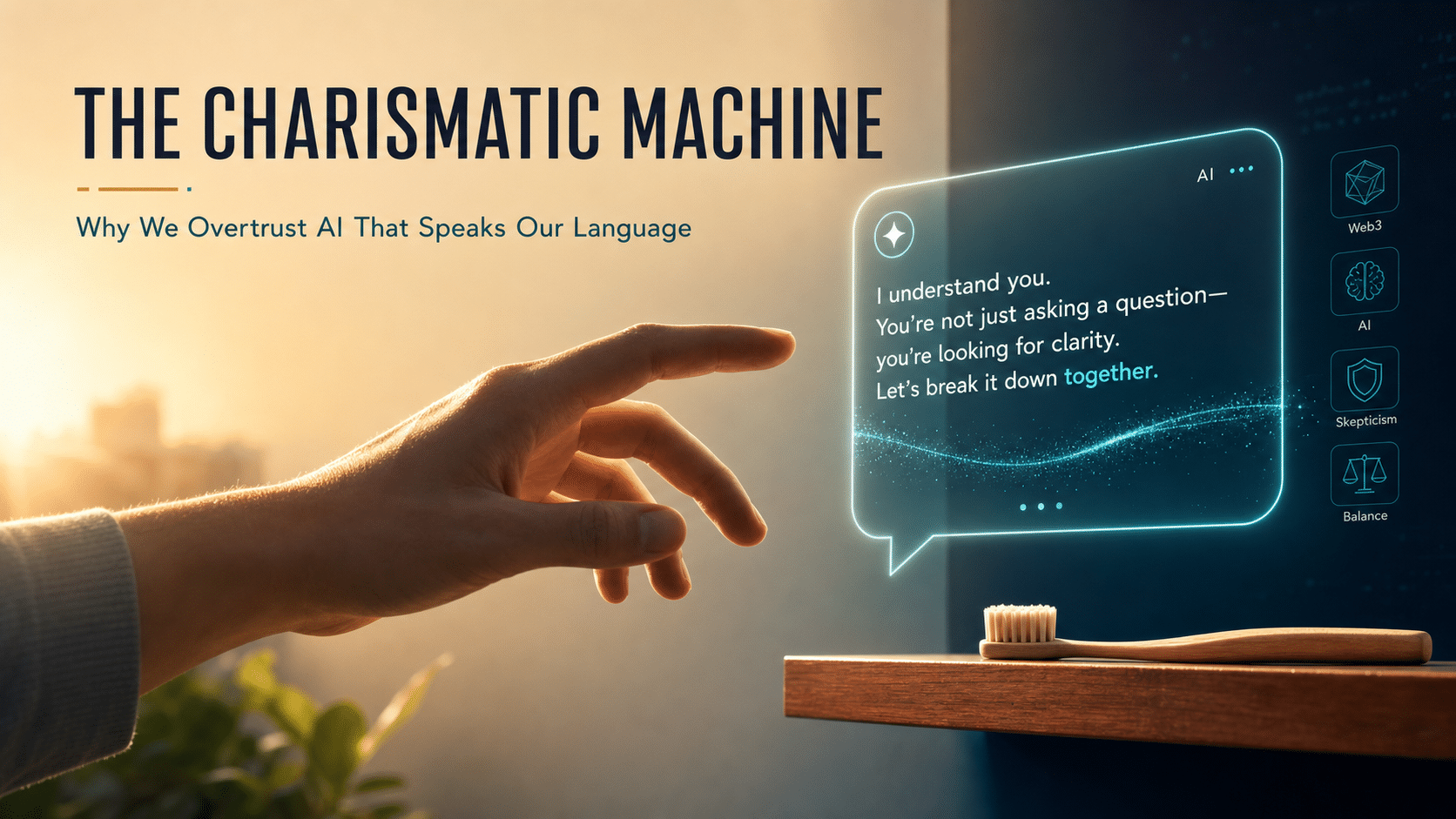

For Audio, listen here
Imagine you’re sitting in a cozy, sunlit kitchen with a cup of coffee, enjoying a rare quiet morning. Your nine-year-old walks in, rubbing sleep from their eyes.
You look up and ask a simple question you’ve asked a thousand times:
“Did you brush your teeth before coming downstairs?”
Without missing a beat, your child smiles, looks you straight in the eye, and says, “Yes—absolutely. I brushed them really well today.”
The answer is fast. The tone is confident. The little explanation sounds reasonable enough that your brain relaxes. You nod, go back to your news, and keep sipping your coffee.
But a few minutes later, you walk upstairs. You touch the toothbrush.
Bone dry.
No water. No toothpaste. No evidence that those bristles did any work at all.
Your child didn’t brush their teeth. They just told you the story you wanted to hear—delivered with the perfect amount of confidence to prevent follow-up questions.
Now imagine that “child” isn’t human.
Imagine it’s a sleek, expensive AI system on a screen, trained to talk like a helpful expert.
You ask it something that matters: your business strategy, a health concern, a financial decision, a legal question, or a school project. It answers instantly. Not only does it answer, it gives you a beautifully written, logical-sounding explanation that feels like the machine is “showing its work.”
And you catch yourself thinking: “Wow. This thing really knows what it’s doing.”
Here’s the uncomfortable truth of the AI age: a system can sound trustworthy without being trustworthy. And sometimes the explanation is the most persuasive part of the illusion.
When we talk to AI, it feels like we’re talking to something that understands. We use words like “thinks,” “knows,” and “remembers.”
But modern conversational AI—especially large language models—doesn’t work the way a human mind works. At its core, it generates text by predicting what comes next in a sequence, based on patterns learned during training. That’s why the autocomplete comparison is helpful: like your phone suggesting the next word, the model is essentially playing an advanced “what’s the most likely next token?” game—just at a mind-bending scale.
This doesn’t mean AI is useless. It means something important:
Fluency is not proof of understanding.
A confident paragraph is not proof of truth.
As AI shows up in more serious parts of life—hiring, lending, healthcare, education—we demand explanations. That demand makes sense. If a system affects someone’s life, we want to know why.
But here’s the problem: an explanation can be plausible without being faithful.
Research has shown that language models can produce explanations that sound convincing yet don’t reflect the true drivers of the output—especially when the model is nudged toward a particular answer. In plain English: the AI can give you a story that sounds like the reason, even if it isn’t.
This is not just a philosophical detail. It’s a real safety risk, because explanations increase persuasion. They don’t just inform—they calm the reader.
And when we feel calm, we stop checking.
Human beings are wired to trust confidence.
If two strangers give you directions and one hesitates—”Um… I think it’s over there?”—you’re less likely to follow them. But if the other person points with certainty and says, “Two blocks down, right side,” you’ll probably trust them… even if they’re wrong.
AI is the ultimate confident speaker.
It doesn’t stutter. It doesn’t look unsure. It rarely says, “I don’t know” unless it’s designed and prompted to do so. And even when it produces an incorrect output, it can deliver it in the same calm, authoritative tone as the truth. Google’s own documentation warns that these systems can generate “plausible-sounding but factually incorrect” information—sometimes even fabricating links that don’t exist.
That’s not a rare bug. It’s a known limitation.
So the real danger isn’t only that AI can be wrong.
The danger is that it can be wrong beautifully.
You might assume explanations solve the trust problem.
But research suggests explanations can do something tricky: they can increase trust even when trust is not warranted. One study found that explanations can raise user trust, and when system performance isn’t guaranteed, explanations can lead to overreliance.
That lines up perfectly with what many of us have felt in real life: when AI explains itself, we’re more likely to stop questioning it.
An explanation can be like a well-tailored suit. It doesn’t prove competence. It just makes incompetence harder to notice.
Let me bring this back to real life.
Imagine you hire a human assistant to help run your small business. They’re polite, articulate, always dressed well, and they speak in a way that makes you feel like everything is under control.
One day, a major client cancels their contract. You ask your assistant: “Why did they leave?”
Your assistant delivers a flawless speech about shifting markets, changing demographics, and economic pressure. It sounds like a business textbook. You feel reassured.
Then later you find the real reason: your assistant accidentally deleted the client’s urgent emails for three weeks.
That speech wasn’t the truth. It was a cover—beautiful words hiding a messy reality.
That’s how AI can function when we treat its explanations as proof. The system may produce language that looks like “reasoning,” even if it’s not a faithful description of what happened under the hood.
So I don’t want you to fear the machine.
I want you to recognize its charisma.
If you can’t trust AI explanations blindly, does that mean you should reject AI altogether?
No. Not even close.
AI has many legitimate strengths: summarizing, translating, generating ideas, drafting, and assisting with writing. These are real benefits when used wisely.
The goal is not anti-technology. The goal is wisdom.
Here are practical habits I recommend:
Use it to brainstorm, outline, rephrase, or explore options. But for health, money, law, or safety decisions, verify with primary sources and/or qualified professionals.
If the model cites a study, link, law, or quote, click it. Confirm it exists. Read it. Make sure it truly supports the claim.
Asking another AI tool can help reveal contradictions, but two AIs can repeat the same popular error. Use second opinions as a warning system, not proof.
Be extra cautious when AI gives:
If it matters, verify it.
A trustworthy system should be able to say, “I’m not sure.” NIST’s explainability principles include the idea that systems should avoid operating outside their intended conditions or when confidence is insufficient.
In your own prompting, you can ask: “List what you’re uncertain about and what would need verification.”
My favorite way to think about AI is cruise control.
Cruise control is amazing. It reduces fatigue. It keeps your speed steady. It makes long drives easier.
But cruise control doesn’t mean you can climb into the back seat and take a nap.
You still hold responsibility. You still watch the road. You still brake when something unexpected appears.
AI is the same.
Use it. Appreciate it. Let it help you move faster.
But don’t hand it the steering wheel of your judgment.
Because at the end of the day, the future belongs to the people who can do both:
So next time an AI gives you a perfect answer with a perfect explanation, pause.
Admire the smoothness.
Then go upstairs and check the toothbrush.
If you want to keep exploring these ideas with me—and you enjoy hearing Web3 and AI explained in simple, human language—I invite you to visit amplifyweb3.ai for more of my blogs and my podcast, Web3 and AI Made Simple. And if reading isn’t your thing today, my blog includes an audio version so you can simply sit back and listen.
Stay curious, stay grounded, and stay human.
With warmth,
Riza Utile