Anouncement

Anouncement

It’s 7:30 AM.
I’m half awake, coffee still negotiating with my brain, and I’m trying to do something simple—log into my bank account, confirm an appointment, maybe buy a concert ticket before it sells out.
And then… the internet hits me with that familiar speed bump.
A grid of nine blurry squares appears like a pop quiz I didn’t study for.
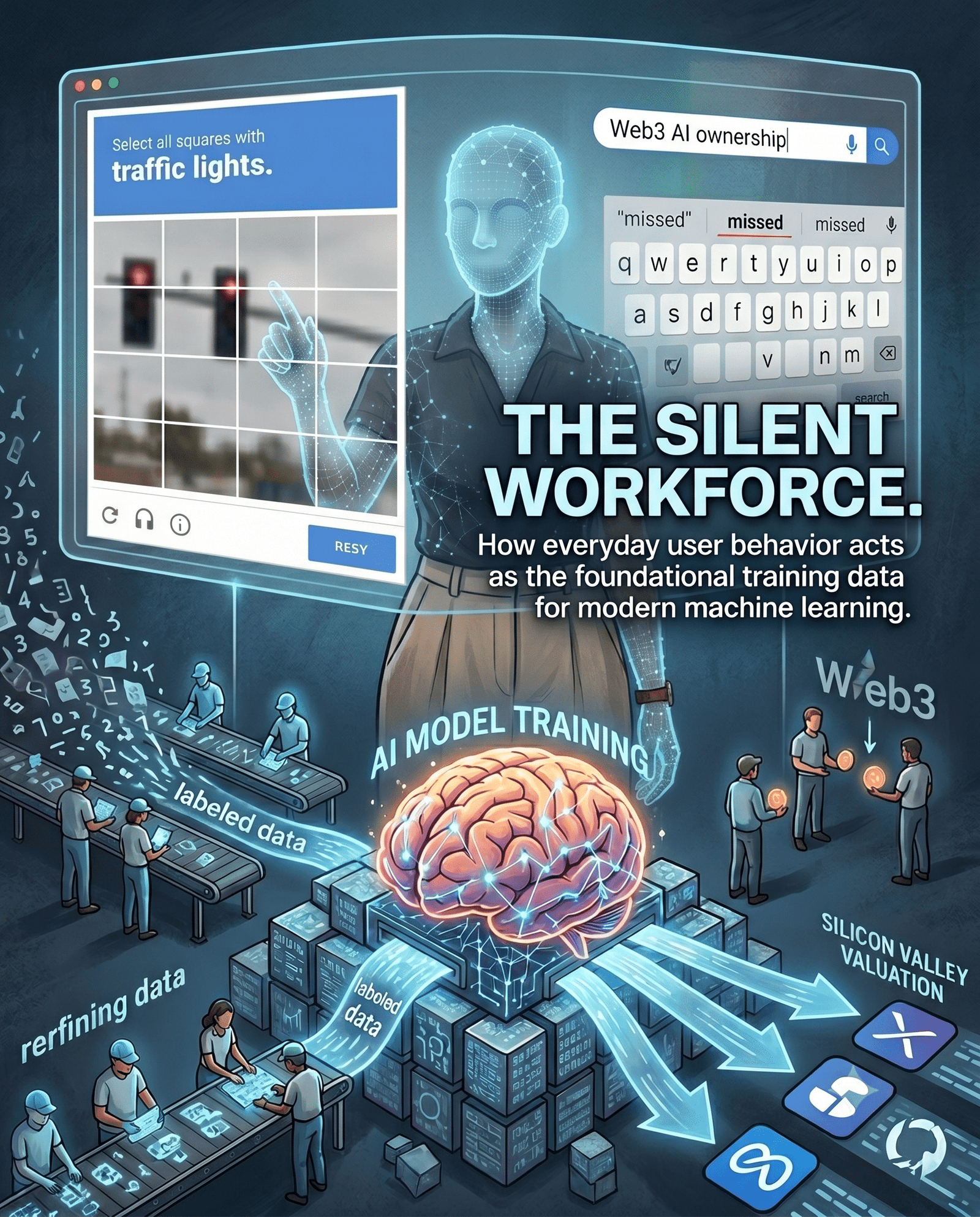
“Select all images with traffic lights to prove you’re human.”
So I sigh the way we all sigh.
I click the obvious one. Then the one that’s kind of behind a tree. Then I stare at that tiny sliver of pole in the bottom-right corner and think, Does that count? (I click it anyway, because I’m not trying to start my day with a debate.)
I press Verify.
The page loads.
I move on with my life, thinking, Cool. Security is doing its job.
But here’s the twist I want you to sit with for a second:
At that moment, I didn’t just prove I was human. I also helped teach a machine how to recognize the world.
Not in a dramatic “I clocked in at an AI company” way.
In a tiny, quiet, micro-shift kind of way.
And when billions of people do billions of micro-shifts, you don’t just get a “security feature.”
You get a training pipeline for modern artificial intelligence.
That’s what this blog is about—not fear, not paranoia, not “throw your phone into the ocean.”
Just awareness.
Because once you realize how much your everyday online behavior functions like training data, you start to see something powerful:
You are not just using technology. You are also teaching it.
CAPTCHA stands for Completely Automated Public Turing test to tell Computers and Humans Apart. It’s supposed to be a quick challenge that’s easy for humans and hard for bots.
And yes—CAPTCHAs really do protect websites from spam and abuse.
But the story gets more interesting when you zoom out.
Early versions of reCAPTCHA didn’t just ask you to type one weird squiggly word. They showed two. One was a “control” word the system already knew (to verify you were human). The other was a word pulled from scanned books or newspapers that OCR software couldn’t read reliably.
If enough humans typed the same answer, that “unknown” word could be confidently digitized—one tiny piece of the world’s printed history rescued by ordinary people who just wanted to log into a website.
When I first learned that, it honestly made me laugh.
Because it’s kind of poetic, right?
We thought we were passing a test.
But we were also building a digital library.
That’s the illusion: the interface tells you one story (“security”), while the hidden machine-learning system benefits from another (“labeled human judgment”).
Then the challenges changed.
The squiggly words became images:
Google even confirmed experiments using Street View-related imagery in reCAPTCHA to improve map data like addresses and street information. And the way reCAPTCHA works—at least conceptually—has been described as channeling human effort into annotating images and building machine learning datasets.
So why images?
Because the tech world stopped focusing only on “can a computer read text?” and moved toward a bigger question:
Can a computer interpret the physical world?
Here’s the simplest analogy I know.
If you’re teaching a toddler what a bicycle is, you don’t hand them a definition.
You point.
“Bicycle.”
Then you point again.
“Another bicycle.”
Then you point at the one with training wheels.
Then the one leaning in the shadow.
Then the one half-covered behind a bush.
After enough examples, the toddler’s brain builds an internal model: Ohhh, that shape? That’s a bicycle.
AI learns the same way. It needs a lot of examples with “this is X” labels—what machine learning calls data labeling.
So when you click “traffic light,” you’re doing something deceptively valuable:
You’re providing a clean signal—this image contains a traffic light—in a world where computers mostly see confusing pixels.
Humans are incredible at messy reality.
We know the difference between a real traffic light and a reflection on a rainy windshield.
That instinct feels ordinary to us.
To AI, it’s gold.
Once you see this, you start noticing it everywhere.
Not just in CAPTCHAs, but in the tiny behaviors you barely register.
Let’s say you search:
“best tool for tightening a leaking pipe”
You click the first result—instant regret. It’s all ads. You hit back.
You ignore the second and third links because the titles feel off.
You click the fourth result and stay for a while because it’s actually helpful.
To you, that’s just a search.
To the system, it can become feedback.
Google publicly states it uses aggregated and anonymized interaction data to assess whether results are relevant and turn that data into signals.
Now, I want to be fair: this doesn’t mean every single click immediately changes rankings for everyone forever. Search is complicated, and some engagement metrics (like “dwell time”) aren’t officially confirmed as direct ranking factors. But the bigger point stands:
Our behavior helps systems learn what people find useful.
My favorite metaphor is this:
Search engines are like a giant library with a librarian who can’t read every book, so they watch what people actually open and keep.
The librarian notices patterns.
“This one looks flashy, but everyone returns it in ten seconds.”
“This one isn’t fancy, but people keep reading.”
Over time, the library gets better at putting the right book in your hands.
And you helped train that librarian—without ever intending to.
Now think about texting.
You type fast. You misspell something. Your keyboard suggests the correction.
When you accept it, you’re basically saying, “Yes, that’s what I meant.”
When you reject it (because it’s a name, slang, or something personal), you’re saying, “Nope. Learn my world.”
What’s fascinating is that some keyboards and AI systems can improve using privacy-preserving approaches. Google explains that Gboard learns and improves using methods like federated learning (learning patterns across many devices) and that some data donation is optional. Apple has also documented differential privacy approaches designed to learn from large groups without exposing individual users’ data.
Translated into human language:
Even when your exact messages aren’t being “read” in the way people fear, your interactions can still shape what the system learns.
Your thumbs are basically coaching a language student 24/7.
People say “data is the new oil,” and they’re not wrong—but they usually stop too early.
Crude oil isn’t useful straight from the ground. It has to be refined into gasoline.
Raw data is the same. The internet is full of chaos—messy clicks, blurry images, half-finished searches, typos, noise.
For AI to become valuable, it needs refinement.
It needs labeling.
It needs context.
It needs human judgment.
And that’s why data labeling is a massive industry—market reports estimate billions of dollars and rapid growth.
So here’s the uncomfortable question:
If labeling is valuable enough that entire industries get paid to do it…
What does it mean that billions of us do labeling-like tasks every day for free?
There’s one more irony that makes this whole story land even harder.
AI has gotten so good—partly because humans trained it—that researchers and reports increasingly argue older CAPTCHA challenges are becoming less effective against modern AI.
Which means sometimes I’m sitting there clicking traffic lights thinking:
Why am I still doing this? Who is this really helping now?
I’m not telling you to be scared of technology.
I’m telling you to be awake.
Because in the modern digital age, there’s no such thing as a passive consumer. Every click, correction, scroll, and pause is a signal. And signals create models. And models shape the world.
So the next time a CAPTCHA blocks your path, don’t just rush through it like it’s meaningless.
Pause for one second and remember:
**Your mind is doing something valuable.
You are the teacher.
The machine is the student.**
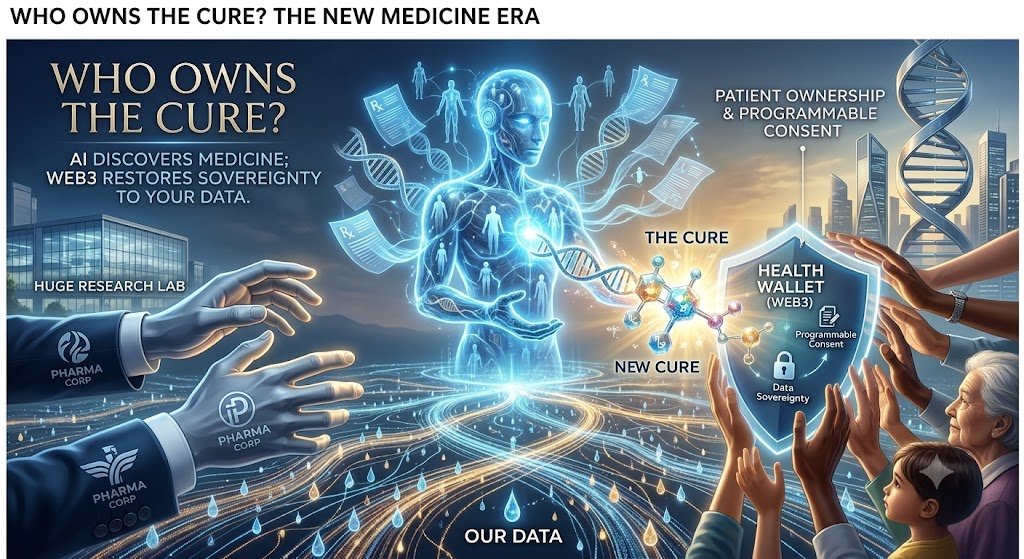
And if our collective behavior is helping build the future, then we deserve a future built with clearer consent, stronger transparency, and fairer value-sharing.
If you want to keep exploring these ideas with me—and you like Web3 and AI explained in simple human language—I invite you to visit https://amplifyweb3.ai/ for more of my blogs and my podcast, Web3 and AI Made Simple.