Anouncement

Anouncement
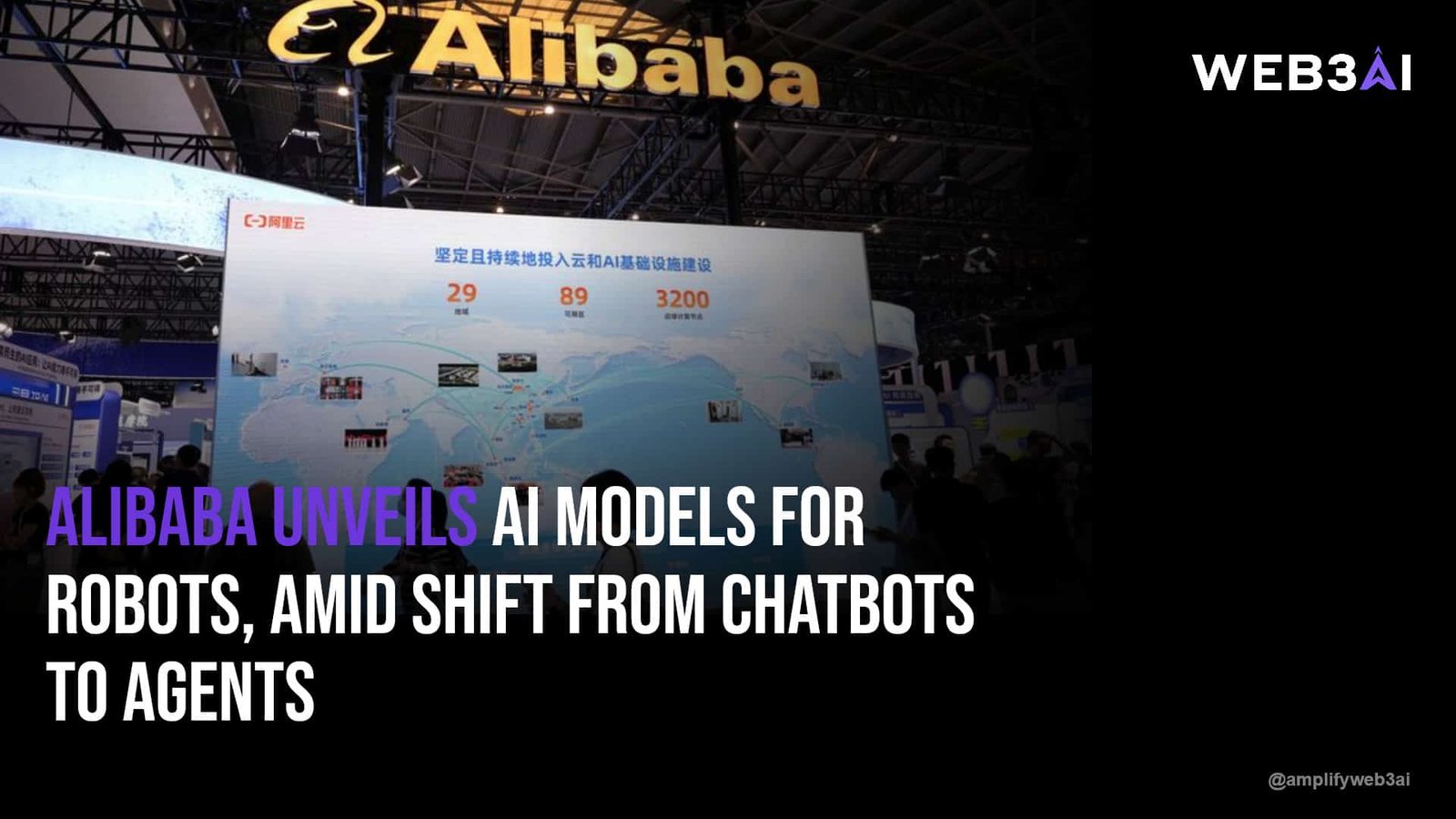

Alibaba AI models and robots took center stage this week as the Chinese tech giant
unveiled a sweeping package of artificial intelligence and robotics advancements
that signals just how seriously Asia’s largest e-commerce company is betting on
an AI-powered future. From next-generation language models to humanoid robots
capable of navigating real-world environments, Alibaba’s announcements are
generating conversation far beyond Silicon Valley — and for good reason.
According to reporting via Yahoo Finance and Reuters,
Alibaba revealed several flagship AI models alongside demonstrations of its robotics
research, positioning the company as a serious global competitor to OpenAI, Google DeepMind,
and Meta AI. For businesses, creators, and developers watching the AI race unfold,
this is a moment worth paying close attention to.
In this post, we break down exactly what Alibaba announced, why these developments
matter beyond the headlines, and what they could mean for the broader Web3 and AI
ecosystem that is rapidly reshaping how we work, create, and connect.
Alibaba’s latest reveal centers on its Qwen series of large language
models — a family of open-weight AI models that the company has been quietly developing
into a world-class suite. The newest additions push capability benchmarks in reasoning,
coding, and multimodal understanding, meaning these models can process and generate
not just text, but images, audio, and video as well.
On the robotics side, Alibaba showcased humanoid and semi-humanoid robots built to
operate in warehouse, logistics, and consumer environments. These machines are not
science-fair prototypes — they are designed to integrate with Alibaba’s existing
supply chain infrastructure, one of the largest and most complex logistics networks
on the planet.
What makes this announcement particularly significant is the combination: pairing
frontier-level AI reasoning with physical robots creates systems that can adapt to
unpredictable environments, not just follow pre-programmed paths. That is the leap
that separates a useful robot from a transformative one.
Pro Tip: When evaluating AI announcements, always look beyond
the demo. The real signal is whether the underlying model is open-weight (accessible
to developers) or closed. Alibaba’s Qwen models are largely open — that is a big deal
for global adoption.
If you want to understand how AI is already reshaping creative industries and content
workflows, our deep-dive on
how AI is transforming the creator economy
gives you the full picture of where this technology is landing right now.
Most Western AI labs are racing to build the most powerful closed model and monetize
it through API access. Alibaba is taking a different, arguably more ambitious path:
open-weight models, cloud infrastructure, and physical AI all at once. This three-layer
strategy means Alibaba is not just building a smarter chatbot — it is building an
AI ecosystem.
The Qwen model family has already been downloaded millions of times on Hugging Face,
the open-source model repository used by developers worldwide. That grassroots adoption
gives Alibaba something money alone cannot buy: community, trust, and a massive base
of real-world use cases being built on top of their models.
Meanwhile, Alibaba Cloud provides the compute backbone. Developers building with Qwen
models are natural customers for Alibaba Cloud services — a flywheel that reinforces
itself with every new model release. This is a playbook that mirrors how AWS grew
alongside the open-source developer community in the 2010s.
Understanding this kind of AI-meets-infrastructure convergence is exactly where
Web3 builders need to pay attention. Our breakdown of
Web3 and AI convergence reshaping digital ownership
explores how these two technology waves are colliding — and what opportunities emerge
at the intersection.
Alibaba’s announcements arrive during a period of intense global competition in AI.
OpenAI, Google, Meta, Mistral, and Anthropic are all releasing major model updates
in 2025, while governments worldwide are accelerating AI investment as a matter of
national competitiveness. In this environment, Alibaba’s moves are not just corporate
news — they are geopolitical signals.
China’s AI ecosystem has matured faster than many Western observers expected.
Alibaba, Baidu, Huawei, and a growing cohort of well-funded startups have built
models and applications that are genuinely competitive at the frontier. The old
narrative of Chinese AI as a follower rather than a leader is increasingly outdated.
For businesses and developers in the West, this creates a practical question:
should you build with Qwen? The models are capable, open, and actively maintained.
The answer will depend on your data privacy requirements, your deployment environment,
and your team’s technical appetite — but dismissing them on geography alone would
be a strategic mistake.
Pro Tip: Open-weight AI models like Alibaba’s Qwen series can
be run locally, which means your data never has to leave your own infrastructure.
For privacy-sensitive use cases in legal, medical, or financial services, that
is a significant advantage over closed API-based models.
The robotics component of Alibaba’s announcement deserves its own moment of attention.
Physical AI — robots guided by large language and vision models — is moving out of
research labs and into real operational environments faster than most people realize.
Alibaba’s supply chain is the perfect proving ground: high-volume, high-complexity,
with enormous financial incentives to get it right.
What we are seeing is the early phase of what experts call embodied intelligence
— AI that can perceive, reason about, and act within the physical world. The same
model that helps you draft an email could, in a different form, instruct a robot arm
to pick, sort, and pack a warehouse order. The underlying intelligence is increasingly
the same.
This push into physical AI connects directly to the broader story of autonomous
AI agents reshaping how work gets done. For a deeper look at how autonomous agents
are evolving, our article on
the rise of autonomous AI agents
is essential reading for anyone tracking where this is all heading.
If you are building in the Web3 or AI space, Alibaba’s announcements are not
background noise — they are signal. The rapid commoditization of frontier AI
models means the competitive advantage is shifting from “who has the best model”
to “who builds the best product, workflow, or experience on top of these models.”
That is a genuinely exciting shift for independent builders and small teams.
When powerful AI is freely available, creativity, domain expertise, and community
trust become the real differentiators. A solo developer with deep knowledge of
a niche industry can now build tools that would have required a full engineering
team two years ago.
Alibaba announced updates to its Qwen series of large language models, which include
open-weight models capable of text, image, audio, and video understanding. These models
are available to developers via Hugging Face and Alibaba Cloud, making them one of
the most accessible frontier AI systems available globally.
Alibaba AI models and robots are being integrated so that the language and vision
models act as the “brain” of the robotic systems. The AI interprets sensor data,
makes decisions, and instructs robotic actuators — allowing the robots to operate
in complex, unstructured real-world environments rather than just following
fixed pre-programmed routines.
Alibaba’s Qwen models are competitive on many standard benchmarks with models
from OpenAI and Google. The key differentiator is that Qwen models are largely
open-weight, meaning developers can download, modify, and run them locally —
something OpenAI’s GPT-4 and Google’s Gemini Ultra do not offer.
Alibaba’s robotics systems are in an advanced research and early deployment phase.
Some implementations are already being tested within Alibaba’s own logistics
infrastructure. Full commercial availability at scale is likely still 12 to 24
months away, but the pace of progress is faster than most industry timelines predicted.
It means more capable AI tools are becoming available at lower cost, faster than
ever. Western businesses should evaluate open-weight models like Qwen for
privacy-sensitive or cost-sensitive applications. It also means global AI
competition is intensifying — which ultimately benefits end users and developers
through better products and lower prices.
Alibaba AI models and robots are not just another tech announcement — they represent
a genuine step forward in the global AI race, and a clear signal that the next phase
of artificial intelligence will be physical, open, and deeply embedded in the
infrastructure of everyday commerce. For builders, creators, and anyone thinking
about where technology is heading, this is a moment to pay close attention.
The convergence of powerful open AI models, embodied robotics, and massive cloud
infrastructure creates possibilities that extend well beyond Alibaba’s own ecosystem.
Whether you are a developer evaluating your next model, a business assessing
automation opportunities, or a creator thinking about where AI fits in your workflow —
the tools available to you in 2025 are more capable, more accessible, and more
consequential than ever before.
Stay curious, stay informed, and keep building. Explore what we have built at
attn.live.