Anouncement

Anouncement

Click this song and listen for FREE: Fortress and Field
Every June, the same quiet panic returns. You walk into the department store, and the aisles greet you like old, tired friends: novelty socks, a barbecue spatula shaped like a guitar, neckties in seventeen shades of blue, and that one ceramic mug — World’s Best Dad — that has somehow survived every cultural shift of the last forty years.
And you ask yourself the question every son and daughter has asked since the invention of retail:
What do you give the man who insists he wants nothing, but deserves everything?
For most of modern history, the answer lived on a shelf. We wrapped it in glossy paper, set it next to a brunch plate, and hoped the gesture said what we couldn’t quite put into words. But the world our fathers raised us in is no longer the world we live in. Our memories live in the cloud. Our love letters are voice notes. Our family albums are camera rolls.
So maybe it’s time the gift caught up.
This Father’s Day, I want to talk about something different — not a product, but a possibility. About how two of the most misunderstood technologies of our time, Artificial Intelligence and Web3, are quietly giving ordinary people the power to create extraordinary, lasting expressions of love.
This isn’t a story about robots or blockchains. It’s a story about connection — amplified.
To understand where gifting is going, look at where it’s been.
If you came of age in the 80s or 90s, you remember the cassette mixtape — that small plastic rectangle that carried more emotional weight than anything you could buy. Making one was a ritual. You sat by the radio, finger trembling over the Record button, praying the DJ wouldn’t talk over the intro. You agonized over the tracklist. Side A told one story. Side B answered it.
The mixtape wasn’t valuable because of the tape. It was valuable because of the time, thought, and intimacy baked into every track.
Then came burned CDs. Then Spotify playlists. The process got easier — and something invisible got lost. Convenience replaced craftsmanship. The mixtape became a link you texted between meetings.
Here’s the twist: AI isn’t the next step in that decline. AI is the technology that brings the mixtape back — not as nostalgia, but as something deeper. A song about your dad. A story for your mom. A poem only your partner could inspire.
You don’t need to be a musician. You just need to remember.
Say the word “AI” out loud and watch what happens. Half the room pictures Terminator. The other half pictures a cold algorithm replacing their job. Almost no one pictures what AI actually is, which is something far more humble — and far more useful.
Think of AI as a master chef who has studied every cookbook ever written.
You walk into the kitchen and say: “I want to bake something for my dad. He smells like cedar and motor oil. He took me fishing before sunrise. His favorite flavor is blackberry.”
You don’t need to know the ratio of flour to baking powder. The chef does. What the chef doesn’t have is your father, your fishing trips, your memory of his hands. That part only you can bring.
That’s the deal AI offers as a creative collaborator: you bring the soul, it brings the structure. You bring the memories, it brings the music theory. You bring the love, it handles the rhyme scheme.
You are still the author. AI is just the pen that finally moves as fast as your heart.
Now the second piece — the one that gets tangled up in headlines about coins and crashes.
Forget the price charts for a moment. At its core, Web3 is about one quiet, radical idea: ownership.
Here’s the analogy that finally made it click for me:
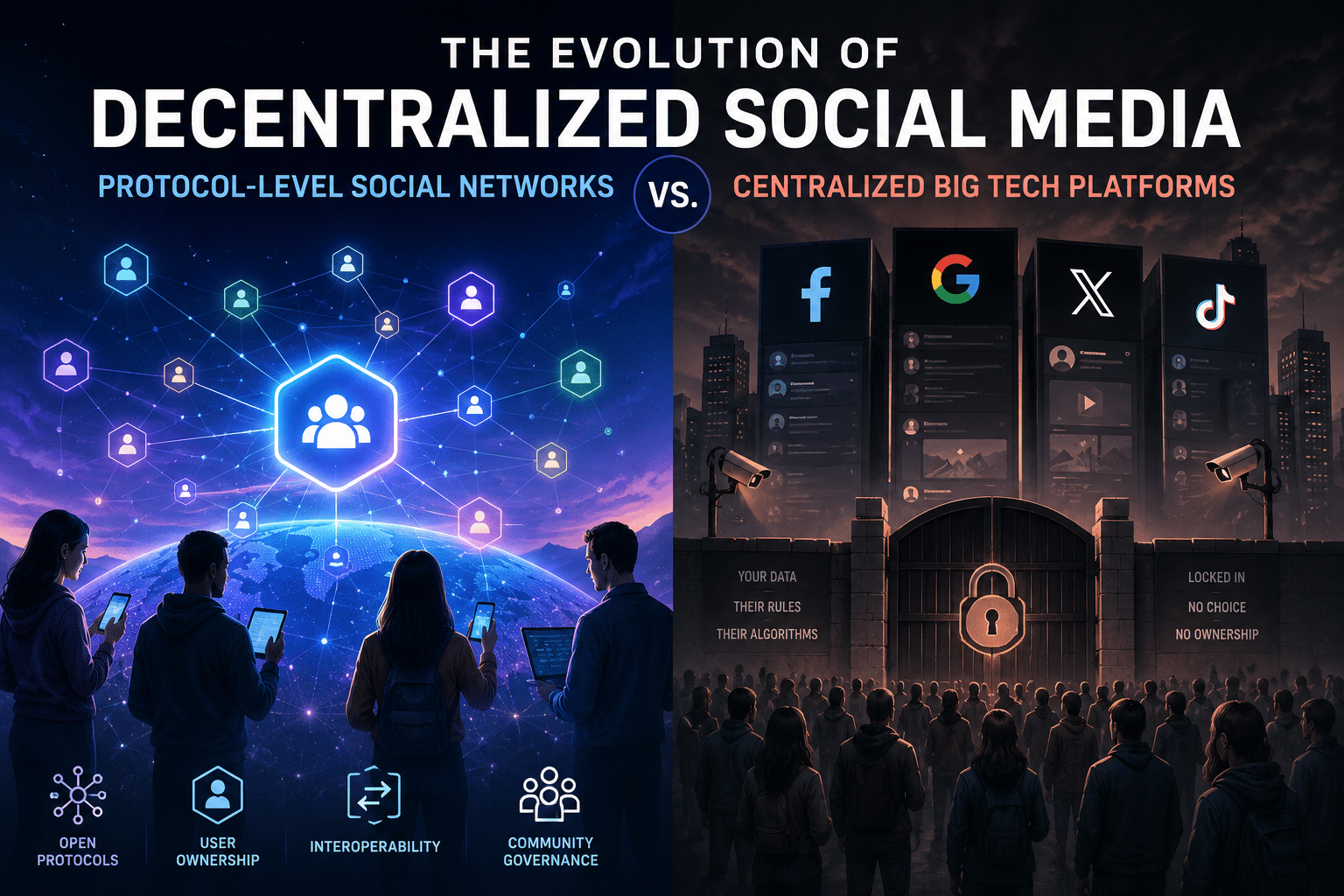
Right now, posting a song or a photo on a social platform is like renting an apartment. You can paint the walls, hang pictures, throw dinner parties — but the landlord owns the building. If the landlord raises the rent, changes the rules, or sells the property, your beautiful apartment disappears. We’ve all watched this happen: platforms pivot, accounts vanish, algorithms bury what we made.
Web3 is the deed to your own house.
When you create something in a Web3 ecosystem, it’s cryptographically tied to you. It can’t be silently deleted by a tech CEO in a hoodie. Its history — who made it, when, and for whom — is permanently recorded.
Why does that matter for Father’s Day?
Because the song you write for your dad shouldn’t disappear into a feed. It should live somewhere it can be found again on his 70th birthday. On his anniversary. On the day, years from now, when you need to hear his story in your own voice.
Web3 turns a digital file into a digital heirloom.
Let me show you what this actually looks like with someone we’ll call Sarah.
Sarah’s father, David, is a retired mechanic. Few words. Rough hands. A heart that fixes everything it touches. For twenty years, Sarah has rotated the same three gifts: a socket wrench set, a hardware store gift card, a new wallet. David has thanked her every time. He’s worn out exactly none of the wallets.
This year, Sarah wants to say the thing she’s never said — that she sees the double shifts, the late-night repairs, the way he quietly emptied his savings to send her to college.
Act 1 — The Inspiration. She opens a blank document. She writes down the smell of motor oil. The squeak of the bicycle he fixed when she was nine. The look in his eyes when she crossed the stage at graduation. Not lyrics. Not poetry. Just fragments.
Act 2 — The AI Collaboration. She opens an AI music tool. She types her memories. She picks a genre — acoustic folk, the kind that played on the dusty garage radio. In under a minute, those scattered fragments become verses, a chorus, a melody. Her words, now wearing music.
Act 3 — The Web3 Minting. She doesn’t just download an MP3. She publishes the song on a Web3 platform, where it’s permanently authenticated as hers. A digital artifact, time-stamped, undeletable.
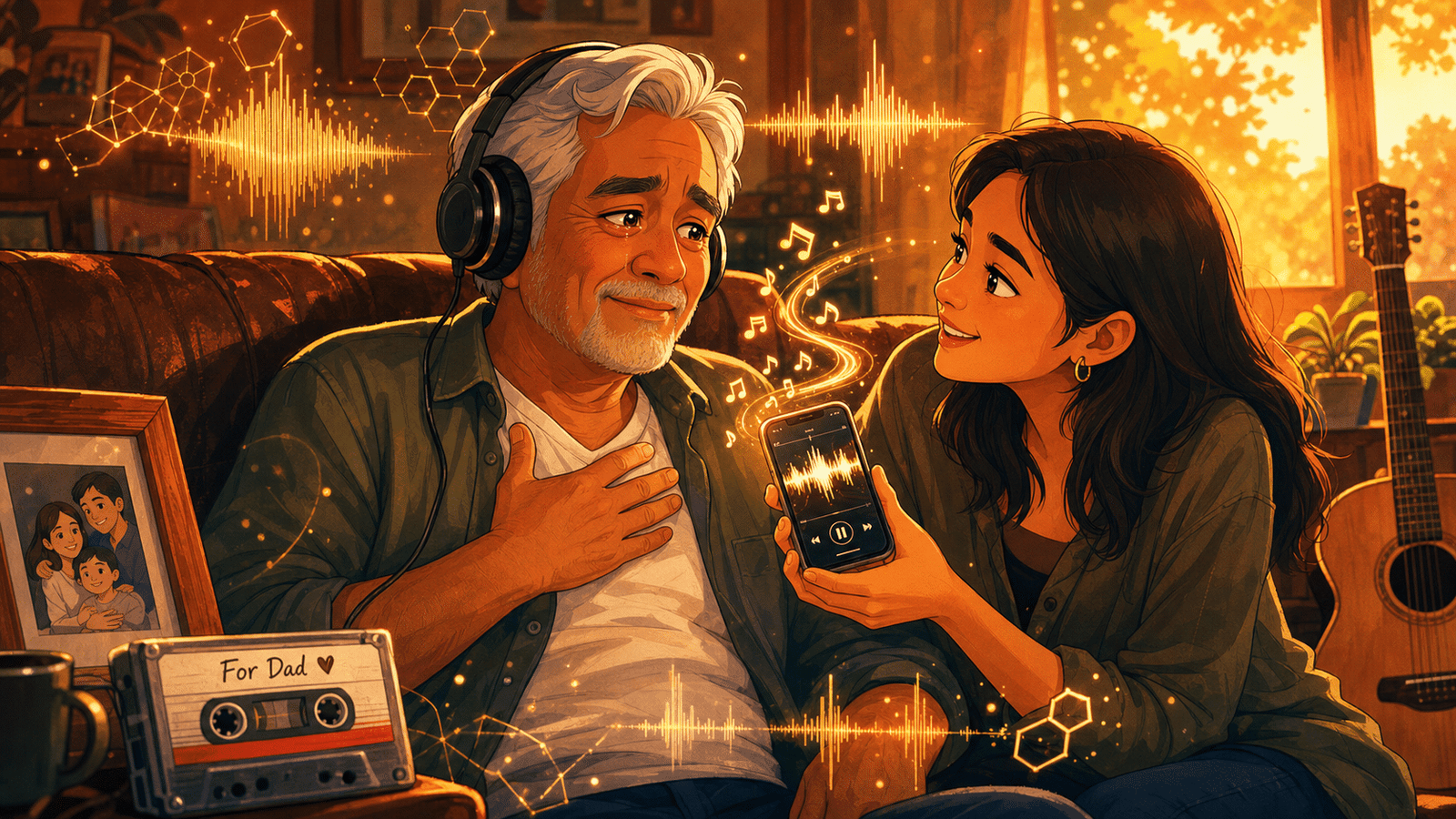
On Father’s Day, Sarah doesn’t hand David a wrapped box. She hands him a pair of headphones.
The first chord hits. The lyrics name the motor oil, the bicycle, the stage. And the man who has not cried in twenty years finally does.
That is not a greeting card. That is a bespoke piece of art, fueled by human emotion, built by AI, and preserved by Web3.
There’s a tired narrative that technology pulls us apart. And yes — passive technology does. Scrolling does. Doomscrolling really does.
But creative technology does the opposite.
You cannot prompt an AI to write a meaningful song about your father without first sitting down and asking yourself: Why does my father matter to me? You can’t generate a story about your mother without remembering the small, specific things — the way she hummed while doing dishes, the phrase she repeated whenever you doubted yourself.
Creation forces reflection. Reflection deepens love.
And Web3 adds something economics has never offered the average person: the chance for your love letter to also be your legacy. In a creator economy, the song Sarah wrote for David could resonate with other mechanics, other daughters, other quiet fathers. Every play could send a small reward back to Sarah — not because she set out to monetize her love, but because what she made was real enough to matter to strangers.
The gifts of the future aren’t things we buy. They’re ecosystems we participate in.
I didn’t write this blog as theory. I wrote it because I tested it.
This Father’s Day, I wanted to see if I could create something deeply personal, beautifully produced, and permanently authenticated — without a studio, without a record deal, without knowing a single line of code.
That’s how I ended up on ÂTTN.LIVE.
ÂTTN.LIVE is an AI creator platform and web app where you can make your own songs and stories in seconds. It’s the clearest real-world example I’ve found of everything I just described:
🎵 The AI Engine. Type in your vibe, your genre, your memories. The AI Music Engine builds a full, custom track — verses, chorus, instrumentation — in under a minute.
🔗 The Web3 Economy. When you publish your work, you earn ÂTTN tokens every time someone plays your track. You’re not just making a gift — you’re participating in a creator economy where engagement translates into real ownership and real value.
I took three words that defined my idea of fatherhood — guidance, patience, and the passing of the torch — and turned them into a song. Not a draft. Not a demo. A finished piece of music that made me stop and breathe.
No studio. No blockchain expertise. Just a memory, a minute, and the desire to make something that matters.
🎧 Listen to the Father’s Day song I created here: (Fortress and Field song created by Riza Utile)
Don’t give him another mug. Don’t give him another wallet he won’t use. Don’t give him another tie that will hang next to the eleven others already collecting dust on the back of the closet door.
Give him the thing only you could make: a song built from your memories, scored by AI, and preserved forever on Web3.
This Father’s Day, skip the tie.
Build a memory that lasts forever.
Always remember, stay curios, stay grounded and stay human.