Anouncement

Anouncement
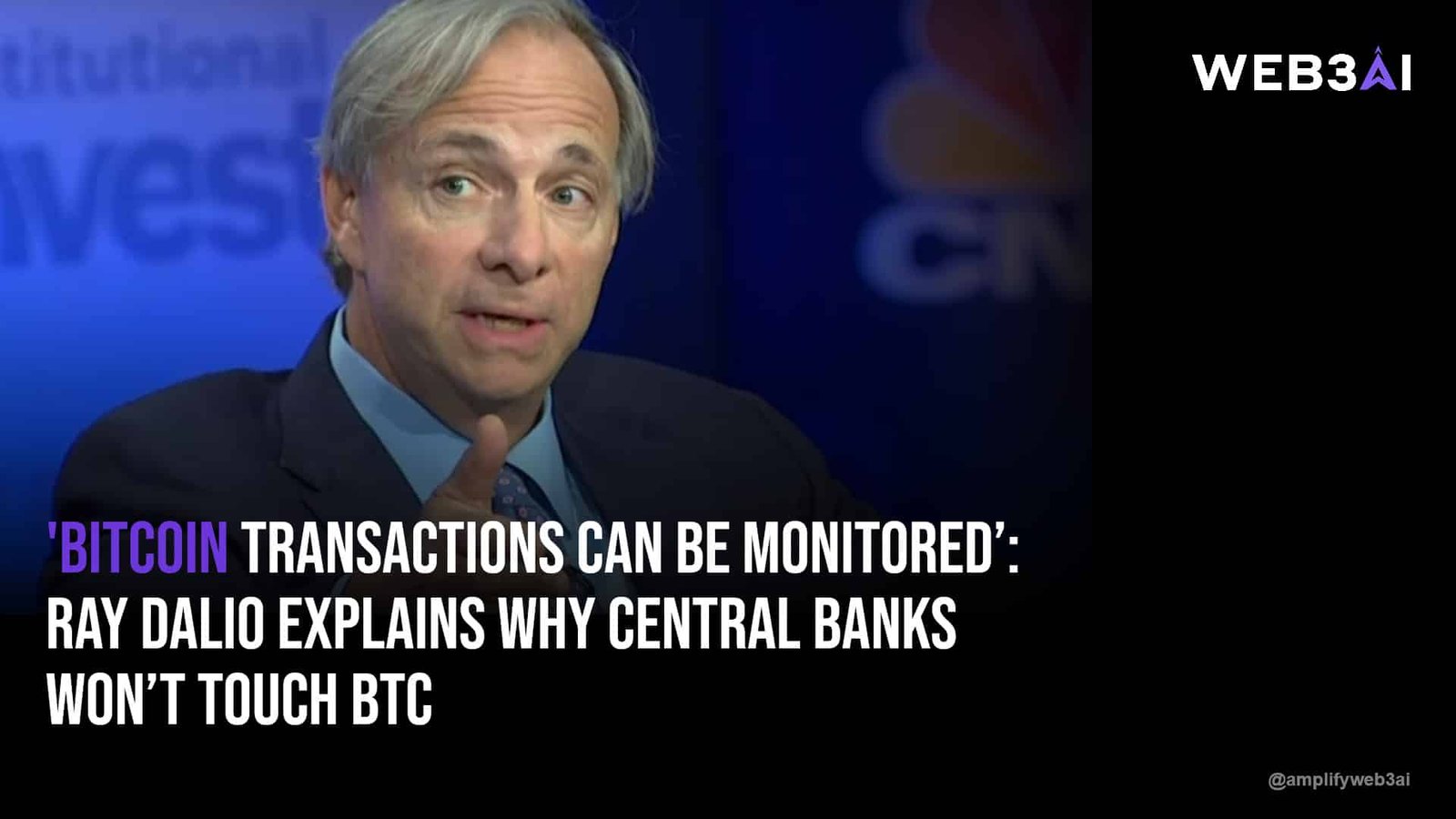

Bitcoin central bank adoption has long been a dream for crypto enthusiasts, but legendary investor Ray Dalio just threw cold water on the idea — and his reasoning is hard to dismiss. In a widely discussed statement, Dalio pointed to Bitcoin’s transparent, traceable transaction ledger as one of the core reasons central banks will never embrace BTC as a reserve asset. For a world where monetary sovereignty and financial privacy are everything, Bitcoin’s openness is a feature to users and a fatal flaw to governments.
This isn’t just one billionaire’s opinion. As Forbes reported in early 2025, Dalio has consistently argued that governments prioritize control over their monetary systems above all else — and any asset that exposes sovereign financial activity to public scrutiny is a non-starter for central banks. The tension between Bitcoin’s core design principles and the needs of nation-state financial institutions runs deeper than most headlines suggest.
In this post, we break down exactly why Dalio believes central banks won’t touch Bitcoin, what the surveillance problem really means, and what this tells us about the future of BTC in the global financial order.
Dalio’s argument centers on one uncomfortable truth: every Bitcoin transaction is permanently recorded on a public blockchain. Unlike gold held in a vault or dollar reserves moved through private interbank systems, Bitcoin movements are visible to anyone with the right tools. For a central bank managing national reserves, that level of transparency creates enormous strategic risk.
Imagine a central bank quietly accumulating Bitcoin as part of a reserve diversification strategy. Within hours, blockchain analysts, rival governments, and financial markets could detect those wallet movements and react accordingly — driving up prices, triggering geopolitical responses, or exposing sensitive monetary policy decisions before they’re ready to be announced. The very feature that makes Bitcoin trustless for peer-to-peer users makes it operationally dangerous for sovereign institutions.
Dalio also raised a second concern: governments have historically moved to control or ban any monetary instrument that threatens their authority. Bitcoin, by design, resists that control. Central banks don’t just want a store of value — they want an asset they can manage, freeze, seize, or redirect if necessary. Bitcoin offers none of those levers.
Pro Tip: When evaluating Bitcoin’s institutional potential, always separate retail and corporate adoption from sovereign central bank adoption. These are fundamentally different use cases with different risk tolerances and regulatory realities.
The blockchain transparency issue goes beyond simple privacy concerns. When a central bank executes large-scale transactions — whether buying, selling, or repositioning reserves — those moves are market-moving events. Traditional reserve assets like gold and foreign currencies can be transacted through private settlement systems. Bitcoin cannot be hidden in the same way.
On-chain analytics firms like Chainalysis and Elliptic have already demonstrated the ability to trace large Bitcoin wallet clusters with high accuracy. Governments are aware of this capability. For the same reason that central banks don’t broadcast their gold purchase schedules or foreign exchange intervention timings, they would be deeply reluctant to operate on a system where every move is timestamped and publicly logged.
This surveillance dynamic also creates a compounding problem: if one central bank holds Bitcoin and a rival government can monitor those holdings in real time, it creates an asymmetric intelligence advantage that no sovereign institution would willingly accept. The transparency that crypto advocates celebrate as a strength becomes a geopolitical liability at the state level.
For a deeper look at how Bitcoin is already reshaping institutional financial thinking outside central banks, see our full breakdown: How Bitcoin Is Changing the Global Financial System.
Central banks don’t just store value — they actively manage economies. They expand and contract money supplies, set interest rate policy, intervene in currency markets, and act as lenders of last resort in financial crises. Every one of these functions requires direct control over the assets in their system. Bitcoin’s fixed supply, decentralized governance, and censorship resistance make it fundamentally incompatible with these roles.
Consider what happened when El Salvador adopted Bitcoin as legal tender. Despite being a sovereign nation making a deliberate policy choice, the IMF applied sustained pressure to reverse course — and ultimately El Salvador scaled back the mandate. If a small nation faces that kind of institutional resistance, a G20 central bank adopting Bitcoin as a reserve asset would face consequences of an entirely different magnitude.
Dalio’s broader worldview — shaped by decades of studying how empires rise and fall through monetary policy — frames Bitcoin not as a replacement for sovereign money but as a parallel system that governments will tolerate only so long as it doesn’t threaten their dominance. The moment BTC genuinely challenges fiat control, the regulatory response would be swift and severe.
Pro Tip: Ray Dalio’s concern about Bitcoin isn’t that it lacks value — he’s acknowledged BTC has a role similar to digital gold. His concern is specifically about its structural incompatibility with how central banks operate. These are two very different critiques worth separating clearly.
None of Dalio’s arguments suggest Bitcoin is worthless or doomed. Rather, they point toward a more nuanced future: Bitcoin thriving as a decentralized store of value and hedge asset for corporations, high-net-worth individuals, and sovereign wealth funds — without ever becoming a core instrument of central bank monetary policy.
Companies like MicroStrategy, Tesla, and a growing list of institutional investors have already demonstrated that corporate Bitcoin adoption follows its own logic, entirely separate from central bank considerations. ETF approvals in the United States have opened BTC to mainstream portfolio allocation without requiring any government reserve mandate.
Understanding the difference between Web3’s decentralized financial infrastructure and traditional monetary systems is key to grasping why this gap exists. Our post on What Is Web3 and Why It Matters provides important context for how these two worlds are designed to operate differently — and why that gap may never fully close.
One natural response to Dalio’s critique is the rise of Central Bank Digital Currencies — CBDCs. If governments want the efficiency and programmability of blockchain technology without surrendering monetary control, CBDCs appear to offer that compromise. And indeed, over 130 countries are now in various stages of CBDC research or deployment, according to the Atlantic Council’s CBDC tracker.
But CBDCs and Bitcoin represent opposite design philosophies. CBDCs are centralized, permissioned, and fully controllable by issuing governments — everything Bitcoin is not. A CBDC gives central banks more surveillance capability over transactions, not less. From a government’s perspective, CBDCs solve the control problem entirely, which may actually reduce the pressure on institutions to ever engage seriously with Bitcoin.
This dynamic reinforces Dalio’s thesis: the financial infrastructure governments build for themselves will look nothing like Bitcoin. The two systems may coexist, but they are not converging. For a detailed look at where decentralized finance is heading in this landscape, read our analysis of The Future of Decentralized Finance.
Dalio’s analysis is a useful reality check for anyone modeling Bitcoin’s future price based on assumptions of central bank accumulation. That scenario faces structural barriers that go far beyond regulatory uncertainty — they are baked into Bitcoin’s core protocol design.
Bitcoin central bank adoption faces two core structural barriers: transparency and control. Every BTC transaction is permanently visible on the public blockchain, exposing sovereign financial moves to real-time market surveillance. Additionally, Bitcoin’s fixed supply and decentralized governance give central banks no ability to manage, adjust, or restrict the asset the way they require with reserve holdings.
Dalio argued that Bitcoin’s public transaction ledger makes it incompatible with central bank reserve management, since any large-scale BTC movements by a sovereign institution would be immediately detectable by rivals, markets, and analysts. He also noted that governments historically suppress any monetary system that threatens their authority — and Bitcoin’s censorship-resistance puts it in direct conflict with that instinct.
It’s theoretically possible if privacy-enhancing technologies were added to Bitcoin at the protocol level, though the Bitcoin development community has historically resisted such fundamental changes. More realistically, some nations may hold Bitcoin through sovereign wealth vehicles rather than central bank reserves — a meaningful distinction. El Salvador’s experiment showed the political and institutional pressure that even partial adoption generates.
When a central bank holds Bitcoin, its wallet activity becomes publicly trackable by any government or analytics firm with the right tools. This means rival nations could monitor reserve movements, infer monetary policy decisions before they’re announced, and potentially exploit that intelligence in currency or commodity markets. Traditional reserve assets — gold, foreign currencies, bonds — don’t carry this same exposure.
Corporate Bitcoin adoption is an investment decision — companies like MicroStrategy hold BTC as a treasury asset or inflation hedge, with no requirement to use it as a monetary policy instrument. Central bank adoption would mean holding BTC as an official reserve asset to support currency stability and monetary operations — a fundamentally different and far more consequential role that Bitcoin’s design actively resists.
Bitcoin central bank adoption is one of the most persistent myths in crypto market narratives — and Ray Dalio’s analysis gives us the clearest framework yet for why it remains unlikely. The same properties that make Bitcoin revolutionary for decentralized finance make it structurally incompatible with how sovereign monetary institutions must operate. That doesn’t diminish Bitcoin’s value; it clarifies it.
BTC’s future likely lies as a decentralized store of value, a corporate treasury asset, and a hedge against fiat currency debasement — roles it fills exceptionally well without needing central bank validation. Understanding these distinctions helps investors build more grounded expectations and more resilient portfolios in a rapidly evolving financial landscape.
If you’re building at the intersection of Web3, AI, and the future of finance, explore what we have built at attn.live.