Anouncement

Anouncement


Coinbase CEO Brian Armstrong is publicly throwing his weight behind the CLARITY Act, a bipartisan cryptocurrency bill aimed at establishing comprehensive regulatory guardrails for the digital asset industry.
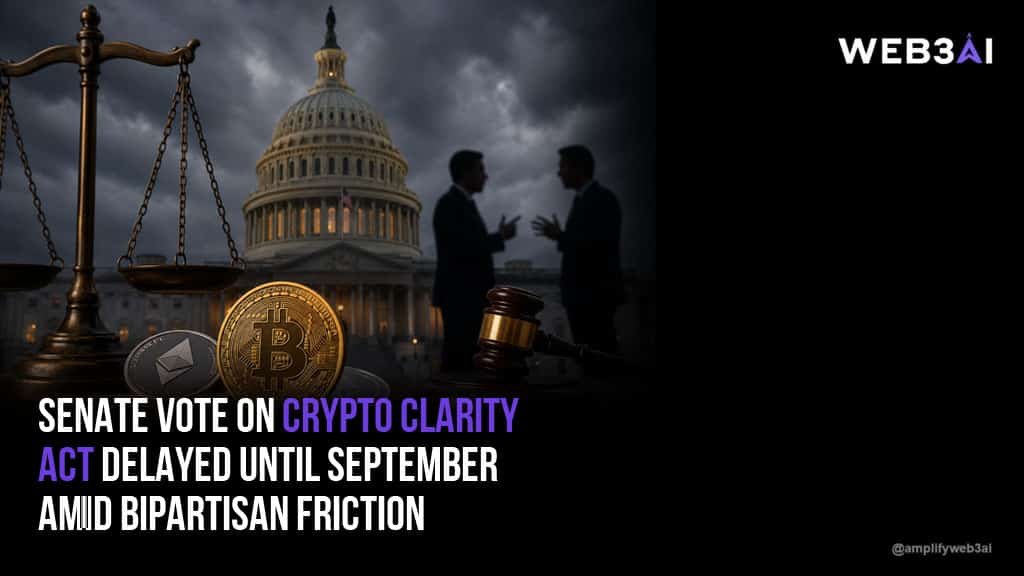
In an interview with CBS News, Armstrong argued that the landmark legislation—backed by President Donald Trump and scheduled for a Senate vote in September—is crucial to protecting everyday consumers and averting another catastrophic market failure like the 2022 collapse of FTX.
“The current status quo today is that there isn’t much clarity about what the rules are. And so we are seeing a lot of ordinary Americans get harmed by using some of these products. So this bill creates lots of consumer protections.”
— Brian Armstrong, CEO of Coinbase
For years, the U.S. cryptocurrency sector has operated in a regulatory gray area, facing what industry leaders often call “regulation by enforcement.” The CLARITY Act seeks to replace ambiguity with statutory rules.
Under the bill—which passed the House of Representatives last year—the SEC and CFTC would establish a unified framework determining whether a token functions as a commodity or a security. This division of power aims to keep innovation within the United States while giving institutional and retail investors a defined legal standing.
| Regulatory Area | Current Landscape | Under the Proposed CLARITY Act |
| Agency Oversight | Jurisdictional disputes between SEC and CFTC | Shared, defined statutory jurisdiction |
| Customer Protection | Inconsistent standard exchange practices | Strict fund segregation and anti-commingling rules |
| Illicit Activity | Reactive enforcement actions | Proactive law enforcement tools and reporting |
| Stablecoin Yields | Uncertain legal compliance | Clear pathway to offer yield on stablecoin holdings |
The urgency behind federal crypto legislation stems largely from the historic 2022 failure of FTX, where founder Sam Bankman-Fried misappropriated billions in user deposits. According to Pew Research, approximately one in five Americans has used or traded cryptocurrency, underscoring the broad exposure of everyday citizens to market instability.
Armstrong highlighted that the CLARITY Act directly addresses structural vulnerabilities by requiring exchanges to maintain high transparency standards and audited reserve ratios.
In addition to consumer safeguards, Armstrong noted the bill provides crucial mechanisms for American competitiveness:
“It also has the opportunity to create new products in crypto that would benefit Americans, including earning rewards on their stablecoin balances, the ability to go raise capital in crypto, capital formation or issuing securities.”
The legislation gained momentum following a White House meeting between tech leaders, including Armstrong, and President Trump. Trump urged Congress to pass the bill, framing it as a geopolitical necessity to keep the U.S. ahead of global rivals like China.
However, the bill faces strong opposition from critics on Capitol Hill regarding potential conflicts of interest.
Following news of progress on the CLARITY Act and positive commentary from industry executives, the cryptocurrency market experienced a positive surge:
As the Senate prepares for its September vote, industry watchers view the CLARITY Act as a pivotal moment that could define the next decade of digital finance in the United States.