Anouncement

Anouncement
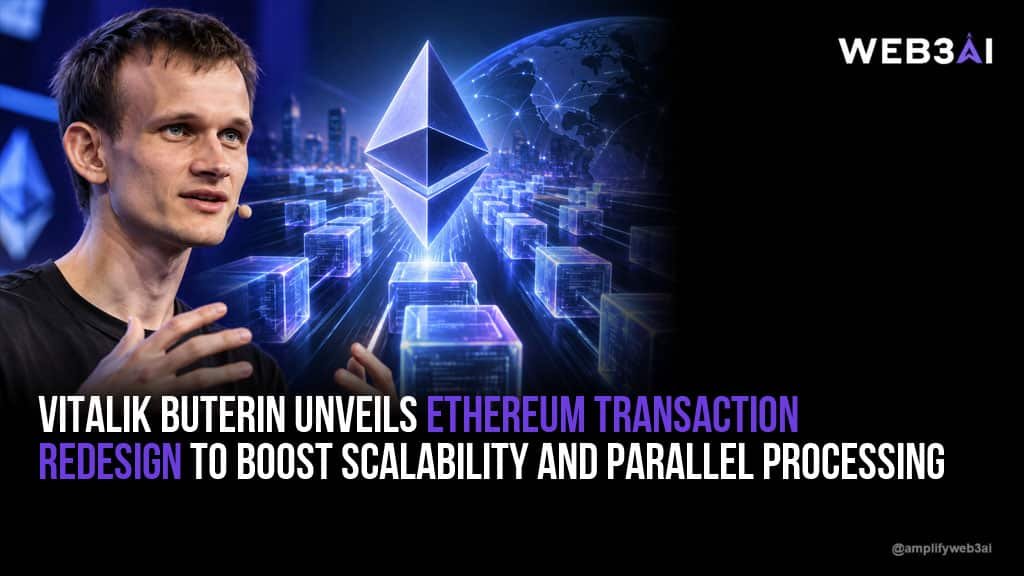

Ethereum co-founder Vitalik Buterin has outlined a groundbreaking long-term transaction model that separates transaction actions from validation dependencies, paving the way for parallel processing, recursive STARK proofs, and native account abstraction.
Ethereum co-founder Vitalik Buterin has proposed a major structural overhaul of how the network handles transactions. Aimed at supercharging scalability, improving mempool efficiency, and easing the path toward post-quantum cryptography, the blueprint introduces a stark division between what a transaction does and what conditions must be met for it to happen.
The framework, detailed in a technical post, tackles long-standing bottlenecks in Ethereum’s transaction lifecycle by decoupling system validation from execution logic.
Currently, Ethereum groups authorization, gas payment, and state execution into a single, tightly coupled linear workflow. Nodes must process everything sequentially, creating scaling bottlenecks.
Under Buterin’s proposed model, transactions are split into two core components:
By separating these layers, validators can handle multiple independent dependency checks in parallel. While state-dependent checks still require careful sequencing, separating out static requirements like cryptographic signatures allows clients to distribute workloads efficiently across available processing resources.
The proposal builds upon ongoing discussions surrounding EIP-8141, a draft Core Ethereum Improvement Proposal that introduces Frame Transactions.
Rather than relying strictly on a rigid, outer-transaction signature format, EIP-8141 divides transactions into distinct contract-call frames. These frames independently handle:
This architecture brings native account-abstraction capabilities directly to externally owned accounts (EOAs) without requiring repetitive contract deployments across different networks. It also opens the door for keyed nonces, giving accounts multiple independent nonce sequences to prevent unrelated transactions from getting stuck behind a single bottleneck.
Looking further ahead, Buterin suggested that dependencies requiring zero state interaction could be verified just once at the mempool layer rather than repeatedly by every single validator on the network.
Using recursive STARKs (Scalable Transparent Arguments of Knowledge), the network could bundle multiple transaction signatures and validity proofs into a single verifiable cryptographic proof. Validators would then only need to verify the compressed aggregate proof, significantly streamlining on-chain verification data and reducing overhead.
Furthermore, this modular verification structure is designed to support post-quantum cryptography. As quantum-resistant signature schemes tend to be larger and more costly to process, recursive proof aggregation could help mitigate high verification costs for future Ethereum accounts.
While the technical direction has generated massive interest across the developer community, EIP-8141 and the broader transaction redesign remain in the research and draft phase.
Core developers have yet to formally schedule the proposal for a mainnet upgrade. Before any changes hit production networks, the specs must undergo extensive reviews concerning denial-of-service risks, mempool admission rules, and wallet compatibility testing.
Nevertheless, Buterin’s proposal marks a crucial step in rethinking Ethereum’s foundational architecture to balance flexibility, high-volume scalability, and long-term crypto-security.