Anouncement

Anouncement
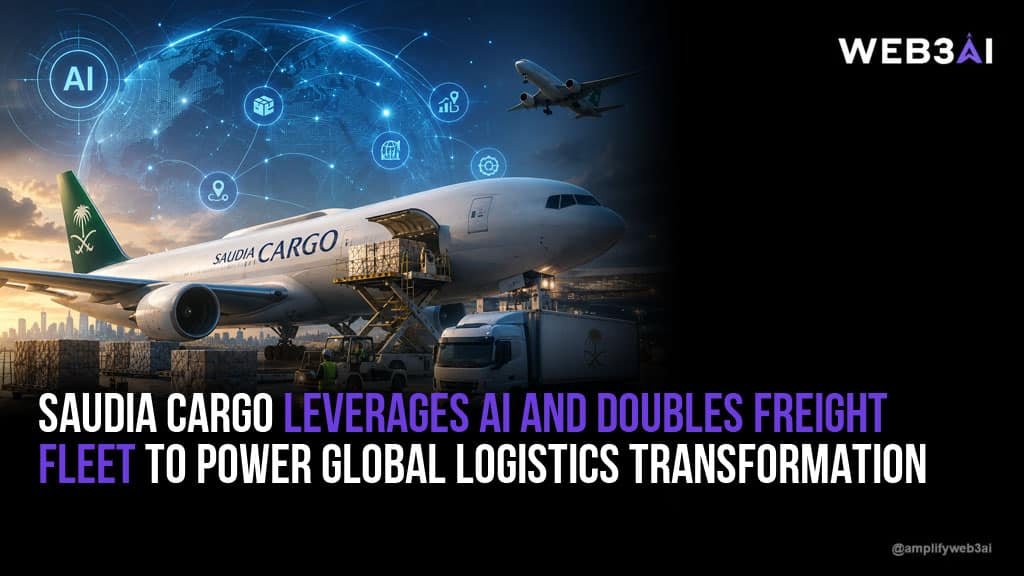

RIYADH — In a major step toward reshaping global supply chains, Saudia Cargo has announced a major operational expansion driven by artificial intelligence (AI) and a strategic doubling of its cargo fleet. The national air freight carrier is positioning itself as a central pillar in Saudi Arabia’s effort to establish the Kingdom as a premier global logistics hub connecting Asia, Europe, and Africa by 2030.
Speaking in an interview at the LEAP 2026 technology conference in Riyadh, Hisham Mallakah, Vice President of Shared Services at Saudia Cargo, outlined how deep tech integration and fleet growth are transforming the company’s core business model.
Rather than using digital tools solely for administrative support, Saudia Cargo has embedded AI algorithms directly into its operational backbone. The airline now uses advanced predictive models for:
This push toward automation mirrors broader trends across the global air freight industry. According to data from the International Air Transport Association (IATA), deploying AI and predictive algorithms to manage cargo loads and cold chain logistics reduces operating costs by more than 15 percent while drastically improving delivery accuracy amid global e-commerce volatility.
To meet surging international demand, Saudia Cargo is preparing to add four Boeing 777-200F freighters over the next two years, effectively doubling the size of its dedicated cargo fleet.
The Boeing 777-200F is an industry benchmark for long-haul cargo transport, offering a range of approximately 9,200 kilometers at maximum payload. The acquisition addresses a global air freight sector where demand for high-value and temperature-sensitive goods—such as semiconductors, pharmaceuticals, and fresh goods—is expanding by more than 7 percent annually.
“The new aircraft will strengthen our ability to transport heavy and temperature-sensitive cargo nonstop over long distances. Their fuel efficiency improves performance while reducing operational costs and carbon emissions,” noted Mallakah.
As part of its international network expansion, Saudia Cargo recently launched a direct cargo route between Riyadh and Melbourne. The strategic route establishes a direct bridge between Oceania, the Middle East, and Europe, serving Australia’s high-volume exports of fresh produce, meat, dairy, and pharmaceuticals.
Direct connection shortens transit times significantly compared to indirect layovers, reducing loss rates for high-yield perishable cargo. Beyond Australia, Saudia Cargo is targeting aggressive expansion into key e-commerce corridors, including:
The technological and operational scaling of Saudia Cargo directly aligns with Saudi Arabia’s National Transport and Logistics Strategy. Under Vision 2030, the Kingdom aims to scale its annual air cargo handling capacity to 4.5 million tonnes by 2030.
By merging AI-driven infrastructure with expanded long-haul routes, Saudia Cargo is helping turn Saudi Arabia’s geographic vantage point at the crossroads of three continents into an agile, tech-driven engine for global trade.