Anouncement

Anouncement
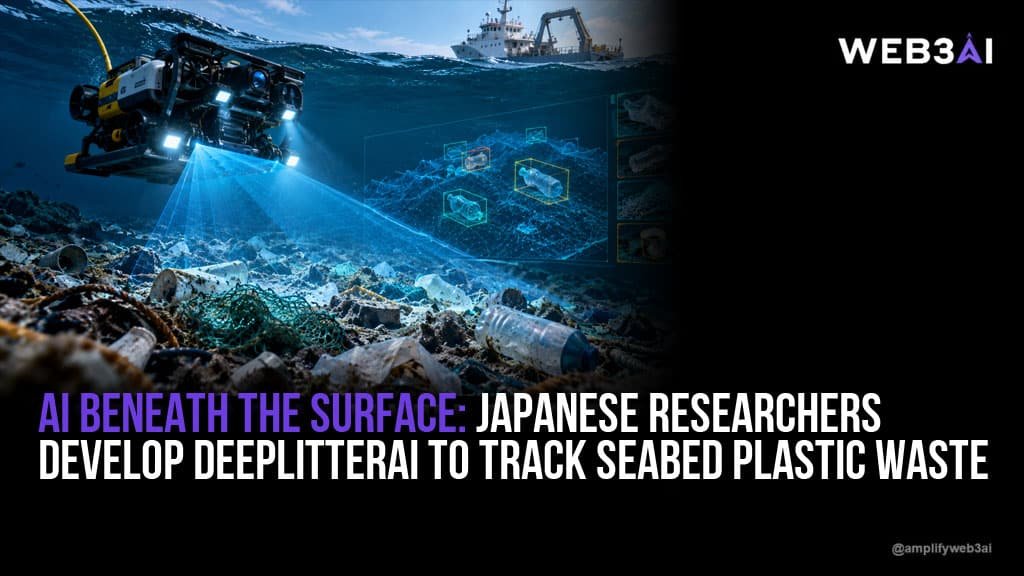

YOKOSUKA, JAPAN — In a major technological leap for ocean conservation, scientists at the Japan Agency for Marine-Earth Science and Technology (JAMSTEC) have developed an artificial intelligence system designed to automatically detect, classify, and count plastic waste scattered across the deep ocean floor.
Dubbed DeepLitterAI, the model tackles one of marine biology’s most notorious bottlenecks: manually scrubbing through thousands of hours of subsea submersible footage to monitor marine litter.
Man-made debris on the ocean floor. Source: Marine Conservation Institute
While floating ocean plastic garners widespread public attention, an estimated majority of marine plastic debris eventually sinks into the abyss. Deep-sea trenches and ocean floors act as terminal accumulation sinks, yet cataloging this debris has historically relied on laborious, frame-by-frame visual inspections by researchers.
Existing computer vision models struggled in deep-sea conditions. Deep-sea submersibles—such as JAMSTEC’s SHINKAI 6500 and remotely operated vehicles like HYPER-DOLPHIN—use wide-angle lenses to navigate pitch-black waters. Under these lenses:
To build a model tailored specifically for real-world ocean exploration, the research team—led by JAMSTEC biological oceanographer Ryota Nakajima—compiled a new visual benchmark named J-Litter.
Drawing from deep-sea footage collected across Japan’s surrounding waters since 1983, the team curated and annotated more than 12,000 images. Crucially, the training data integrated:
Published in the environmental science journal Environmental Pollution, the study’s findings demonstrate that DeepLitterAI achieves human-level detection benchmarks at commercial processing speeds:
| Metric | Human Expert Inspection | DeepLitterAI System |
|---|---|---|
| Detection Rate (Major Debris) | Baseline Reference | ~80% (bottles, bags, containers) |
| Margin of Error | Baseline Reference | Within ~10% of expert consensus |
| Processing Speed | Standard visual review | 2.1× to 3.1× faster |
| Turnaround Time | ~1 month of video analysis | A few days |
“Because huge quantities of plastic sink directly to the seafloor, assessing the true scale of pollution has always been exceptionally difficult,” said lead researcher Ryota Nakajima. “With this tool, we can rapidly identify accumulation hotspots and provide the hard empirical data needed to target conservation measures.”
As international negotiators work toward legally binding global treaties on plastic pollution, scalable monitoring tools are critical. JAMSTEC plans to use DeepLitterAI to automate the processing of archival deep-sea footage worldwide, paving the way for comprehensive global maps of seafloor waste hotspots.