
Anouncement

Anouncement
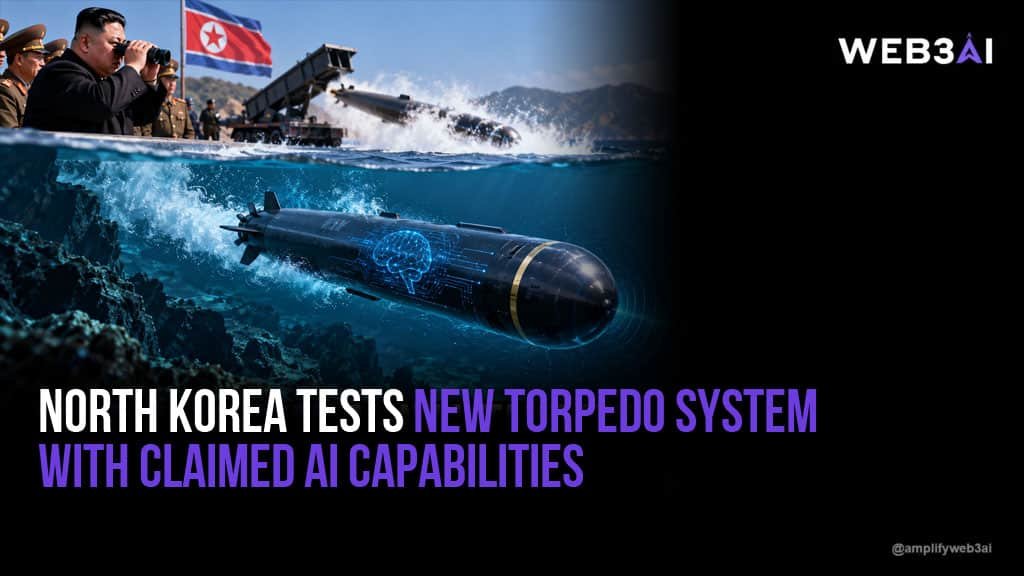

SEOUL, South Korea — In its latest display of military advancement, North Korea announced on Saturday the successful testing of a new torpedo system reportedly equipped with artificial intelligence for enhanced target detection and guidance.
The test, which took place on Thursday, marks a significant step in leader Kim Jong Un’s recent strategic shift toward expanding Pyongyang’s naval warfare capabilities.
According to the Korean Central News Agency (KCNA), the newly tested weapon is a “super-speed, precisely guided” torpedo officially named Zam-2.0. While the state media outlet heavily touted the integration of artificial intelligence, it stopped short of explaining exactly how AI functions within the weapon’s operational framework.
The KCNA report noted that Thursday’s launch successfully verified the torpedo’s advanced propulsion systems. The Zam-2.0 is not an overnight development; state media claims the system has undergone rigorous development, encompassing more than 180 tests over the past five years.
South Korea’s military, which frequently points out Pyongyang’s tendency to exaggerate its technological achievements, has not yet issued an official comment regarding the Zam-2.0 test.
The torpedo launch is part of a broader, aggressive ramp-up in weapons demonstrations by North Korea in recent weeks. After years of heavily prioritizing land-based ballistic missile programs, Kim Jong Un appears to be shifting his focus toward the sea.
Just days prior, on Wednesday, North Korea conducted its first underwater-launched missile tests in nearly three years. Defense experts assess that these tests likely involved a yet-to-be-deployed submarine specifically designed by Pyongyang to launch nuclear payloads.
The push for AI integration also appears to be a growing theme in North Korean military propaganda. Following hypersonic missile tests conducted on September 20 and October 3, Kim Yo Jong—the powerful sister of Kim Jong Un—asserted that those advanced missiles also utilized artificial intelligence technology to bypass missile defenses in South Korea and Japan.
Despite the bold declarations from Pyongyang, international defense experts remain deeply skeptical about the true extent of North Korea’s artificial intelligence capabilities.
While analysts concede that North Korea is likely making steady improvements to its guidance software and flight-control systems, it remains highly doubtful that the heavily sanctioned nation possesses the advanced digital infrastructure required for true AI-driven autonomous target designation.
These rapid-fire weapons tests arrive during a period of historically high tensions on the Korean Peninsula. In recent years, Kim Jong Un has systematically dismantled diplomacy and cooperation efforts with Seoul, officially designating South Korea as a “permanent enemy.”
This hardened stance comes as nuclear disarmament negotiations with Washington remain in a years-long stalemate, prompting Pyongyang to rapidly expand its arsenal of weapons designed to overwhelm regional defenses.