Anouncement

Anouncement
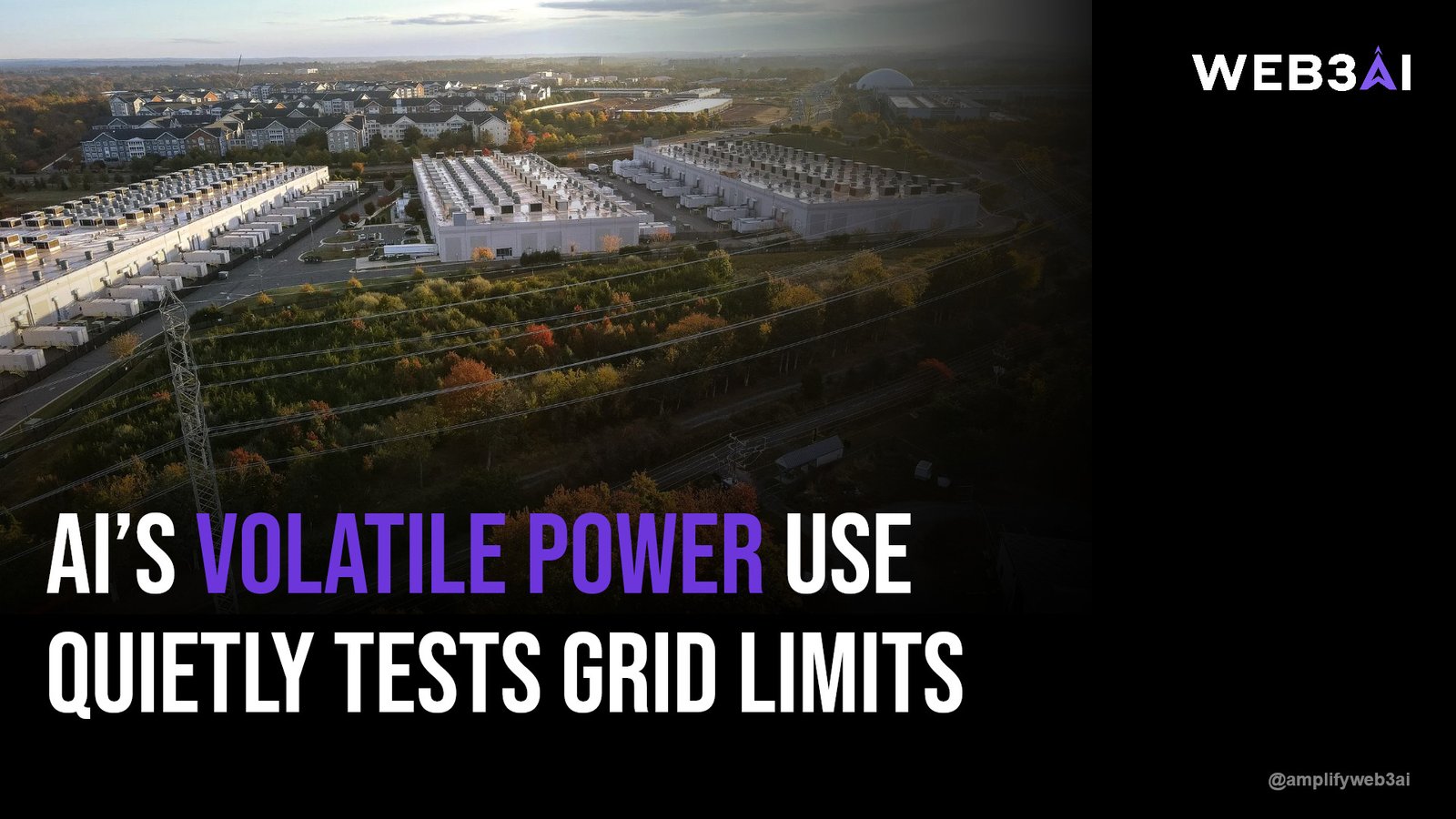

Data centers grid instability has moved from a niche engineering concern to a front-page economic and climate crisis — and most people have no idea it’s already happening. Every time you run a large language model query, stream 4K video, or train an AI system, a data center somewhere draws a surge of power from the electrical grid. Multiply that by billions of daily users and thousands of new facilities planned through 2030, and you begin to see the scale of the problem. The power grid — much of it built decades ago — was simply never designed for this.
According to reporting by IEEE Spectrum, data centers are now one of the fastest-growing sources of electricity demand in the United States and globally, with projections suggesting they could account for 9% or more of total U.S. electricity consumption by 2030. That explosive growth is triggering real instability risks: voltage fluctuations, frequency deviations, and in worst-case scenarios, rolling blackouts affecting homes and businesses nowhere near a single server. The story isn’t just about energy — it’s about whether our digital infrastructure can scale responsibly.
In this post, we break down exactly what’s driving the strain, what grid operators are doing about it, and what the broader Web3 and AI community needs to understand about the infrastructure powering the future.
The numbers are staggering. A single hyperscale data center can consume anywhere from 100 to 500 megawatts of power — roughly equivalent to the electricity demand of a mid-sized city. Now imagine dozens of those facilities being permitted, built, and connected to the same regional grid within a span of two or three years. That is precisely what is happening in Northern Virginia, Texas, Georgia, and across the European Union right now.
The AI boom is the primary accelerant. Training a large AI model like GPT-4 consumes an estimated 50 gigawatt-hours of electricity — before a single user ever queries it. Inference (running the model in real time) adds even more continuous load. Unlike traditional enterprise computing, AI workloads are irregular, intense, and difficult to predict, making load-balancing a nightmare for grid operators who depend on smooth, foreseeable demand curves.
What makes data centers grid instability particularly dangerous is the speed of the ramp-up. Grid infrastructure — transmission lines, substations, transformers — takes years or even decades to permit and build. Data centers can be constructed and energized in 18 to 24 months. That mismatch between supply-side grid buildout and demand-side data center growth is the core tension driving instability today.
Pro Tip: If you’re evaluating AI infrastructure investments, always factor in the local grid capacity and interconnection queue timelines — not just land cost and fiber availability. Grid access is increasingly the binding constraint.
To understand data centers grid instability, it helps to understand how electrical grids maintain balance. Grid operators must match supply and demand in real time — measured in fractions of a second. When a large data center suddenly ramps up (or down) power draw, it creates what engineers call a “step change” in load. If that change is large enough or fast enough, it can cause frequency deviations that trigger protective relays, cascading into outages far removed from the original source.
Voltage instability is a related but distinct problem. Data centers often draw highly reactive power loads, which can degrade power quality for neighboring industrial and residential users. This is particularly acute in regions where the grid was built for a lighter, more distributed load profile — not for a cluster of megawatt-scale computing campuses.
There’s also the issue of interconnection queues. In the United States, the process of connecting a new large-load customer to the transmission grid can take three to seven years due to required studies, upgrades, and regulatory approvals. The result: some data center developers are circumventing queue delays by connecting at the distribution level (lower-voltage local grids), which those grids were never intended to handle at this scale.
For a deeper look at how artificial intelligence is reshaping energy systems at every level, explore our coverage of how AI is transforming the energy sector — including the feedback loop between AI’s energy hunger and the clean energy transition.
Not all regions are equally exposed to data centers grid instability. Certain geographic clusters have become so dense with compute infrastructure that local grids are operating at or near capacity. Northern Virginia — home to the largest concentration of data centers on Earth — is a prime example. Dominion Energy, the region’s primary utility, has publicly stated that new large-load interconnections face multi-year delays due to transmission congestion.
Texas presents a different flavor of risk. The ERCOT grid, which operates largely independently of the broader U.S. grid, has already experienced high-profile instability events. Adding hundreds of megawatts of new data center load onto a grid with limited interconnection to neighboring regions increases the stakes considerably during extreme weather events.
In Europe, Ireland’s data center cluster around Dublin consumes so much electricity that the country’s grid operator, EirGrid, issued a moratorium on new data center connections in the Dublin region for several years. The UK, the Netherlands, and Germany face similar pressures. This is not a future scenario — it is the present reality for grid planners on multiple continents.
The industry is not sitting still. Several meaningful technical and policy responses are emerging — though whether they will prove sufficient at the pace AI infrastructure is scaling remains an open question. On the technical side, more data center operators are investing in on-site generation: large-scale battery storage, fuel cells, and increasingly, small modular nuclear reactors (SMRs) that promise dispatchable, low-carbon power without grid dependency.
Demand flexibility programs are another lever. Some hyperscalers are negotiating “interruptible load” agreements with utilities, agreeing to curtail non-critical workloads during peak grid stress events in exchange for lower energy rates. This is a meaningful contribution to grid stability — essentially turning data centers from passive consumers into active grid participants.
The Web3 ecosystem has a specific and underappreciated role here. Decentralized physical infrastructure networks (DePIN) offer an alternative model: distributing compute workloads across thousands of smaller nodes rather than concentrating them in a handful of hyperscale campuses. This architectural shift has real implications for grid resilience. Our analysis of the rise of AI infrastructure explores how decentralized models could reshape the compute landscape — and reduce single-point grid dependencies.
Pro Tip: Distributed compute architectures — including Web3-native DePIN networks — could meaningfully reduce grid stress by spreading load geographically rather than concentrating it in already-strained regions.
Regulators are beginning to respond — but the pace of policy rarely matches the speed of technological change. In the United States, the Federal Energy Regulatory Commission (FERC) issued Order 2023 in 2023, aimed at reducing interconnection queue backlogs by overhauling the study and approval process. Early results are promising but modest; the queue still contains hundreds of gigawatts of projects waiting for connection.
Several U.S. states have introduced or are considering legislation requiring data centers to disclose their projected electricity consumption before receiving permits. Virginia — home to the world’s densest data center cluster — passed legislation in 2024 requiring utilities to publish detailed load forecasts that account for data center growth. This is a meaningful step toward coordinated planning rather than reactive crisis management.
At the federal level, the Department of Energy has launched initiatives around grid modernization and transmission buildout, but the permitting process for new high-voltage transmission lines remains notoriously slow — often taking a decade or more from proposal to energization. Closing that gap will require sustained political will and, likely, federal preemption of some state-level permitting barriers.
The intersection of sustainability commitments and grid reality is increasingly fraught. Many hyperscalers have made net-zero pledges, but meeting those pledges while rapidly scaling compute infrastructure requires clean energy to be available when and where data centers need it — not just on an annual average basis. Our exploration of Web3 and sustainability examines how blockchain-based energy accounting and REC markets are evolving to meet this challenge.
You might wonder what data centers grid instability has to do with your business or daily life. The answer is: more than you might think. Every SaaS application, cloud storage bucket, streaming service, and AI assistant you use lives in a data center. If those facilities face power constraints — or if grid instability forces emergency curtailments — your digital tools go down with them.
For businesses building on AI infrastructure, the risk is more direct. If your AI pipeline depends on cloud compute in a region with grid constraints, your uptime SLAs are only as good as the local utility’s ability to keep the lights on. That is not a hypothetical — it is a consideration that enterprise risk teams are increasingly baking into their cloud architecture decisions.
Data centers grid instability refers to the stress that large, rapidly growing data center loads place on electrical grids — causing voltage fluctuations, frequency deviations, and in extreme cases, outages. It matters now because AI-driven compute demand is scaling faster than grid infrastructure can accommodate, creating real risks for power reliability across entire regions.
Data centers create instability through sudden, large changes in power draw — called “step loads” — that grid operators struggle to balance in real time. They also draw reactive power that degrades voltage quality for neighboring customers. At sufficient concentration, as seen in Northern Virginia or Dublin, they can push regional grids to their physical capacity limits.
Northern Virginia, Texas (ERCOT), Dublin, the Netherlands, and Singapore are among the most stressed regions today. These areas have high concentrations of data centers relative to local grid capacity and have either already experienced connection moratoria or are operating near the edge of available transmission capacity.
Renewable energy is a crucial part of the solution but doesn’t by itself solve grid instability. Solar and wind are intermittent, meaning they can’t always match the continuous, high-intensity demand profile of a hyperscale data center. Battery storage, nuclear, and demand flexibility programs are needed alongside renewables to create a truly stable, low-carbon grid for compute infrastructure.
Web3-native decentralized physical infrastructure networks (DePIN) distribute compute across many smaller nodes rather than concentrating it in a few massive campuses. This geographic distribution spreads grid load more evenly, reducing the risk of any single region becoming a stability chokepoint. It also aligns with sustainability goals by enabling workloads to follow available clean energy across regions.
Businesses can reduce their exposure and contribution by diversifying compute regions, choosing cloud providers with strong on-site generation and demand flexibility commitments, scheduling non-urgent workloads during off-peak hours, and exploring decentralized compute options. Engaging with energy-transparent infrastructure providers is increasingly both an ethical and a risk-management imperative.
Data centers grid instability is not a distant warning — it’s an active constraint shaping where AI can be built, how fast it can scale, and who bears the cost of that growth. The collision between exponential compute demand and decades-old grid infrastructure is one of the defining infrastructure challenges of the 2020s. Understanding it isn’t just for grid engineers; it’s essential knowledge for anyone building, investing in, or depending on digital infrastructure.
The good news is that solutions exist — from smarter grid policy to on-site generation to decentralized compute architectures that distribute load rather than concentrate it. The harder question is whether the industry and regulators can move fast enough to stay ahead of the curve. At ATTN.LIVE, we believe that transparent, decentralized infrastructure is a meaningful part of the answer — not just for performance and cost, but for the long-term resilience of the digital economy.
Explore what we have built at attn.live.