
Anouncement

Anouncement
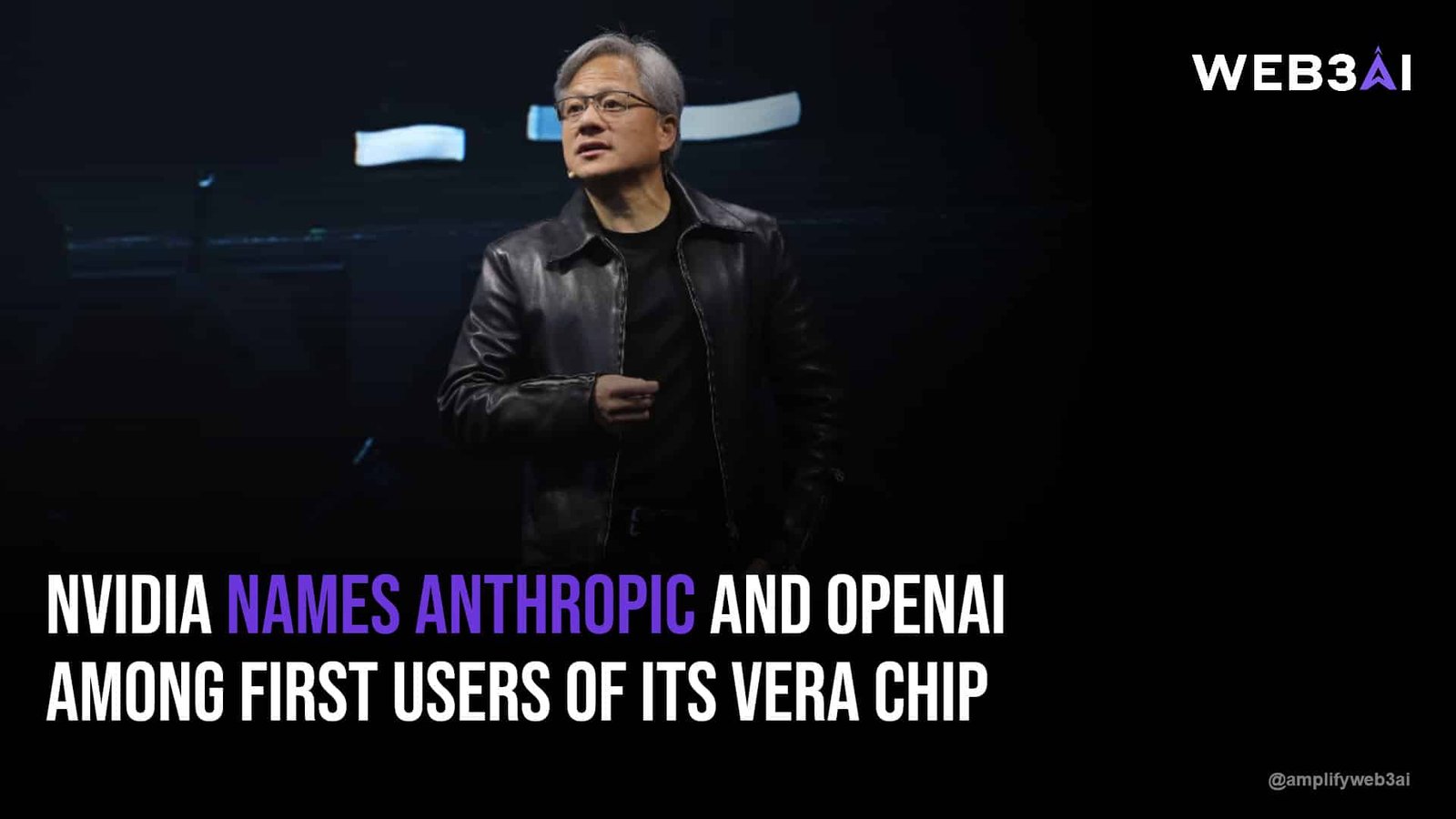

The Nvidia Vera chip AI platform has arrived — and it is already reshaping how the world’s most ambitious AI companies think about compute. Announced as part of Nvidia’s Vera Rubin architecture roadmap, the Vera CPU is not a minor upgrade. It represents a fundamental shift in how large-scale AI workloads are designed, delivered, and scaled. If you have been paying attention to the race between AI labs, you already know that the battle for supremacy is increasingly fought at the chip level.
According to reporting by Wired, Nvidia’s new chip lineup is explicitly engineered for the next wave of AI demands — a wave that is no longer theoretical. OpenAI and Anthropic, two of the most powerful AI labs on the planet, have already signed on as early adopters of the Vera platform. That level of industry validation is not something that happens by accident. It signals that Vera is solving a real and urgent problem in the AI compute stack.
In this post, we break down exactly what the Nvidia Vera chip is, why Anthropic and OpenAI are betting on it, and what it means for the broader AI infrastructure landscape heading into 2025 and beyond.
Nvidia’s Vera chip is a custom-designed CPU built to pair directly with the company’s next-generation Rubin GPU architecture. Unlike previous Nvidia processor designs that leaned heavily on third-party CPU partners like AMD or Arm, Vera is Nvidia’s own in-house CPU — purpose-built for AI data center workloads. This is a significant strategic pivot for a company that has historically dominated the GPU side of the AI compute equation.
The core promise of Vera is tight hardware-software integration. By designing the CPU and GPU together under one roof, Nvidia can eliminate the latency and bandwidth bottlenecks that traditionally slow down large model training and inference. Think of it like building a custom highway specifically for AI data rather than forcing that data to navigate roads designed for general traffic. The efficiency gains are not marginal — they are architectural.
Vera is expected to power the next generation of Nvidia’s GB300 and GB200 NVL systems. These are the server configurations that hyperscale cloud providers and frontier AI labs depend on to train and run their largest models. By taking control of the full chip stack, Nvidia is positioning itself not just as a component supplier but as the defining infrastructure partner for the AI era.
Pro Tip: When evaluating AI infrastructure investments, look beyond raw GPU performance. The CPU-to-GPU interconnect bandwidth is increasingly the hidden bottleneck in large-scale AI training — and it is exactly what Vera is designed to solve.
It is one thing for Nvidia to announce a new chip. It is another thing entirely when OpenAI and Anthropic — two organizations that are actively competing to build the most capable AI systems in the world — commit to adopting it. Their endorsement of the Nvidia Vera chip AI platform tells us something important about where frontier AI development is heading.
For OpenAI, compute efficiency is existential. Training GPT-class models requires staggering amounts of energy, time, and hardware. Any architecture that reduces the cost per token trained — even by a few percentage points — translates into billions of dollars in savings and a measurable competitive edge. Vera’s tight CPU-GPU integration directly addresses this. It is not about raw power alone; it is about how intelligently that power is used.
Anthropic faces a similar calculus. As the company behind Claude, Anthropic has built its reputation on responsible AI development — which includes building systems that are efficient as well as capable. Adopting hardware that is designed from the ground up for AI inference and training aligns directly with Anthropic’s technical philosophy. Efficiency and safety are not opposites; in the world of large language models, efficient systems are often safer systems because they are more predictable and easier to monitor.
For a deeper look at how Nvidia’s hardware roadmap has been evolving, explore our coverage of how Nvidia is shaping the future of AI hardware — which provides essential context for understanding why Vera is such a pivotal development.
To fully appreciate the Nvidia Vera chip AI announcement, you need to understand the Rubin architecture it sits within. Rubin is Nvidia’s codename for its next-generation GPU platform — the successor to the current Blackwell architecture. Just as Blackwell succeeded Hopper, Rubin represents another generational leap in AI compute capability, and Vera is the CPU designed to unlock its full potential.
The Rubin GPU is expected to deliver dramatic improvements in memory bandwidth and compute throughput compared to Blackwell. But raw GPU power alone is not enough. As AI models grow larger and inference demands increase, the CPU’s ability to orchestrate workloads, manage memory hierarchies, and feed data to the GPU becomes a critical performance variable. Vera is designed to be the ideal orchestration layer for Rubin — ensuring that GPU cores are never left waiting for data.
Nvidia has described Vera as featuring a custom Arm-based CPU core design that is optimized specifically for AI server environments. This is not a laptop chip or a consumer processor running in a data center rack. It is a purpose-built silicon designed for one job: making AI infrastructure faster, more efficient, and more scalable than anything currently on the market.
Pro Tip: The shift to custom CPUs in AI data centers mirrors what Apple did with its M-series chips for consumer devices. Vertical integration — controlling both the chip design and the software stack — consistently produces performance gains that off-the-shelf component combinations cannot match.
The arrival of the Nvidia Vera chip AI platform does not exist in a vacuum. It lands at a moment when every major technology company — from Google and Microsoft to Amazon and Meta — is racing to build or secure next-generation AI infrastructure. The decisions being made right now about chips, data centers, and compute architectures will shape the AI capabilities of the next decade.
For enterprises and developers building on top of AI platforms, this matters in a very practical way. The chips that power the models you use every day — from ChatGPT to Claude — are about to become significantly more capable. That means faster inference, lower latency, and potentially lower costs as compute efficiency improves. The Vera chip is not just an internal Nvidia milestone; it is a rising tide that will lift many boats across the AI ecosystem.
It is also worth noting the geopolitical dimension. The race for AI chip supremacy is increasingly intertwined with national security and economic policy. Nvidia’s ability to design and deploy cutting-edge silicon like Vera — while navigating export restrictions and supply chain complexity — reinforces why chip architecture is now considered a strategic asset, not just a technical one.
To understand how OpenAI fits into this broader competitive landscape, our post on OpenAI and the race to AGI provides essential context for why compute access is so central to the AGI timeline debate.
Understanding the technical highlights of the Vera chip helps explain why it has generated such significant interest from the AI community. Here is a breakdown of the most important features:
These are not incremental improvements. They represent a coherent architectural philosophy: build the whole system, not just the GPU. For AI labs running models at scale, each of these improvements compounds into a meaningful operational advantage.
The Nvidia Vera chip story is part of a larger shift in how the industry thinks about AI infrastructure. For years, the conversation was almost entirely GPU-centric — more VRAM, more CUDA cores, more teraflops. But as models have grown larger and more complex, it has become clear that the GPU alone is not the bottleneck. The entire compute stack — CPUs, memory, networking, and cooling — needs to evolve together.
This is why companies like Google have invested heavily in custom Tensor Processing Units (TPUs), why Amazon has developed its Trainium and Inferentia chips, and why Nvidia is now moving into CPU design with Vera. The era of general-purpose hardware running AI workloads is giving way to an era of purpose-built AI infrastructure. The companies that control that infrastructure will have a significant and durable advantage.
For organizations building Web3 and decentralized AI applications, this shift has important implications. Access to efficient, scalable compute is no longer just a concern for hyperscalers — it is becoming a foundational requirement for any serious AI-native product. Understanding the infrastructure layer is essential for anyone building in this space.
Our overview of what AI infrastructure is and why it matters is a great starting point if you want to build a stronger foundation for understanding these dynamics.
The Nvidia Vera chip is a custom-designed CPU built specifically for AI data center workloads. It is designed to pair tightly with Nvidia’s next-generation Rubin GPU architecture, reducing latency, improving memory bandwidth, and enabling more efficient large-scale AI training and inference. Rather than relying on third-party CPUs, Nvidia developed Vera in-house to create a fully integrated AI compute system.
OpenAI and Anthropic are adopting the Nvidia Vera chip AI platform because it offers meaningful efficiency improvements for the types of large-scale model training and inference they run continuously. For organizations spending tens or hundreds of millions of dollars on compute annually, architectural improvements that reduce cost-per-token or increase throughput translate directly into competitive advantage. Both companies need the best available hardware to stay at the frontier of AI development.
Vera is Nvidia’s first fully custom in-house CPU design, built on Arm architecture and optimized for AI workloads from the ground up. Previous Nvidia systems relied on third-party CPUs from companies like Intel or AMD. By designing its own CPU, Nvidia can optimize the CPU-GPU interface at a level that is not possible when working with off-the-shelf processors, resulting in significantly higher data throughput and lower latency.
Rubin is Nvidia’s next-generation GPU architecture — the successor to the current Blackwell platform. The Vera CPU is designed specifically to work alongside Rubin GPUs, using Nvidia’s NVLink-C2C interconnect technology to enable extremely high-speed communication between the CPU and GPU. Together, Vera and Rubin form Nvidia’s most integrated AI compute platform to date, intended for deployment in large AI data centers.
Nvidia has indicated that Vera-based systems are expected to become available in 2026, following the current Blackwell generation. However, given Nvidia’s track record of accelerating its roadmap in response to customer demand — particularly from hyperscale cloud providers and frontier AI labs — timelines could shift. OpenAI and Anthropic’s early adoption signals that production planning is already underway.
While most users will never interact directly with Vera chips, the platform will meaningfully improve the AI products and services built on top of it. Faster inference means quicker responses from AI assistants. Better compute efficiency can translate to lower operating costs, which may reduce prices for AI-powered services over time. The Vera chip is infrastructure-level innovation — invisible but foundational to everything AI-powered that consumers use daily.
The Nvidia Vera chip AI platform is more than a hardware announcement — it is a signal about the direction of the entire AI industry. By designing its own CPU for the first time, Nvidia is making a decisive bet on vertical integration as the path to AI compute leadership. And with OpenAI and Anthropic already committed to the platform, that bet looks increasingly well-placed.
For anyone building in the AI or Web3 space, understanding the infrastructure layer is not optional anymore. The chips being designed today will determine which AI capabilities are possible in 2026 and beyond. Vera is the clearest indication yet that Nvidia intends to own not just the GPU market, but the entire AI compute stack. The companies that understand this shift early will be the ones best positioned to take advantage of what comes next.
Explore what we have built at attn.live.