Anouncement

Anouncement


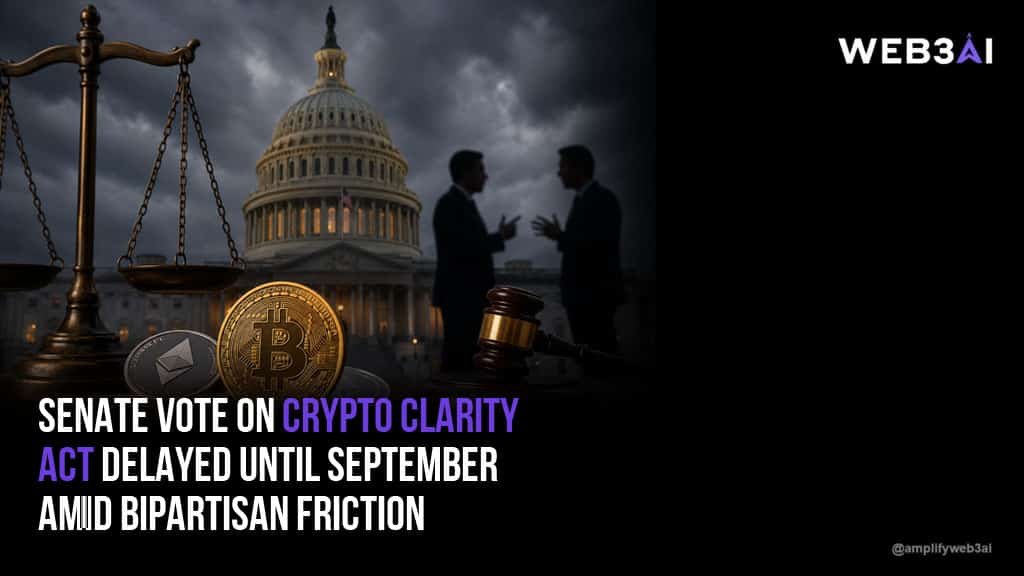
The Crypto Clarity Act Senate advancement marks one of the most significant legislative moments in the history of digital assets in the United States. For years, crypto builders, investors, and everyday users have operated under a cloud of regulatory ambiguity — never quite sure whether a token is a security, a commodity, or something else entirely. That uncertainty has cost the industry billions in legal fees, stunted innovation, and driven talent offshore. Now, with the Clarity Act moving through the Senate, a real resolution may finally be within reach.
Crypto stocks surged on the news, with major publicly traded companies in the digital asset space posting sharp gains as markets responded to the prospect of a defined legal framework. According to Reuters, investor sentiment across the crypto sector shifted notably as the bill cleared a key Senate hurdle, signaling that lawmakers are taking market structure seriously for the first time in a meaningful way. The rally was broad-based — touching exchanges, mining companies, and blockchain infrastructure providers alike.
This post breaks down what the Clarity Act actually proposes, why the market reacted the way it did, what it means for Web3 builders and token projects, and what still needs to happen before the law takes effect.
At its core, the Crypto Clarity Act aims to draw a clear line between digital assets that should be regulated as securities — falling under SEC jurisdiction — and those that function more like commodities, placing them under CFTC oversight. This distinction has been one of the most fiercely contested battles in Washington since Bitcoin first entered mainstream awareness. The SEC and CFTC have long operated in an uncomfortable gray zone when it comes to crypto, with both agencies claiming authority over different corners of the market.
The bill introduces a framework that evaluates tokens based on their decentralization and functionality. If a network is sufficiently decentralized and the asset is used primarily as a medium of exchange or utility within that network, it would likely fall outside SEC securities classification. If a project is still centralized — where a founding team controls most of the supply and investors expect profit from the team’s efforts — it would remain a security subject to traditional disclosure requirements.
This is not a blanket deregulation of crypto. The Clarity Act still demands accountability, disclosure, and consumer protection. What it removes is the indefinite guessing game that has paralyzed legitimate projects and handed bad actors a convenient excuse. A defined rulebook is something every serious participant in the space has asked for — and the Senate advancing this bill suggests that ask is finally being heard.
Pro Tip: If you are building a token project, now is the time to document your network’s decentralization metrics. The Clarity Act framework will likely require clear evidence of decentralization to qualify for commodity classification.
Markets moved fast once news broke that the Crypto Clarity Act Senate vote had cleared a procedural hurdle. Coinbase stock climbed sharply, as did shares of MicroStrategy, Marathon Digital Holdings, and Riot Platforms. The reasoning was straightforward: regulatory clarity reduces risk, and reduced risk means institutional capital that has been sitting on the sidelines is more likely to enter the market.
For publicly traded crypto companies, the Clarity Act matters in a very direct way. Under the current ambiguous framework, these firms face enormous legal exposure just by listing or supporting tokens that the SEC might later decide to classify as unregistered securities. A clear legislative definition removes that existential threat and allows companies to build product roadmaps, hire staff, and raise capital with far more confidence.
It is also worth noting that the rally extended beyond the obvious names. Fintech companies with crypto exposure, traditional banks piloting blockchain settlement, and even some AI infrastructure firms with Web3 integrations saw their share prices tick upward. The market read this as a rising tide moment — one that could lift the entire digital asset ecosystem rather than a narrow group of winners.
We have been writing about the intersection of regulatory change and Web3 growth for some time now. To understand how the creator economy specifically stands to benefit from this kind of clarity, our post on how Web3 is reshaping the creator economy is a strong complement to what this legislation is unlocking.
For anyone building in Web3, the Crypto Clarity Act Senate advancement is not just a political headline — it is a potential restructuring of how you design, launch, and operate your project. The most immediate implication is that token classification will become a structured legal analysis rather than an educated guess. Lawyers will have a codified test to apply, and founders will know in advance which regulatory path their token falls under.
This matters enormously for decentralized autonomous organizations, where the question of legal status has always been murky. If your DAO issues governance tokens, are those securities? Under current law, the answer depends heavily on how aggressively the SEC chooses to pursue you. Under the Clarity Act framework, the answer would be more deterministic — tied to actual on-chain and organizational characteristics rather than enforcement mood. For a deeper look at how DAOs are structured and why their legal status matters, our explainer on what a DAO is and how it works provides important context.
The bill also opens a clearer path for DeFi protocols. Decentralized exchanges, lending platforms, and yield-generating protocols have long operated in fear of sudden SEC action. A CFTC-supervised framework — which is generally seen as more permissive toward commodity-like digital assets — would give many DeFi projects a significantly more workable operating environment.
Pro Tip: Start a regulatory readiness audit now. Document your token’s use case, governance structure, and decentralization evidence so you are prepared the moment the Clarity Act becomes law. Being reactive is far more expensive than being proactive.
Senate advancement is meaningful, but it is not the finish line. The Clarity Act still needs to pass a full Senate vote, then reconcile with any House version of the bill, and finally receive a presidential signature. Each of those steps carries its own set of political negotiations, lobbying pressures, and potential amendments that could strengthen or weaken the final text.
There are legitimate concerns on both sides. Consumer protection advocates worry that moving crypto assets to CFTC oversight removes important investor safeguards that SEC regulation provides. Some crypto-native voices, on the other hand, worry that any federal framework — even a favorable one — will introduce compliance burdens that disadvantage smaller projects and bootstrap founders relative to well-funded incumbents.
The timeline also matters. Crypto markets move quickly. If the legislative process drags into late 2025 or beyond, the industry may face another sustained period of uncertainty while waiting for resolution. That said, the bipartisan support the Clarity Act has attracted suggests it has a better chance of passage than previous attempts at crypto legislation, which often stalled in committee.
One underappreciated angle of the Crypto Clarity Act Senate story is what it means for the convergence of AI and Web3. Platforms that use tokenized incentive systems to reward AI model contributors, data providers, or compute operators have been in a particularly precarious position. These systems often involve tokens that could be interpreted as securities, making legal operation in the US extremely difficult.
If the Clarity Act creates a defined commodity classification for utility tokens, AI-native Web3 platforms gain immediate breathing room. They could operate, compensate contributors, and raise capital without the constant threat of an SEC enforcement action redefining their tokens as unregistered securities retroactively. This is not a hypothetical scenario — it is exactly what has chilled AI-Web3 innovation in the United States for the past several years.
The role of AI in Web3 growth is only expanding, and regulatory clarity is the infrastructure that allows that growth to happen at scale. Our deep dive into the role of AI in Web3 growth explores the technical and strategic dimensions of this convergence in more detail.
The Crypto Clarity Act Senate bill aims to establish a clear legal framework for classifying digital assets as either securities or commodities. It seeks to divide regulatory authority between the SEC and CFTC based on the decentralization and function of each asset, ending years of regulatory ambiguity that has hampered legitimate crypto development in the United States.
The Crypto Clarity Act Senate advancement signals a meaningful reduction in regulatory risk for publicly traded crypto companies. Investors interpreted the bill’s progress as a sign that the legal environment for digital assets is becoming more predictable, which makes it safer for institutional capital to enter the market and for companies to plan long-term investments.
DeFi protocols could benefit significantly if the Clarity Act routes sufficiently decentralized digital assets to CFTC oversight rather than SEC regulation. CFTC jurisdiction is generally considered more favorable for commodity-like assets, potentially allowing DeFi platforms to operate with clearer compliance pathways than they have today.
No. The Clarity Act is not a deregulation of crypto. Projects that remain centralized or where investors reasonably expect profit from a founding team’s efforts will still be classified as securities subject to SEC oversight and full disclosure requirements. The bill creates clarity, not a regulatory vacuum.
After passing the Senate, the bill must be reconciled with any House version, pass a joint vote, and receive a presidential signature. Each step involves potential amendments. The timeline could stretch into late 2025 or early 2026, meaning the industry will need to continue monitoring legislative developments closely.
Founders should begin documenting their token’s decentralization metrics, governance structure, and primary use cases now. Engaging a crypto-specialist attorney to map your project against the bill’s proposed classification tests is the most proactive step you can take. Being prepared before the law passes is far less costly than scrambling to comply after it does.
The Crypto Clarity Act Senate advancement is arguably the most consequential regulatory development for digital assets in the United States since the SEC first started issuing enforcement actions against token projects. It does not solve every problem, and it is not yet law — but it represents a genuine legislative effort to give the crypto industry a workable framework built on defined rules rather than enforcement-by-surprise. For builders, investors, and anyone who wants to see Web3 reach its full potential, this moment deserves close attention.
The rally in crypto stocks is one data point, but the deeper signal is about long-term confidence. When institutional investors, mainstream banks, and global enterprises can look at the US crypto market and see a legal structure they can operate within, capital flows. Innovation accelerates. Talent returns from offshore. The Clarity Act is not a guaranteed win, but it is the most credible attempt yet to build that structure.
We will continue tracking the legislative progress of the Clarity Act, its implications for token projects, and what it means for the AI-Web3 convergence that defines the next chapter of the internet. Explore what we have built at attn.live.
##