Anouncement

Anouncement
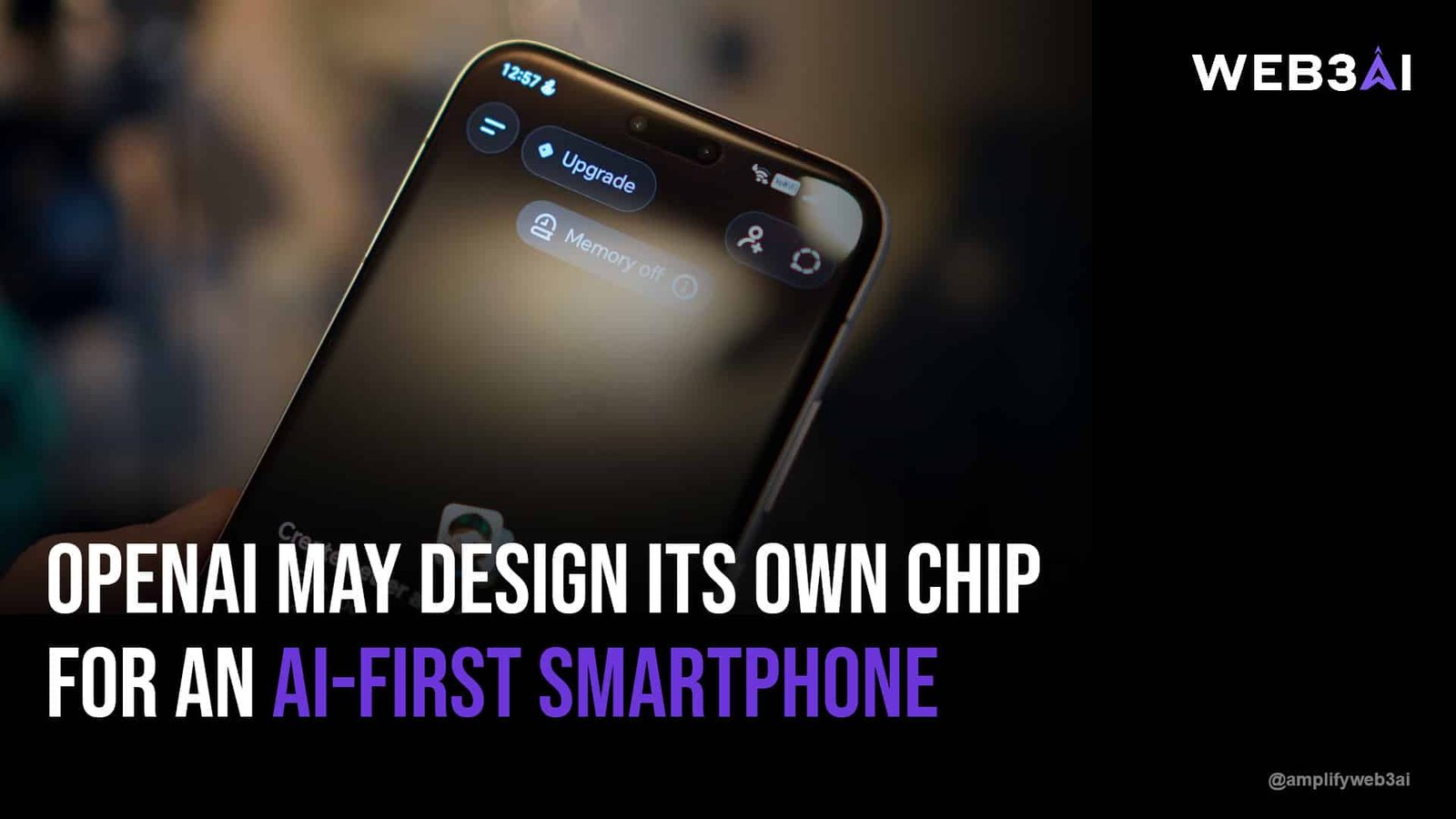

The OpenAI AI-first smartphone is no longer just a rumor whispered in Silicon Valley corridors — it is shaping up to be one of the most consequential hardware bets in tech history. OpenAI is reportedly in advanced talks to acquire io Products, the secretive startup founded by legendary Apple designer Jony Ive, in a deal valued at roughly $6.5 billion. At the same time, the company is quietly designing its own custom AI chip to power future consumer devices. Together, these two moves signal that OpenAI is done being just a software company.
According to a Reuters report published in May 2025, OpenAI and Ive’s team have been collaborating for over a year on a device described internally as an “AI companion” — something that rethinks what a personal device should feel like in a world where intelligence is ambient. The pain point is one most of us already feel: our current smartphones were built for an app-based, screen-first world, not for the conversational, context-aware AI interactions we are increasingly demanding every day.
In this post, we break down what we know about OpenAI’s hardware ambitions, why the Jony Ive partnership matters, what a custom chip means for AI performance, and what this all signals for the future of personal technology.
The device OpenAI is reportedly developing is not a traditional smartphone with a shiny new paint job. Instead, it is being conceived as a fundamentally different kind of personal device — one that leads with AI rather than bolting it on top of existing hardware. Early descriptions suggest it will be screen-light or possibly screenless, relying on voice, cameras, and contextual awareness to interact with users in a more natural way.
Think less “iPhone with ChatGPT pre-installed” and more “a device that knows your calendar, your preferences, your habits, and proactively helps you navigate your day.” The goal, reportedly, is to replace the reflexive phone-checking behavior that defines modern life with something more intentional and less distracting. That is a genuinely ambitious design philosophy — and it is exactly the kind of brief that Jony Ive built his reputation on.
The acquisition of io Products would give OpenAI not just Ive’s design sensibility but also a team of former Apple engineers who understand how to ship beautiful, functional hardware at scale. That is a rare capability, and one that companies like Humane and Rabbit have struggled to build quickly enough to matter.
Pro Tip: When evaluating new AI hardware, ask one question first: does the device reduce friction or just add a new kind of it? The best AI-first devices will feel invisible — until you need them.
To understand why the OpenAI AI-first smartphone matters so much, it helps to zoom out and look at the broader shift happening in how AI is being woven into everyday tools. We are moving from AI as a feature — think Siri or Google Assistant — to AI as the operating layer itself. That transition changes everything about how devices should be designed, from the chip architecture up to the interface.
Content creation, communication, navigation, health monitoring, financial decisions — AI is quietly taking over the cognitive heavy lifting across all of these categories. We explored this transformation in depth in our post on how AI is changing the way we create content, which unpacks how generative tools are already replacing entire workflows that used to require specialized skills and hours of human effort.
The implication for hardware is significant. If AI is doing the heavy cognitive lifting, then the device does not need to be optimized for human finger-tapping on a glass screen. It needs to be optimized for continuous, low-latency AI inference — sensing context, processing language, understanding intent. That is a completely different design problem than the one Apple and Samsung have been solving for the past fifteen years.
Alongside the hardware device news, reports have surfaced that OpenAI is designing its own custom AI chip — a move that mirrors the strategic decisions made by Apple with its M-series chips and Google with its Tensor processors. The logic is straightforward: if you want AI to run fast, cheap, and privately on a device, you cannot rely on off-the-shelf silicon designed for general-purpose computing.
A custom chip would allow OpenAI to optimize directly for the kinds of neural network operations that power its models — transformer inference, context window management, multimodal processing. Running these workloads efficiently on a mobile device is the key technical challenge standing between today’s clunky AI phone experiences and the seamless AI companion that OpenAI seems to be envisioning.
There is also a strategic independence argument. Right now, OpenAI runs its inference workloads almost entirely on Nvidia GPUs via Microsoft Azure. Designing its own silicon would reduce that dependency and, over time, dramatically lower the cost of serving AI at scale. For a company burning through enormous infrastructure costs, that matters enormously.
One reason the OpenAI AI-first smartphone concept is so timely is the rapid emergence of AI agents — autonomous software systems that can take actions, browse the web, manage files, book appointments, and execute multi-step tasks on your behalf. We covered the mechanics and implications of this shift in our piece on the rise of AI agents and what you need to know.
Agents change the hardware equation in a fundamental way. A smartphone optimized for human-directed apps needs a great touchscreen, fast scrolling, and responsive UI. A device optimized for AI agents needs persistent background processing, robust sensor inputs, and the ability to act on your behalf without draining your battery in two hours. These are genuinely different engineering targets.
If OpenAI can build a device where agents run natively — where your AI assistant is not a chatbot you open but a background presence that is always understanding your context and ready to act — that would be a leap beyond anything currently on the market. That is the vision, and it explains why both the Jony Ive acquisition and the custom chip project are happening at the same time.
Pro Tip: The companies that win the AI hardware race will not be those with the best specs sheet — they will be the ones who make AI feel like a natural extension of how you already think and work.
OpenAI’s hardware push does not exist in a vacuum. It is part of a larger story about who controls the infrastructure of intelligence — and that story intersects directly with the Web3 movement’s push for decentralized, user-owned data and identity systems. If AI agents are going to act on your behalf, the question of where your data lives and who has access to it becomes critically important.
A device with on-chip AI inference and strong privacy architecture could become a natural access point for decentralized identity, verifiable credentials, and user-controlled data wallets — the kinds of systems that Web3 has been building toward. We explored exactly this convergence in our post on Web3 and AI: the convergence reshaping the internet.
The companies that figure out how to combine powerful on-device AI with user-sovereign data architectures will hold an enormous advantage in a world where consumers are increasingly aware of — and concerned about — how their personal information is being used.
For all the excitement, it is worth being clear-eyed about the very real obstacles standing between OpenAI’s vision and a device sitting in your pocket. Hardware is genuinely hard — the graveyard of failed AI gadgets (Humane AI Pin, Rabbit R1) is fresh in everyone’s memory, and those were far less ambitious projects than what OpenAI seems to be attempting.
Building a custom chip from scratch typically takes three to five years and billions of dollars in R&D, even for companies with deep semiconductor experience. OpenAI is a software-first organization hiring into an extremely competitive chip talent market. Getting the silicon right in a reasonable timeframe will require exceptional execution and, likely, some significant partnerships or acquisitions in the semiconductor space.
Then there is the market education challenge. Consumers have been trained over fifteen years to think of a smartphone as a glass rectangle full of apps. Convincing people to adopt a fundamentally different form factor — especially one that may not have a traditional screen — requires not just a great product but a genuine cultural shift in how people think about personal technology.
OpenAI is reportedly developing a new consumer device designed from the ground up for AI interaction rather than traditional app-based smartphone use. The project involves a potential $6.5 billion acquisition of io Products, the hardware startup founded by Jony Ive, along with a separate effort to design custom AI chips for the device. The goal is to create a personal companion device that is contextually aware, conversational, and potentially screen-light.
Jony Ive is widely regarded as one of the greatest industrial designers in history, responsible for the look and feel of the iPhone, iMac, and Apple Watch during his two decades at Apple. His io Products startup brought together a team of former Apple hardware engineers specifically to rethink personal devices for an AI-first era. OpenAI’s acquisition of that team would give the company rare hardware design and manufacturing expertise that pure software companies typically lack.
A purpose-built chip would allow OpenAI to optimize silicon architecture specifically for the neural network operations that power its models — transformer inference, multimodal processing, and context management. This would result in faster on-device AI responses, significantly better battery life, and the ability to keep sensitive data local rather than sending it to cloud servers. It would also reduce OpenAI’s dependence on Nvidia GPUs and Microsoft Azure infrastructure over time.
Current AI phone features — like Apple Intelligence, Google Gemini on Pixel, or Samsung Galaxy AI — are essentially software layers added on top of traditional smartphone hardware and operating systems. The OpenAI device is reportedly conceived as a ground-up rethink where AI is the primary interface, not an add-on feature. This may mean a very different physical form factor, potentially with no traditional touchscreen, and hardware optimized for continuous ambient AI processing rather than app interaction.
No official release date has been announced. Given that custom chip development typically takes several years and the io Products acquisition is still being finalized, industry observers estimate a consumer device is unlikely before 2026 or 2027 at the earliest. OpenAI CEO Sam Altman has acknowledged working on hardware initiatives but has not provided a specific timeline for a consumer product launch.
The OpenAI AI-first smartphone project — combining Jony Ive’s design genius, a ground-up custom chip strategy, and OpenAI’s frontier AI models — represents the most credible attempt yet to move beyond the smartphone paradigm that has dominated personal technology for nearly two decades. If it works, it will not just be a new gadget. It will be the first device that makes AI feel less like a tool you use and more like an intelligence that moves through the world alongside you.
The path is genuinely difficult. Hardware is unforgiving, chips take years to build, and consumers are famously resistant to unfamiliar form factors. But OpenAI has resources, momentum, and now — if the Ive deal closes — one of the most respected hardware design teams on the planet. That combination is hard to bet against.
The intersection of AI, hardware, and decentralized technology is one of the most fascinating spaces to watch right now, and it is exactly the kind of convergence we are built to help you navigate. Explore what we have built at attn.live.