Anouncement

Anouncement
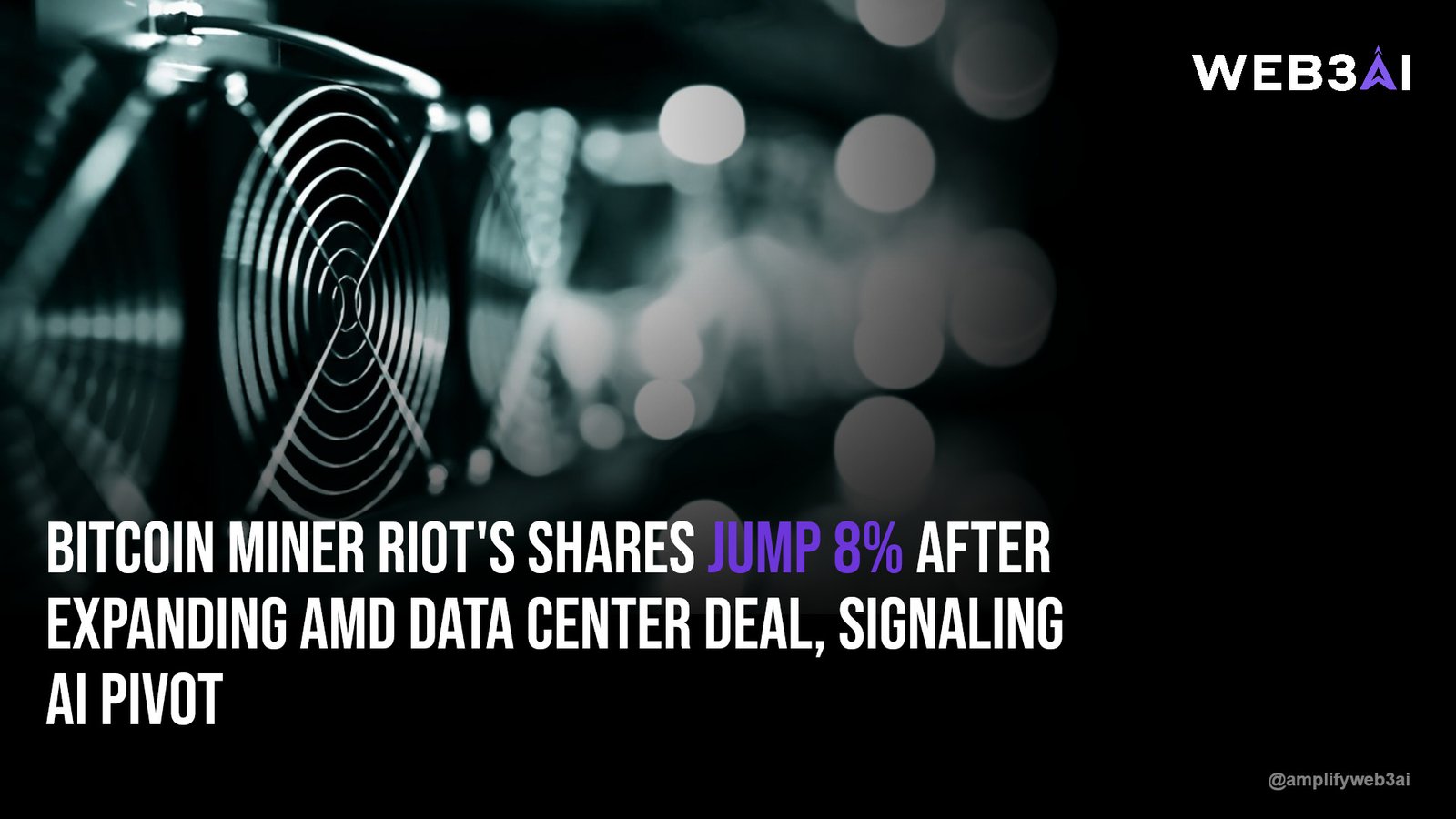

The Bitcoin miner AI data center pivot is no longer a fringe strategy — it is rapidly becoming the defining business model shift of 2025, and Riot Platforms just made that clearer than ever. On May 1, Riot’s shares surged approximately 8% after the company announced a significant expansion of its existing partnership with AMD, converting more of its vast power infrastructure into high-performance AI computing capacity. For investors and crypto watchers alike, this move is a signal worth paying close attention to.
This isn’t an isolated event. As Forbes reported in early 2025, a growing number of Bitcoin miners are redirecting their energy infrastructure toward AI and high-performance computing (HPC) workloads — and the market is rewarding them for it. The reasoning is straightforward: miners already own massive power contracts, cooling systems, and physical facilities. Plugging AI servers into that infrastructure is a natural — and highly lucrative — extension.
In this post, we break down exactly what Riot’s AMD deal expansion means, why the Bitcoin miner AI data center pivot trend is accelerating, and what it signals for the broader crypto and AI investment landscape in 2025.
Riot Platforms is one of the largest publicly traded Bitcoin miners in North America, known primarily for its massive facility in Rockdale, Texas. The company has been quietly building a second revenue stream through data center hosting — and its expanded deal with AMD takes that strategy to a new level. Under the expanded agreement, Riot will dedicate additional capacity at its facilities to supporting AMD-powered AI and HPC workloads.
The 8% single-day share jump that followed the announcement tells a story in itself. Markets have been watching miners closely for any sign that they can diversify beyond the volatile and increasingly competitive Bitcoin mining business. Riot’s AMD expansion was read as confirmation that the company has a credible, high-margin path forward that doesn’t depend entirely on Bitcoin’s price or block reward cycles.
This pivot is also strategically timed. With the Bitcoin halving having already compressed mining margins industry-wide in 2024, operators with the infrastructure to host AI workloads are finding a significantly more stable — and growing — revenue opportunity. Riot is betting that its power assets are worth more in service of AI than they are running ASICs around the clock.
The Bitcoin miner AI data center pivot trend didn’t start with Riot. Companies like Core Scientific, Hut 8, and CleanSpark have all announced similar moves in recent months, signaling that this is a structural industry shift rather than a one-off experiment. The underlying economics are compelling: AI data center demand is growing faster than new capacity can be built, while mining profitability has been squeezed by the halving and rising network difficulty.
Power infrastructure is the critical bottleneck for AI data centers. Getting grid connections, permits, and cooling systems in place can take years. Bitcoin miners, who spent the last decade solving exactly those problems, have a genuine head start. Their sites are essentially pre-built AI-ready campuses waiting for a GPU or accelerator upgrade.
Pro Tip: When evaluating Bitcoin miners as investments, look beyond their hashrate and Bitcoin treasury. Their power capacity (in megawatts) and existing infrastructure deals are now equally important signals of long-term value.
For a deeper look at how AI is transforming the infrastructure layer of Web3 and crypto-adjacent businesses, our guide to how AI is reshaping the Web3 landscape breaks down the convergence trends driving this shift across the industry.
AMD’s involvement is notable for reasons that go beyond the Riot deal itself. While Nvidia has dominated the AI accelerator market, AMD has been aggressively positioning its Instinct GPU line as a competitive alternative — and large enterprise customers are actively seeking supply chain diversification away from Nvidia’s constrained allocations. Riot’s facility effectively becomes a proving ground for AMD-powered AI infrastructure at scale.
For Riot, the AMD partnership provides something valuable beyond revenue: credibility. Being the infrastructure partner of a major semiconductor company legitimizes Riot’s pivot in the eyes of institutional investors who might otherwise view a Bitcoin miner’s AI ambitions skeptically. It also opens doors to future enterprise contracts from companies looking for AMD-compatible HPC hosting.
This type of deal structure — where a miner provides power, cooling, and physical space while a technology company brings the compute hardware and clients — is likely to become a standard template across the industry. It allows miners to generate revenue from their infrastructure without taking on the capital risk of purchasing expensive AI hardware themselves.
Pro Tip: Watch for Bitcoin miners that announce multi-year HPC hosting contracts — these deals lock in stable, non-cyclical revenue that the market tends to value at a significant premium over pure mining income.
Riot’s announcement puts immediate pressure on competing miners to articulate their own AI strategies. Companies that remain purely focused on Bitcoin mining now face a clear narrative disadvantage in capital markets: why should investors pay a premium for a business with cyclical, Bitcoin-correlated revenue when peers are locking in stable AI hosting contracts?
This dynamic is already playing out in valuations. Miners with credible AI pivots have been trading at significantly higher price-to-sales multiples than pure-play mining operations. The market is effectively pricing in a future where the most valuable Bitcoin mining companies are, in large part, AI infrastructure companies that also happen to mine Bitcoin.
For a broader perspective on where the Bitcoin mining industry is heading in 2025 and beyond, our analysis of Bitcoin mining industry trends covers the key forces reshaping this sector — from halving impacts to regulatory developments and energy market dynamics.
For investors, the Riot-AMD deal expansion is a useful template for evaluating miners with genuine AI pivot potential. Not every miner can make this shift successfully — it requires the right scale of power infrastructure, the right geographic location (low-cost power, reliable grid), and the operational expertise to manage enterprise-grade data center relationships. Riot has all three, which is why the market responded so strongly.
The AI infrastructure market itself benefits from this trend. Traditional data center REITs and hyperscalers like Microsoft and Google have struggled to build new capacity fast enough to meet exploding AI demand. Bitcoin miners stepping into that gap — with existing power contracts that took years to negotiate — represent genuinely new capacity rather than a reallocation of existing resources.
Here is what investors should look for when evaluating Bitcoin miners making the AI pivot:
To understand how the convergence of Web3 infrastructure and high-performance computing is creating entirely new categories of opportunity, our deep dive into Web3 and high-performance computing is essential reading for anyone following this space.
Stepping back, the Riot-AMD deal is a microcosm of a much larger transformation underway at the intersection of energy, computing, and finance. The companies that built the infrastructure to secure the Bitcoin network are now finding that infrastructure can serve an equally — and potentially more — important role in powering the AI revolution.
This creates a fascinating alignment of incentives. Miners need stable, non-correlated revenue. AI companies need power and physical infrastructure they can’t build fast enough. The match is almost elegant in its logic, and deals like the one Riot just expanded are likely to become far more common over the next 12 to 24 months.
A Bitcoin miner AI data center pivot refers to the strategic shift by Bitcoin mining companies to repurpose or expand their existing power and physical infrastructure to host AI and high-performance computing workloads. Rather than dedicating all capacity to mining Bitcoin, these companies rent out data center space to AI companies and semiconductor firms, creating a more diversified and stable revenue stream.
Riot’s share price jumped approximately 8% because the expanded AMD deal signals that the company has a credible, high-margin business beyond Bitcoin mining. Investors rewarded the news because AI data center hosting revenue is seen as more stable and less cyclical than mining income, which fluctuates with Bitcoin’s price and network difficulty. The AMD name also lends credibility to Riot’s pivot strategy.
Bitcoin miners have spent years building the exact infrastructure that AI data centers need: large-scale power contracts, advanced cooling systems, physical facilities, and grid connections. These are among the hardest and most time-consuming assets to acquire, giving miners a genuine competitive advantage over traditional data center developers. Their existing infrastructure allows them to bring new AI capacity online far faster than starting from scratch.
AMD is expanding its partnership with Riot to use Riot’s infrastructure for AMD-powered AI and high-performance computing workloads. AMD’s Instinct GPU line competes with Nvidia in the AI accelerator market, and partnering with established infrastructure operators like Riot helps AMD offer enterprise clients a complete solution. For Riot, the partnership provides stable revenue and high-profile validation of its AI pivot.
Not necessarily — miners like Riot are generally expanding into AI hosting alongside their existing mining operations rather than replacing mining entirely. However, some capacity that might otherwise have been used for additional mining is being redirected to AI workloads when the economics favor it. Over time, companies may optimize the balance between mining and hosting based on relative profitability.
Riot is not alone in this shift. Companies including Core Scientific, Hut 8, CleanSpark, and Marathon Digital have all signaled or announced moves toward AI and HPC hosting as part of their diversification strategies. The trend reflects a broader industry recognition that mining infrastructure has value far beyond Bitcoin production, particularly as AI compute demand continues to outpace available capacity globally.
The Bitcoin miner AI data center pivot is not a temporary trend driven by one company’s press release — it is a fundamental realignment of how the crypto mining industry creates value. Riot Platforms’ expanded AMD deal and the resulting 8% share jump are an early signal of how the market will reward miners who successfully execute this transition. The companies that own large-scale power infrastructure are sitting on assets that the AI industry desperately needs, and the smartest operators are moving quickly to unlock that value.
For anyone watching the intersection of crypto, AI, and infrastructure investing, this is one of the most important stories to follow in 2025. The lines between Bitcoin miner, AI infrastructure provider, and technology company are blurring — and that blurring is creating genuinely new categories of investment opportunity. Stay close to this space, because the deals being struck today are laying the foundation for the next generation of digital infrastructure.
Explore what we have built at attn.live.