Anouncement

Anouncement
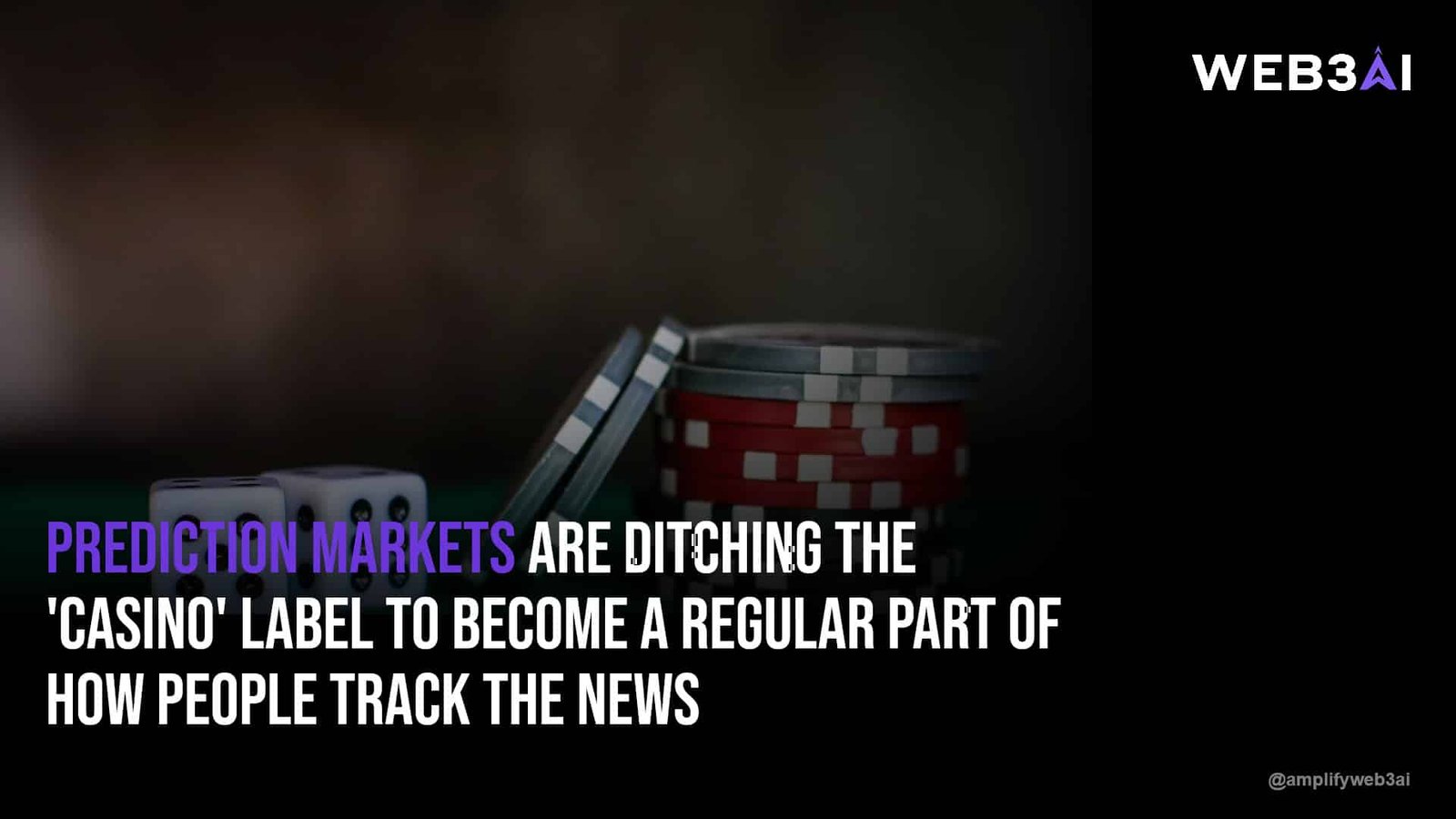

Prediction markets track the news in a way that no traditional headline can — by putting real money behind real beliefs, turning crowd sentiment into a living, breathing probability score. What started as a niche corner of crypto speculation is now becoming something far more interesting: a legitimate lens through which millions of people follow politics, economics, science, and global events. If you have ever felt frustrated by spin, bias, or 24-hour noise in the media, this shift is worth paying close attention to.
The transformation is not accidental. According to a Reuters report on prediction markets in 2024, platforms like Polymarket recorded over $3.6 billion in trading volume during the U.S. election cycle alone — a figure that would have seemed absurd just five years ago. The platforms are attracting not just crypto traders but journalists, policy analysts, academics, and everyday readers who want signal, not noise.
In this post, we break down exactly how prediction markets evolved from a casino label into a credible news-tracking tool, what that means for how you consume information, and what the Web3 ecosystem is building to make this shift permanent.
At their core, prediction markets are platforms where participants buy and sell contracts based on the likelihood of a future event. If you believe a bill will pass, a central bank will raise rates, or a particular verdict will land — you can express that belief with real money. The price of any contract at any given moment reflects the collective probability the crowd assigns to that outcome happening.
This is very different from a sportsbook. A sportsbook sets odds. A prediction market discovers them through the behavior of thousands of informed participants. The result is a data point that economists have long considered surprisingly accurate — especially for complex, multi-variable events where no single expert has the full picture.
Platforms like Polymarket, Kalshi, and Manifold Markets have all leaned into this distinction deliberately. They are not trying to compete with casinos. They are trying to compete with Reuters alerts and breaking-news push notifications — and in many cases, they are winning that race for accuracy.
Pro Tip: When a major news event is unfolding, check the relevant prediction market contract before reading op-eds. The price movement often tells you more about where the story is actually heading than any pundit’s take.
Traditional journalism tells you what happened. Prediction markets tell you what is likely to happen next — and they update in real time as new information enters the world. That is a fundamentally different information product, and it fills a gap that cable news, newspapers, and even high-quality newsletters have never been able to close.
Consider the 2024 U.S. presidential election. While major networks were still debating polling methodology and calling the race within a margin-of-error, Polymarket had already shifted dramatically toward one outcome days before election night. Traders were aggregating information — from local canvassing reports, fundraising data, early vote patterns — that no single journalist or anchor had synthesized. The market was, in effect, a giant collaborative intelligence machine running 24 hours a day.
This crowd-sourced accuracy has deep roots in economic theory. The concept of the “wisdom of crowds” holds that large groups of people with diverse information and genuine stakes in an outcome will often out-predict any individual expert. Prediction markets are that concept made operational, with money and on-chain transparency enforcing honesty in a way that no opinion poll can replicate.
For more on how decentralized platforms are reshaping how we understand events as they unfold, read our deep dive on how Polymarket is changing the way we understand world events.
For years, regulators, critics, and casual observers dismissed prediction markets as glorified gambling. And to be fair, early platforms gave them plenty of ammunition. Poorly designed markets with thin liquidity, anonymous participants, and no verification mechanisms really did look more like poker tables than policy tools. The rebranding happening right now is not just marketing — it is structural.
Kalshi became the first prediction market in the United States to receive full regulatory approval from the Commodity Futures Trading Commission (CFTC). That single approval changed the conversation dramatically. It meant that at least one platform had met the legal threshold for operating as a legitimate financial exchange — not a gambling operation. Other platforms are now following that regulatory roadmap.
On-chain platforms like Polymarket add a layer of transparency that traditional financial markets lack. Every position, every settlement, every price movement is publicly verifiable on the blockchain. There is no house edge hidden in the code, no back-room odds-setting. What you see is what the crowd collectively believes, recorded immutably on a public ledger.
No information tool is perfect, and prediction markets have real limitations worth naming honestly. The most significant is liquidity bias. Markets with low trading volume are easy to manipulate — a single large bet can move a price dramatically, sending a misleading signal to anyone reading it as ground truth. Thin markets on niche events can be gamed precisely because few participants are watching closely enough to correct the distortion.
There is also the question of who is in the market. Prediction markets work best when participants have genuine information advantages — domain expertise, local knowledge, proprietary data. When a market is dominated by retail speculators chasing momentum, the wisdom-of-crowds effect breaks down. The crowd becomes a mob, and the price reflects emotion rather than analysis.
Regulatory uncertainty also remains a live issue in many jurisdictions. U.S. consumers faced significant restrictions on political prediction markets for years, and the global patchwork of rules means that not everyone can access the same platforms. Until regulation stabilizes globally, the audience — and therefore the information quality — remains fragmented.
Pro Tip: Always check a prediction market’s total trading volume before using its price as a signal. A market with under $50,000 in open interest is far more susceptible to manipulation than one with millions. Volume is your quality filter.
Web3 tools are helping solve some of these problems by making market data more accessible and verifiable. See how the broader ecosystem is evolving in our overview of Web3 tools transforming the media industry.
The integration of prediction market data into mainstream news consumption is happening faster than most people realize. Several major newsrooms now monitor Polymarket and Kalshi alongside traditional wires as part of their real-time editorial workflow. When a contract price moves sharply, it is often a signal that something significant has entered the information ecosystem — even before a formal press release or official confirmation arrives.
For individual readers, the value is slightly different. Prediction markets offer a way to stress-test your own assumptions. If you are convinced a particular policy will fail, but the market is pricing it at 70% success, that gap is worth examining. Either the market knows something you do not, or you have spotted a genuine inefficiency. Either way, the exercise sharpens your thinking in a way that passively consuming headlines never will.
The intersection of AI and blockchain is making it even easier to verify the information underlying these markets. We explore that convergence in our piece on AI and blockchain as the future of information verification.
The trajectory is clear: prediction markets are moving from the periphery of the information economy to its core infrastructure. As regulatory frameworks mature, as on-chain transparency becomes table stakes, and as AI-powered tools make market data easier to interpret, these platforms will increasingly function as a real-time pulse on collective human belief about the world.
We are already seeing early-stage integration with AI summarization tools — products that monitor dozens of prediction market contracts simultaneously and surface the most significant probability shifts in a digestible format. Imagine a morning briefing that tells you not just what happened overnight, but what the most informed collective in the world thinks will happen next. That product is closer than most people realize.
Platforms like ATTN.LIVE and amplifyweb3.ai are built precisely for this convergence — combining Web3 transparency with AI-powered intelligence to help creators, journalists, and everyday users make sense of a world where the signal-to-noise ratio keeps declining. Prediction markets are one piece of that puzzle, and understanding how to read them is becoming a genuine media literacy skill for 2025 and beyond.
Prediction markets track the news by aggregating the financial stakes of thousands of participants, each of whom has a personal incentive to be accurate. Unlike polls, where respondents face no consequence for guessing wrong, market participants lose real money when they are mistaken. This financial accountability enforces a level of intellectual honesty that makes market prices reliably more accurate than expert panels or traditional surveys on many types of events.
The legal landscape has evolved significantly. Kalshi received full CFTC approval in 2023, establishing a regulated framework for event contracts in the U.S. Polymarket, while based outside the U.S., reached a settlement with the CFTC in 2022 over serving American customers without registration. The regulatory picture is stabilizing, but U.S. residents should verify what is currently permitted on any specific platform before participating.
Thin, low-volume markets are vulnerable to manipulation by large individual bets that move prices artificially. However, high-volume markets with many participants are significantly harder to manipulate because corrections happen quickly. On-chain platforms add an additional layer of transparency — every trade is publicly visible, making coordinated manipulation easier to detect and expose than in opaque, off-chain environments.
Prediction markets now cover a remarkably wide range of topics beyond politics, including central bank decisions, scientific milestone timelines, corporate earnings outcomes, sports results, and even entertainment awards. The same mechanics apply — crowd-sourced financial stakes produce probability estimates that update in real time as relevant information enters the public domain. This breadth makes them useful as a general-purpose news-tracking instrument, not just an election tool.
Polymarket is a decentralized platform built on the Polygon blockchain, allowing global participants to trade event contracts with cryptocurrency. Kalshi is a U.S.-regulated exchange operating under CFTC oversight, using dollars rather than crypto. Manifold Markets is a play-money platform designed more for community forecasting than financial gain. Each attracts a different participant profile, which is why comparing prices across all three can give a richer and more reliable signal than relying on any single platform alone.
Prediction markets track the news in a way that is structurally different from — and in many cases superior to — traditional media. By converting collective belief into transparent, real-time probability scores, they offer something headlines rarely can: an honest, financially-enforced consensus on what is actually likely to happen next. The casino label is fading, and in its place is something far more valuable — a new layer of the information infrastructure that rewards accuracy over attention.
The shift is not without its complications. Thin markets, regulatory patchwork, and liquidity imbalances are real challenges that the industry is still working through. But the direction of travel is unmistakable. Prediction markets are becoming a standard part of how informed people — journalists, analysts, policymakers, and curious readers — make sense of a complex world. Learning to read them well is one of the most practical media literacy skills you can develop right now.
Explore what we have built at attn.live.