Anouncement

Anouncement
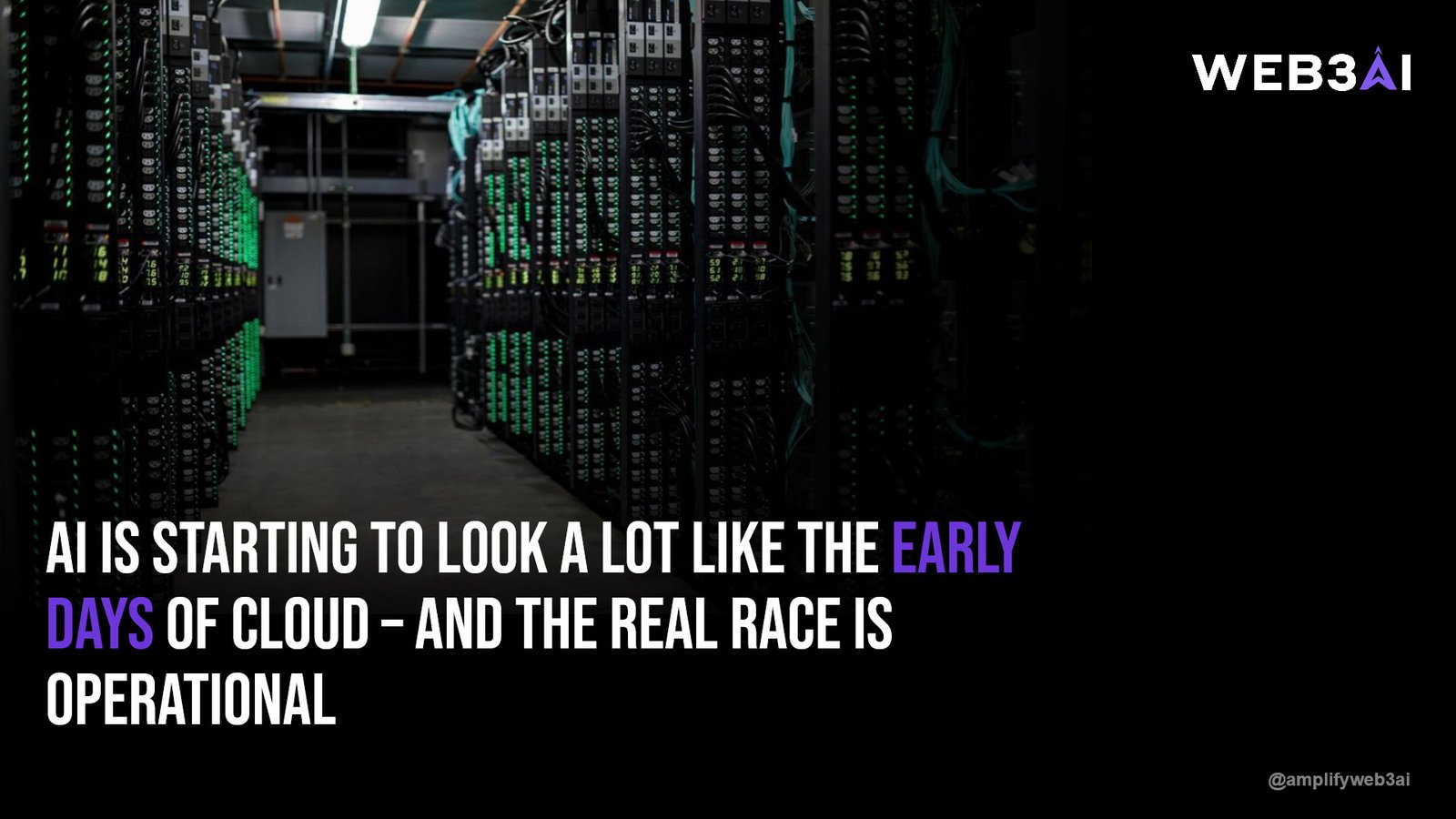

A winning AI operational transformation strategy is no longer optional for enterprises — it is the defining competitive advantage of 2025. Much like cloud computing in its early days, AI has moved through the breathless experimentation phase and arrived at a more demanding question: can your organization actually run this at scale? The honeymoon of proof-of-concept projects is ending, and what replaces it is a rigorous, unglamorous, and genuinely exciting operational challenge.
According to McKinsey’s State of AI report, while AI adoption has advanced significantly across industries, scaling AI from isolated pilots to enterprise-wide operations remains one of the most persistent and costly challenges organizations face today. The gap between “we ran a successful pilot” and “this is embedded in how we work” is where most AI investments stall — and where the real race is now being run.
This post unpacks why the AI-to-cloud analogy is so instructive, what the operational maturity curve actually looks like, and how forward-thinking teams are building strategies that survive contact with reality.
Cast your mind back to 2009 or 2010. Cloud computing was the headline technology, and every enterprise CTO was being asked the same question: “Are you in the cloud yet?” Early adopters ran pilots, spun up test environments, and declared victory. Then the harder work began — governance, security, cost management, integration with legacy systems, and retraining entire IT departments. Sound familiar?
AI in 2025 is tracking almost the same arc. Organizations rushed to deploy large language models, build chatbots, and automate isolated workflows. Now the board wants to know what the return is, the compliance team wants to know where the data goes, and the operations team wants to know who is responsible when the model gets it wrong. These are not AI problems — they are organizational maturity problems wearing an AI costume.
The companies that won the cloud era were not the ones with the most impressive demos. They were the ones that invested in cloud-native culture, governance frameworks, and operational muscle. The same logic applies directly to AI today. The technology is largely commoditized at the model layer; the differentiation is entirely operational.
Pro Tip: Stop measuring AI success by the number of pilots you launch. Start measuring by the number of pilots that graduate into permanent, governed, production-grade systems. That ratio tells you everything about your operational maturity.
For a closer look at how intelligent systems are already reshaping day-to-day business workflows, explore how AI agents are transforming business operations — a deep dive into the practical mechanics driving this shift.
Not every organization is at the same point on the curve, and that is completely normal. What matters is having an honest diagnosis of where you are — and a clear-eyed view of what the next stage actually requires. Most enterprises today sit somewhere between stage one and stage two, often believing they are further along than they are.
Stage 1 — Experimentation: Individual teams run AI pilots with minimal coordination. Success is measured by demo quality, not business impact. There is little governance, no unified data strategy, and AI is largely a skunkworks activity. This stage feels exciting but creates technical debt and misaligned expectations fast.
Stage 2 — Integration: AI begins connecting to core business processes. Dedicated AI teams emerge, basic governance frameworks are established, and there is a conscious effort to connect model outputs to measurable business outcomes. This is where most leading enterprises sit in 2025 — and where the cloud analogy becomes most instructive.
Stage 3 — Operational Embedding: AI is not a project; it is an infrastructure layer. Models are monitored like production systems, retraining cycles are automated, and every team has AI embedded in its core workflows. Governance is proactive, not reactive. This is where the competitive advantages compound — and where the gap between leaders and laggards becomes very difficult to close.
Reaching stage three requires more than technology investment. It demands a deliberate AI operational transformation strategy that treats people, processes, and platforms as equally important variables. The organizations getting this right share a handful of consistent practices that are worth examining in detail.
First, they appoint dedicated AI operations ownership — not just an AI ethics committee or a center of excellence, but people whose explicit job is to run AI in production. This includes model performance monitoring, incident response, bias auditing, and version control. It mirrors the DevOps function that made cloud deployments reliable, and it is equally non-negotiable.
Second, they build feedback loops from day one. Every deployed model needs a mechanism to capture when it fails, when users override it, and when outputs diverge from expected patterns. Without this, models drift silently — a problem that is nearly invisible until it becomes very expensive. Cloud teams learned this lesson with infrastructure costs; AI teams are learning it with model quality.
Third, they standardize their data infrastructure before expanding their model portfolio. A sprawling set of AI tools built on inconsistent, ungoverned data is a liability — not an asset. The most operationally mature organizations treat their data layer as the foundation and their AI capabilities as the structure built on top of it.
Pro Tip: Before deploying your next AI model, ask: “Do we have the data infrastructure to monitor this in production for 18 months?” If the answer is no, fix the foundation first. Operational failure almost always traces back to data quality, not model quality.
One of the most underestimated elements of any AI operational transformation strategy is the workforce dimension. Technology leaders often focus on model selection and infrastructure, while the real friction accumulates in the people layer. Employees who distrust AI outputs, managers who do not understand what the models are doing, and teams with no training on AI limitations are the most common reason operational deployments fail.
Effective AI transformation programs invest as heavily in change management as in technology. This means clear communication about what AI will and will not do, structured upskilling programs, and — critically — genuine involvement of frontline workers in shaping how AI tools are used in their workflows. The organizations that get this right find that employee trust accelerates adoption; the ones that skip it find that resistance quietly undermines ROI.
For a broader view of how these workforce and technology trends are converging, the analysis on the future of AI in business and the key trends shaping 2025 provides essential context for any team building a long-term strategy.
Ask any enterprise AI team what keeps them up at night, and governance comes up in the first three answers. Regulatory scrutiny of AI systems is intensifying globally — from the EU AI Act to emerging frameworks in the United States and Asia-Pacific. Organizations without proactive governance structures are not just taking on ethical risk; they are taking on legal and reputational risk that can materialize very quickly.
Operational AI governance is not a one-time audit. It is an ongoing function that tracks model behavior, documents decision logic, maintains audit trails, and ensures that AI outputs can be explained to regulators, customers, and internal stakeholders. The organizations that build this muscle early will find it becomes a competitive differentiator — especially in regulated industries like finance, healthcare, and insurance.
The intersection of AI governance and decentralized technology also opens genuinely new possibilities for auditability and transparency — a theme explored in depth in the discussion of how Web3 and AI convergence is reshaping entire industries. The combination of immutable audit trails and intelligent automation may become a core governance tool for AI-heavy organizations.
The organizations pulling ahead on AI are not necessarily the ones with the biggest model budgets or the most publicized AI strategies. They are the ones that have quietly built operational infrastructure that makes AI reliable, governable, and continuously improving. They treat AI deployment like a product lifecycle, not a project milestone.
Winning in this era looks like a financial services firm that can deploy a new credit-scoring model, monitor it in production, detect drift within 48 hours, retrain it automatically, and provide a full audit trail to regulators — all without a fire drill. It looks like a healthcare system where AI-assisted diagnostics are embedded in clinical workflows with clear human override protocols and documented performance benchmarks. It looks, in other words, like operational maturity applied to a very powerful technology.
The race is not who can say “we use AI.” The race is who can say “our AI works reliably, at scale, within governed parameters, and we can prove it.” That is a much harder race to win — and a much more durable one to lead.
An AI operational transformation strategy is a structured approach to embedding AI into core business operations in a reliable, governed, and scalable way. It goes beyond running experiments or pilots and focuses on making AI a durable part of how an organization works day-to-day. It includes technology infrastructure, data governance, change management, and ongoing model monitoring.
A standard AI strategy often focuses on which use cases to pursue and which models to adopt. An AI operational transformation strategy focuses on how to run those models reliably in production over time. It is the difference between planning a deployment and operating one — and the operational layer is where most AI investments either succeed or quietly fail.
Both technologies followed a similar adoption curve: initial excitement, rapid experimentation, and then a maturity phase where governance, operational discipline, and integration with existing systems became the real differentiators. The companies that won the cloud era were those that built operational muscle, not just those that adopted early. The same dynamic is now playing out with AI.
The most significant risks include model drift (where performance degrades silently over time), inadequate governance frameworks that create regulatory exposure, workforce resistance that undermines adoption, and data infrastructure gaps that make models unreliable at scale. Most of these risks are organizational rather than purely technical, which is why change management is as important as technology investment.
Key metrics include the ratio of pilots that graduate to production systems, model uptime and performance consistency, time-to-detect and time-to-resolve model drift incidents, employee adoption rates in AI-embedded workflows, and measurable business outcomes tied directly to AI deployments. Governance metrics — such as audit trail completeness and regulatory readiness scores — are becoming equally important benchmarks in 2025.
The AI operational transformation strategy conversation is no longer a future planning exercise — it is the present competitive reality for every organization that has already made meaningful AI investments. The experimentation phase delivered valuable lessons. The operational phase is where those lessons either compound into durable advantage or get quietly written off as sunk costs. The cloud analogy is instructive precisely because we know how that story ended: the winners were not the boldest experimenters, they were the most disciplined operators.
Building operational maturity around AI requires honest self-assessment, investment in governance and infrastructure, genuine commitment to workforce enablement, and the patience to treat AI like the production system it is — not the pilot project it started as. The organizations doing this well in 2025 are building moats that will be very difficult for late movers to cross.
The real race has always been operational. Now the whole industry knows it. Explore what we have built at attn.live.