Anouncement

Anouncement

For decades, software has been designed to follow instructions. A program waits for a user, receives an input, processes data, and produces an output. But a new generation of artificial intelligence is changing that model.

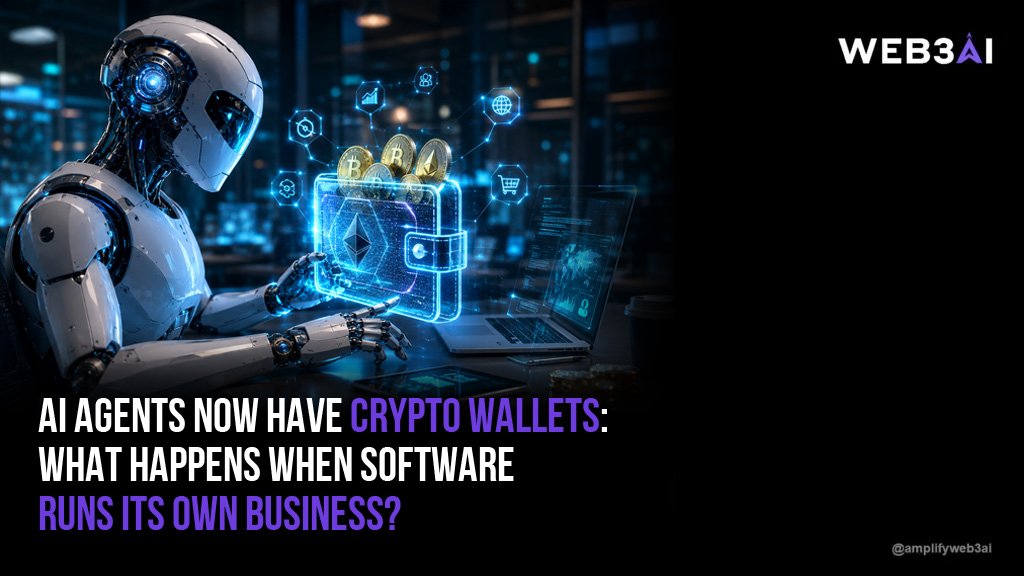
AI agents are no longer just chatbots that answer questions. They are becoming autonomous digital workers capable of making decisions, completing tasks, interacting with online systems, and managing resources. The next major evolution? Some AI agents are beginning to control their own crypto wallets.
This development creates a fascinating question:
What happens when software can earn, spend, negotiate, and operate its own business?
The combination of artificial intelligence and blockchain technology could create a new economic system where autonomous agents participate in markets alongside humans. AI agents may hire services, pay for computing power, purchase digital assets, manage investments, and even generate revenue.
The future of business might not only belong to humans and companies — it may also belong to intelligent software entities.
Before exploring AI agents with crypto wallets, it is important to understand what an AI agent actually is.
Traditional AI tools usually respond when prompted. For example:
AI agents go further.
An AI agent can:
Think of an AI agent as a digital employee.
Instead of asking an AI every step of the process, you could give it a mission:
“Find profitable market opportunities, analyze data, and create a report.”
The agent could research, evaluate information, use software tools, and deliver results.
Now imagine that same AI agent has access to a wallet.
It can potentially pay for services, receive income, and manage transactions.
That changes everything.
A crypto wallet gives AI agents something traditional software does not have:
financial autonomy.
Normally, software depends on humans or companies to handle payments.
For example:
But an AI agent with a wallet could potentially manage its own economic activity.
It could:
Blockchain technology allows digital transactions to happen without requiring a traditional bank account or human approval for every action.
This creates the possibility of software becoming an independent economic participant.
The idea of a machine economy has existed for years.
In the future, we may see millions of AI agents interacting with each other:
Instead of humans coordinating every transaction, AI systems could negotiate and exchange value automatically.
For example:
An AI business assistant needs better graphics for a campaign.
It searches for another AI agent specializing in design.
They negotiate:
“Create 100 images for this project. Payment: 0.05 ETH.”
The design agent completes the task.
Payment is automatically transferred.
No invoices.
No waiting.
No human approval.
This is the foundation of an AI-powered digital economy.
The biggest shift is that AI agents could move from being tools to becoming operators.
Today:
Human → Uses AI → Gets Result
Future:
Human → Gives Goal → AI Agent Runs Operations
A person could create an AI agent and assign it a business objective:
“Build a profitable online store.”
The AI agent could:
With access to a crypto wallet, it could also handle payments.
This does not mean AI suddenly becomes a legal company. Regulations and ownership questions remain complicated.
However, from a technological perspective, AI agents could function like independent digital businesses.
Web3 technologies provide several features that make autonomous AI systems more practical.
Traditional financial systems often require:
Blockchain networks allow digital wallets to send and receive payments globally.
This makes them attractive for autonomous software.
Smart contracts are programs that automatically execute agreements.
For example:
An AI agent completes a task.
A smart contract verifies completion.
Payment is released automatically.
This creates trust between machines.
Blockchain allows ownership of digital assets.
AI agents could potentially manage:
This creates new possibilities for AI-powered businesses.
The combination of AI agents and crypto wallets could unlock major opportunities.
Entrepreneurs may create AI-powered companies that operate 24/7.
A single person could manage multiple AI agents performing different roles:
Small teams could compete with much larger companies.
AI agents do not sleep, take vacations, or operate only during business hours.
They can provide services globally.
A small business owner could access powerful AI workers without hiring a large team.
Entirely new industries may appear:
Just as websites created new businesses in the internet era, AI agents may create new economic models.
While the possibilities are exciting, autonomous AI businesses also create serious challenges.
A wallet controlled by an AI agent creates a new target for attackers.
Questions arise:
Security will become critical.
If an AI agent makes a harmful decision, who is responsible?
The developer?
The owner?
The company using the AI?
Legal frameworks will need to evolve.
AI systems are powerful but not perfect.
An AI agent managing money could:
Financial autonomy requires strong safeguards.
This is one of the most interesting questions.
A company traditionally requires:
AI agents challenge these definitions.
Imagine a future where:
A person creates an AI agent.
The agent launches a product.
It earns cryptocurrency.
It pays other AI agents.
It improves itself.
It grows revenue.
Is it a business?
Technically, it may operate like one.
Legally, society is still figuring out what that means.
The rise of AI agents with wallets does not necessarily mean humans become irrelevant.
The most likely future is collaboration.
Humans provide:
AI agents provide:
The strongest businesses may be human-led organizations powered by networks of autonomous AI workers.
As AI agents become more capable, one major question emerges:
Who benefits from this new economy?
Will AI automation create opportunities for everyone?
Or will only large corporations control powerful AI systems?
The answer may depend on accessibility.
If individuals can create, own, and deploy AI agents, then AI could become a powerful tool for entrepreneurs worldwide.
If control becomes concentrated, AI could increase existing inequalities.
The future of AI and crypto will not only be about technology.
It will also be about ownership, access, and fairness.
AI agents with crypto wallets represent a major shift in how we think about software.
Software is moving from being something that simply executes commands into something that can participate in economic activity.
The idea of software running its own business may sound like science fiction, but the building blocks already exist:
The next generation of the internet may not only be built by humans.
It may also be operated by intelligent digital agents working alongside us.
The question is no longer:
“Can AI do tasks?”
The bigger question is:
What happens when AI can create value, manage money, and participate in the economy itself?
The answer could define the next era of technology.