Anouncement

Anouncement
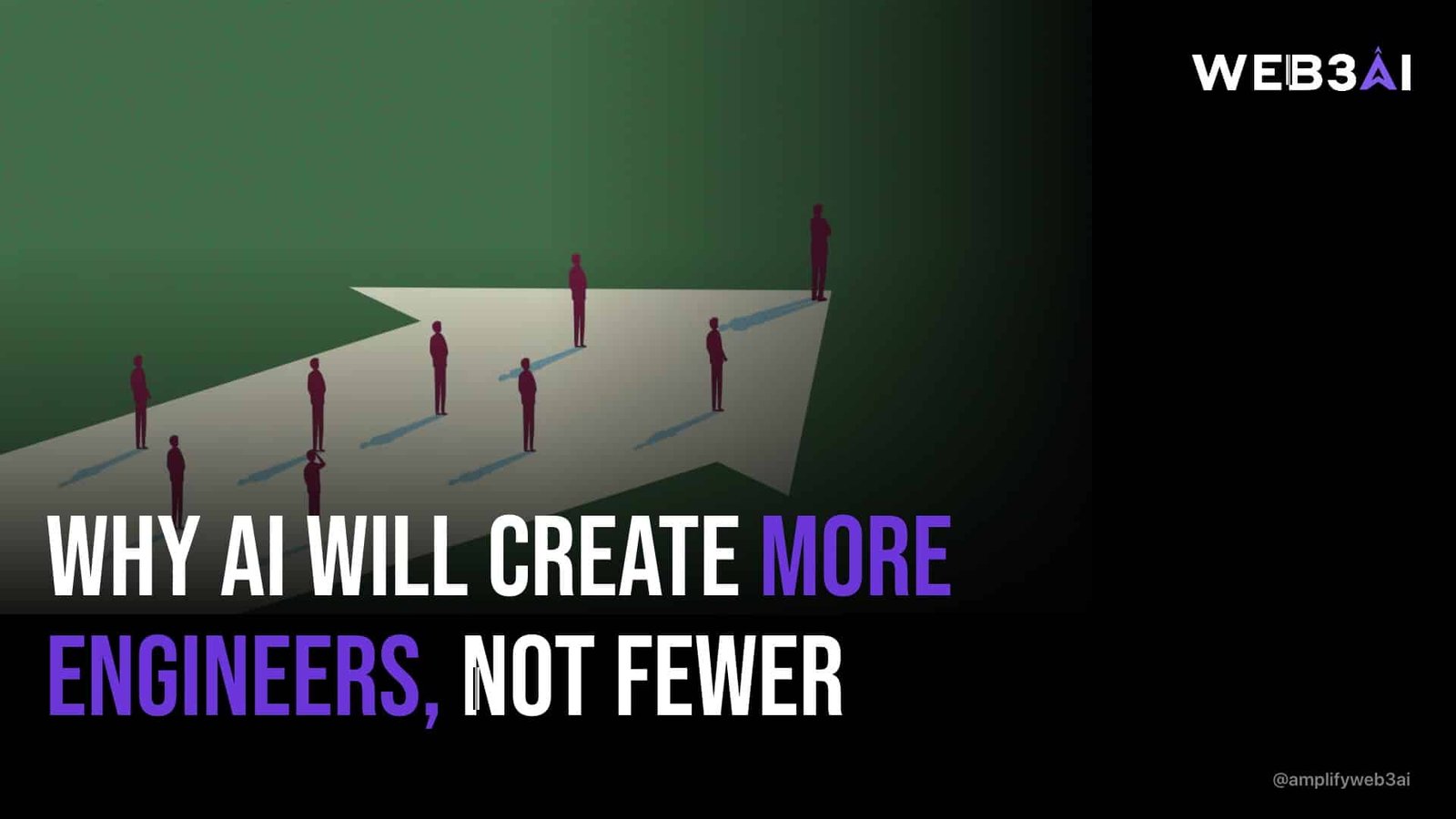

The fear that AI will create more engineers sounds counterintuitive — most headlines warn that artificial intelligence is coming for technical jobs, automating code, and rendering developers obsolete. But a growing body of evidence points in the exact opposite direction: AI tools are dramatically lowering the barriers to engineering, pulling millions of people into the field who never would have entered it before. Far from shrinking the profession, AI is quietly expanding it.
This isn’t wishful thinking. Research from McKinsey’s analysis of generative AI’s economic potential shows that while AI will automate specific tasks, it simultaneously creates enormous demand for workers who can design, deploy, direct, and maintain AI-powered systems. The net effect across engineering disciplines is expected to be strongly positive. In other words, the technology that some fear will replace engineers is, in practice, recruiting engineers.
In this post, we’ll unpack why the “AI kills jobs” narrative misses the bigger picture, what historical precedent tells us, and how you can position yourself — or your organization — to thrive in a world where engineering is becoming more accessible, not less relevant.
Every major technological leap in history has triggered the same fear: that new tools would eliminate the workers who depended on older ones. The printing press was supposed to put scribes out of work. Spreadsheets were going to make accountants redundant. CAD software was meant to render draftspeople unnecessary. In every case, the opposite happened — the tools made practitioners more productive, which expanded demand and grew the profession.
AI-assisted coding tools like GitHub Copilot, Cursor, and Claude follow the same pattern. When a junior developer can produce in one hour what once took a full day, the economics of software projects shift dramatically. Suddenly, projects that were once too expensive to build become feasible. Products that required a team of ten can be built by a team of three — which means more products get built, and more engineers get hired to build them.
This is what economists call the productivity-demand paradox: when a tool makes a skilled worker significantly more productive, it doesn’t eliminate demand for that skill — it expands the market for it. AI is doing exactly this for software engineering right now, in real time.
Pro Tip: If you’re worried AI will make your engineering skills obsolete, focus on moving up the value chain — learn to direct AI tools strategically, not just use them mechanically. The engineers who will thrive are those who understand what to build, not just how to build it.
One of the most underappreciated effects of AI coding tools is how dramatically they lower the cost and difficulty of learning to build software. A teenager in a small town with no access to a computer science teacher can now open a browser, describe what they want to build, and get working code explained line by line. That’s a fundamentally different world than the one that existed five years ago.
AI doesn’t just help experienced engineers — it acts as a patient, always-available tutor for people who are just starting out. Tools like ChatGPT, Claude, and Gemini can explain error messages in plain English, suggest fixes, and walk beginners through concepts at whatever pace they need. The learning curve for software development has flattened significantly, and that means the pool of people who can call themselves engineers is growing fast.
We’ve explored how this kind of transformation plays out at the organizational level in our post on how AI agents are transforming the way we work — the same forces reshaping productivity inside companies are reshaping who gets to participate in technical fields in the first place.
A new phrase has entered the tech lexicon: “vibe coding.” It describes a style of development where someone with limited formal training uses AI tools to build functional software by describing what they want in plain language and iterating quickly on the results. Critics dismiss it as amateurish. But many “vibe coders” are landing real jobs, shipping real products, and learning real engineering principles along the way.
This matters because it represents a new on-ramp into the profession — one that didn’t exist before. Traditional pathways into software engineering required either a four-year computer science degree, an expensive bootcamp, or years of self-directed study. AI tools are creating a third path: build something real, learn from the process, and grow into a professional engineer organically. It’s messy, but it works.
What this means for the engineering talent pipeline is significant. Companies that once competed for a narrow pool of CS graduates are now discovering strong candidates who taught themselves using AI tools. The definition of “engineer” is broadening — and that’s a good thing for innovation, diversity, and the pace of product development.
Pro Tip: If you’re hiring engineers, reconsider credential-first screening. Some of the most capable developers entering the workforce right now learned their craft through AI-assisted building, not formal education. Skill-based assessments will serve you better than degree requirements.
At its core, engineering is about solving problems. Writing code is just one tool in that process — and it has always been one of the easier parts to teach. The harder parts are understanding what problem actually needs solving, designing systems that won’t fail at scale, communicating with stakeholders, making tradeoffs under uncertainty, and knowing when a technically elegant solution is the wrong business decision.
AI tools are extraordinarily good at generating code for well-specified problems. They are considerably less good at figuring out what the right problem is in the first place. That judgment — contextual, human, and deeply tied to understanding the real world — is what senior engineers spend most of their time doing. AI doesn’t eliminate that need. It amplifies its importance.
The future belongs to engineers who can use AI as a force multiplier: generating boilerplate quickly, testing edge cases automatically, and reviewing documentation instantly — while reserving their human judgment for the decisions that actually matter. We dig into these broader trends in our look at the future of AI in business, where the theme is consistent: AI augments human decision-making rather than replacing it.
If AI will create more engineers, which sectors will absorb them? The answer is: almost all of them. Every major industry is in the middle of a software-driven transformation, and the pace of that transformation is accelerating because AI tools make it cheaper and faster to build. Healthcare, agriculture, manufacturing, logistics, education, and financial services are all racing to digitize operations and build AI-native products.
Here are the sectors where engineering demand is growing fastest:
Across all of these sectors, the common thread is that software is becoming the core operating layer — and someone has to build, maintain, and evolve it. That someone is an engineer.
Whether you’re an experienced developer adapting to new tools, a career-changer considering a move into tech, or a student deciding what to study, the AI-era engineering landscape rewards a specific set of skills and mindsets. Here’s a practical framework for positioning yourself well:
The weight of historical evidence and current data suggests that AI will create more engineers than it displaces. While specific tasks — like writing boilerplate code or generating unit tests — are being automated, the demand for engineers who can design, deploy, and direct AI systems is growing faster than those tasks disappear. The net effect on engineering employment is expected to be strongly positive over the next decade.
AI tools act as always-available tutors and coding assistants that can explain concepts, debug errors, and generate working code from plain-language descriptions. This dramatically lowers the learning curve for people entering the field, making it possible to build real software without years of formal training first. It doesn’t eliminate the need to learn — but it makes the learning process faster and more accessible.
The skills that matter most in an AI-augmented engineering environment are systems thinking, domain expertise, and the ability to communicate precisely with both humans and AI tools. Writing code from scratch will matter less; understanding what to build, why it matters, and how the pieces fit together will matter more. Judgment, context, and problem framing are becoming the core of the engineering value proposition.
Increasingly, yes — though it works best when combined with deliberate learning alongside the building process. Engineers who start by using AI to build real projects and learn from the experience are developing genuine skills. The key is to treat AI-assisted building as a learning accelerator, not a shortcut that replaces understanding the fundamentals of how software actually works.
Healthcare technology, clean energy, financial services, agriculture, and Web3 infrastructure are among the fastest-growing sectors for engineering talent. In each case, AI is accelerating the pace of software development in that industry, which increases demand for engineers who understand both the technology and the domain. The best opportunities will go to engineers who combine software skills with deep industry knowledge.
The case that AI will create more engineers, not fewer, is grounded in economics, history, and the observable behavior of the technology right now. AI tools are lowering entry barriers, expanding the definition of who can be an engineer, amplifying the productivity of experienced practitioners, and igniting software development in industries that have barely started their digital transformation. The profession isn’t shrinking — it’s opening up.
For individuals, this is an invitation. The tools have never been more accessible, the demand for technical talent has never been broader, and the pathways into engineering have never been more varied. For organizations, it’s a signal to rethink how you hire, train, and develop technical talent. And for all of us watching AI reshape the economy, it’s a reminder that the most important question isn’t “what will AI take away?” — it’s “what does AI make possible?”
Explore what we have built at attn.live.