Anouncement

Anouncement
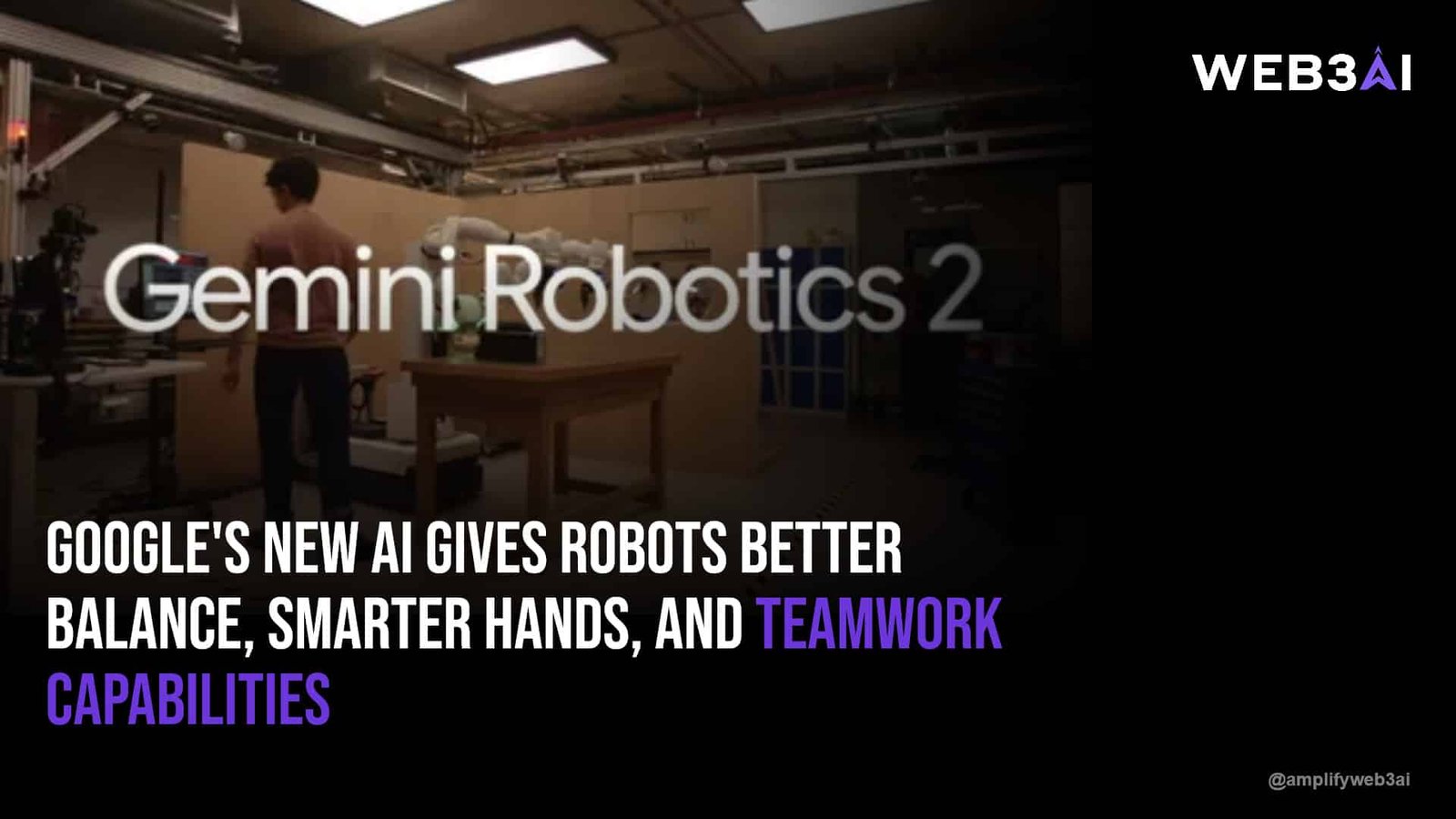

AI robot balance and dexterity have quietly become the two biggest bottlenecks holding humanoid robotics back from real-world use. For years, robots could lift, push, and roll — but ask them to catch a falling object or walk across uneven ground, and things fell apart fast. Literally.
Google’s latest robotics AI models are changing that story. According to TechCrunch’s coverage of Google DeepMind’s Gemini Robotics announcement, the new system gives robots dramatically improved spatial reasoning, finer motor control, and — perhaps most surprisingly — the ability to coordinate tasks with other robots in real time. That last part sounds a lot like teamwork, and it’s a genuine leap forward.
If you’ve ever watched a robot arm fumble a simple grasp or a warehouse bot freeze up on a ramp, you know the frustration this technology is aiming to solve. This post breaks down what Google actually built, why AI robot balance and dexterity matter so much right now, and what it means for the businesses and developers watching this space closely.
Balance and dexterity aren’t flashy specs, but they’re the foundation everything else depends on. A robot that can’t stay upright on a factory floor is useless no matter how smart its “brain” is. Likewise, a robot that can walk fine but can’t pick up an irregularly shaped object is stuck doing a fraction of the jobs humans do effortlessly.
Google’s approach tackles both problems using the same underlying AI model family that powers its Gemini language systems. Instead of hand-coding rules for every possible movement, the robots learn generalized physical reasoning — essentially predicting how objects and their own bodies will behave in space. That’s a meaningful shift from older robotics approaches built on rigid, pre-programmed motion paths.
Pro Tip: When evaluating any robotics AI claim, ask whether the improvement is in perception, control, or planning. Google’s update touches all three, which is why it’s getting so much attention.
The dexterity improvements are arguably the most visually striking part of this update. Robots equipped with the new models can now handle tasks like sorting small objects, manipulating deformable materials, and adjusting grip strength on the fly — all without needing task-specific retraining.
This kind of adaptability has been a long-standing challenge in robotics. Similar to how AI is powering the next generation of automation across manufacturing and logistics, these dexterity gains suggest robots may soon handle far more nuanced physical tasks than the repetitive, single-purpose actions we’re used to seeing on assembly lines.
What makes this notable isn’t just the mechanical skill — it’s the underlying reasoning. The AI model appears to understand object properties, not just movement patterns. That distinction matters when a robot has to figure out, in real time, whether something is fragile, heavy, or slippery.
Balance might sound like a simpler problem than dexterity, but it’s arguably harder to solve because it requires constant, split-second adjustment. Google’s new models reportedly improve how robots predict shifts in their own center of gravity, which matters enormously for anything walking on legs rather than rolling on wheels.
This is where AI robot balance and dexterity intersect most clearly. A robot with excellent hand control but poor balance still can’t function reliably in unpredictable environments like warehouses, outdoor terrain, or disaster zones. Google’s update appears to treat these two capabilities as parts of one unified physical intelligence system, rather than separate engineering problems.
Perhaps the most forward-looking part of this announcement is multi-robot coordination. Google’s models allow multiple robots to share situational awareness and divide tasks without a human manually assigning each step. Think of it less like remote-controlled machines and more like a small team silently agreeing on who does what.
This kind of coordination echoes concepts covered in The Beginner’s Guide to Understanding AI Agents, where independent AI systems negotiate and collaborate toward shared goals. Applying that same agentic logic to physical robots is a natural — if ambitious — next step.
In practical terms, this could mean warehouse robots dynamically redistributing workload when one unit gets backed up, or delivery robots rerouting around each other without a central dispatcher. It’s early, but the direction is clear.
For companies evaluating robotics investments, this update signals that general-purpose physical AI is getting closer to commercial viability. Instead of buying single-task robots, businesses may soon deploy adaptable systems trained on broad physical reasoning models.
Tools built around this shift are already emerging. Our recent roundup of top AI tools changing business operations in 2025 highlights several platforms exploring similar generalized-intelligence approaches, even outside pure robotics.
Pro Tip: If you’re researching robotics AI for your business, prioritize vendors demonstrating cross-task generalization over those showcasing a single impressive demo.
Even if your business isn’t deploying humanoid robots tomorrow, these advances hint at where automation is headed. Preparing now can save significant retraining costs later.
Companies that start experimenting early tend to adapt faster once the technology matures and pricing becomes more accessible.
AI robot balance and dexterity refer to a robot’s ability to stay physically stable while performing fine motor tasks like grasping, manipulating, or adjusting objects. Google’s new models improve both simultaneously using shared physical reasoning AI.
The model uses learned physical reasoning instead of pre-programmed motion paths, letting robots adapt grip and movement in real time. This allows handling of irregular or fragile objects without task-specific retraining.
Better balance and dexterity mean robots can operate reliably in unpredictable, real-world environments like warehouses or outdoor sites. This expands where and how businesses can safely deploy automation.
Yes, Google’s models include multi-robot coordination features that let machines share awareness and divide tasks without constant human direction. This works similarly to how AI agents negotiate tasks in software systems.
Google has not announced a specific commercial rollout timeline, but early access and research partnerships are typically the first stage before broader availability. Businesses should monitor official Google DeepMind announcements for updates.
AI robot balance and dexterity are no longer separate engineering puzzles — Google’s latest models treat them as one connected system, alongside a genuinely new capability: robot-to-robot teamwork. Together, these advances push physical AI closer to the adaptability we’ve long seen in language models.
Whether you’re tracking robotics for your industry or just curious where AI is headed next, this update is worth watching closely. Explore what we have built at attn.live.