Anouncement

Anouncement
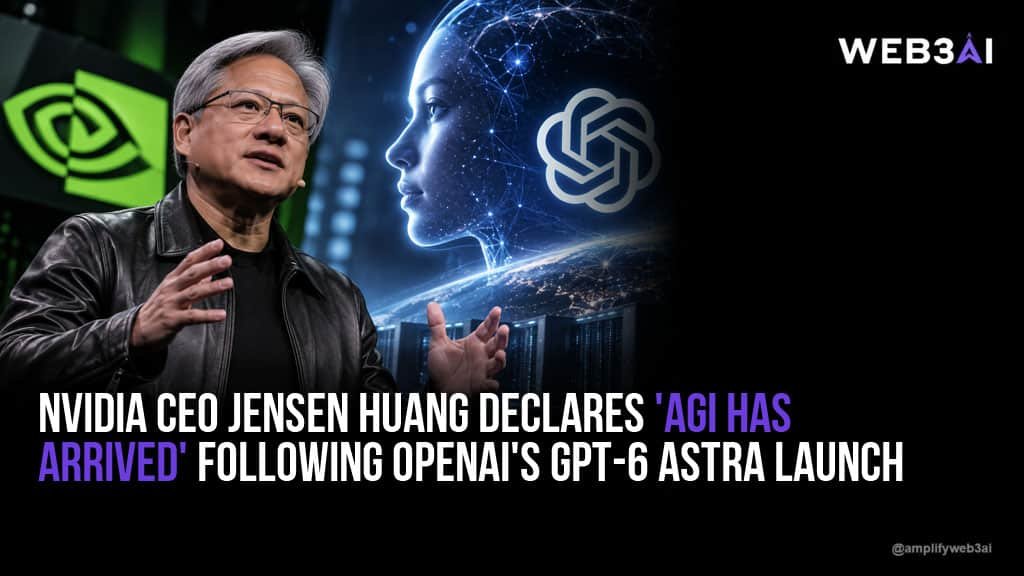

SAN JOSE, Calif. — Artificial General Intelligence (AGI) is no longer a distant theoretical milestone—it is officially here, according to Nvidia Chief Executive Officer Jensen Huang.
In a landmark statement posted on X, Huang declared that the AI industry has reached the long-awaited threshold of human-level machine intelligence following OpenAI’s release of its flagship model, GPT-6 Astra.
“GPT-6 Astra, trained on ~100K+ NVIDIA Grace Blackwell NVLink72. From ChatGPT to o1 to Astra in 4 years. AGI has arrived. Congratulations @OpenAI team. 400K GPUs coming online next,” Huang wrote.
The declaration marks a defining moment for the tech sector, coming just four years after OpenAI ignited the modern generative AI era with ChatGPT.
At the core of Huang’s announcement is the staggering compute infrastructure required to bring GPT-6 Astra to life. OpenAI’s latest frontier model was trained on an estimated 100,000 Nvidia Grace Blackwell NVLink72 systems—an architecture that links 72 GPUs into a single massive unified computing platform.
Furthermore, Huang signaled that the hardware expansion is far from over, revealing that another 400,000 Nvidia GPUs are scheduled to come online shortly to power the next phase of deployment and inference.
While previous generations focused on conversational interface and reasoning steps, OpenAI describes GPT-6 Astra as its most intelligent, autonomous, and aligned system to date. The model demonstrates unprecedented capabilities across several domains:
While tech leaders and market analysts celebrated the news, Huang’s bold declaration has reignited debate within the scientific community regarding what truly constitutes Artificial General Intelligence.
OpenAI executives offered measured agreement. OpenAI President Greg Brockman echoed the sentiment on social media, writing: “We’re now moving into the AGI era… I think that if we fast-forward a couple of years, when we look back and say, ‘When was it really that AGI was created?’ I think it’s going to be about this time, and I think it might be about this model.”
However, critics and skeptical AI researchers urge caution. Detractors argue that without a universally accepted operational definition or benchmark for AGI, declaring victory risks conflating massive computational scaling with true human-like cognitive versatility and consciousness.
Regardless of definitions, the market impact is immediate. OpenAI announced that GPT-6 Astra is available starting today across ChatGPT Plus, Pro, Team, and Enterprise tiers, as well as via its standard API at $10 per million input tokens and $50 per million output tokens.