Anouncement

Anouncement

For decades, animal testing has played an important role in scientific research. New medicines, chemicals, cosmetics, and other products have often been tested on animals before they are considered safe for humans.
But scientists are now asking an important question: Do we still need to rely so heavily on animals when technology can give us better ways to understand how products affect the human body?
Artificial intelligence (AI), human cells, miniature organs, and computer-based testing are beginning to offer another path.
Researchers in Europe and the United States are developing new ways to predict whether a chemical or medicine could be harmful without depending entirely on animal experiments. These technologies could make research faster and less expensive while potentially producing results that are more relevant to humans.
The goal is not necessarily to eliminate animal testing overnight. Instead, scientists are looking at how AI and other technologies can reduce, replace, and improve animal testing wherever possible.
Animal testing became a major part of scientific research decades ago because researchers needed a way to understand how medicines and chemicals affected living organisms.
Animals can provide information that cannot always be obtained from a simple laboratory test. Researchers can observe how a substance affects different organs and how the body reacts over time.
However, there is a major limitation: animals are not humans.
A chemical that appears safe in an animal may behave differently in a human body. Likewise, something that causes a particular reaction in an animal may not produce the same result in people.
Researchers have increasingly questioned how accurately animal studies predict human health outcomes.
According to research highlighted by Innovation News Network, some experts estimate that only around half of animal tests may be representative of what happens in humans.
There is also the issue of scale.
Thousands of chemicals are already used in products around the world, while new substances continue to be developed. Testing every chemical through traditional animal experiments can take years and cost millions of euros.
One researcher cited by Innovation News Network estimated that testing a single substance could potentially cost up to €15 million and take three to seven years.
That makes finding alternatives increasingly important.
AI can process enormous amounts of information much faster than humans can.
In the context of scientific research, AI can study existing data from previous experiments and look for patterns. It can then use those patterns to estimate how a new chemical or medicine might affect cells, tissues, or organs.
Think of it as teaching a computer to learn from thousands or millions of previous scientific observations.
Instead of testing every new substance on animals first, researchers could use AI to identify which substances appear safe, which ones may be dangerous, and which ones require further investigation.
This could significantly reduce the number of animal experiments needed.
The U.S. Food and Drug Administration (FDA), for example, is developing its AnimalGAN initiative, which uses AI to create virtual animal models based on existing animal-study data. The goal is to generate useful predictions while reducing reliance on additional animal experiments.
AI does not have to work alone, either.
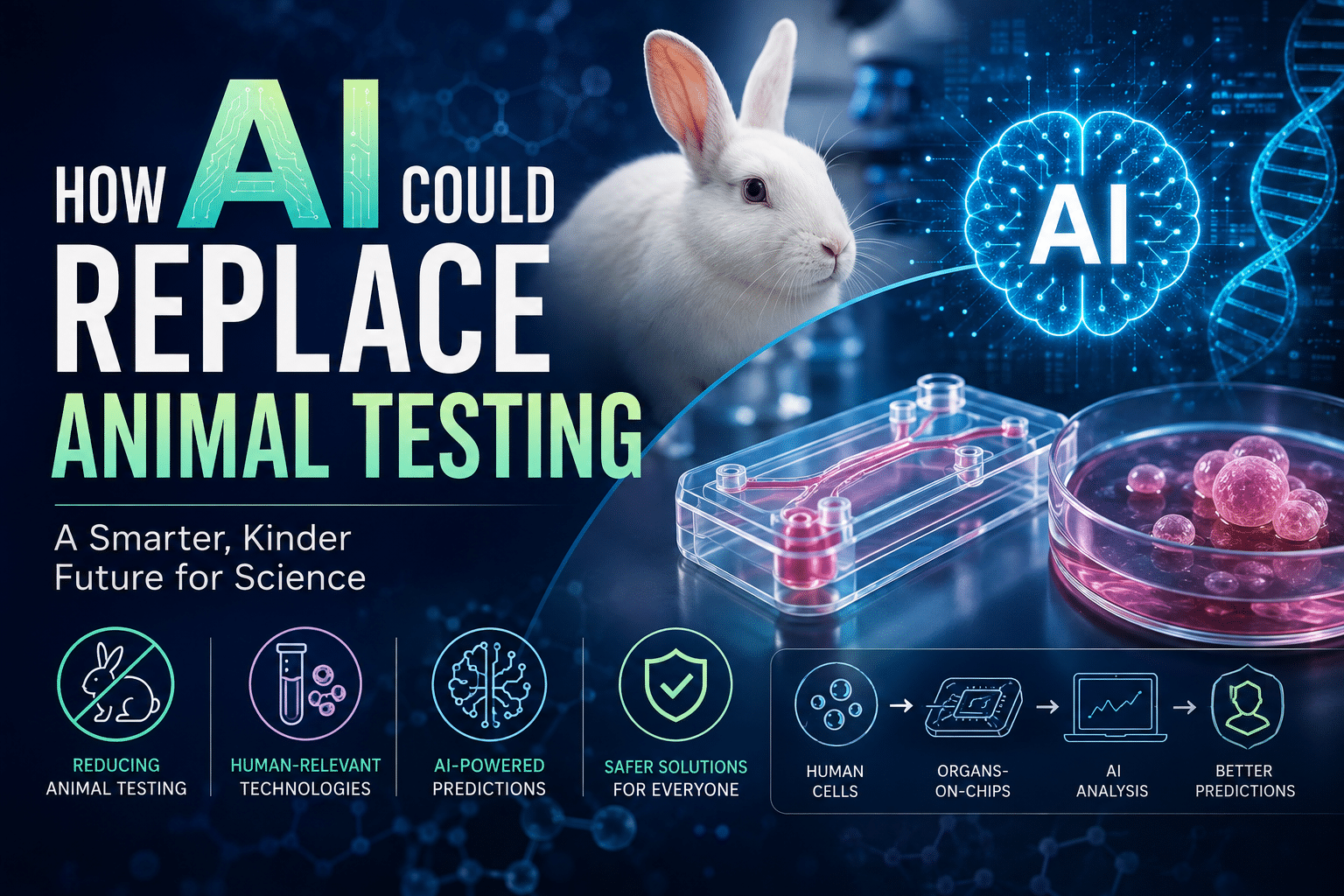
Some of the most promising approaches combine AI with human cells and miniature versions of human organs.
One of the most interesting developments is the use of miniature organs and devices known as “organs-on-chips.”
These systems contain human cells and are designed to reproduce certain functions of real organs.
For example, researchers can create models that imitate aspects of the human liver, kidney, or brain. They can then expose these models to chemicals and observe what happens.
AI can help analyze the results.
This approach could potentially provide scientists with information that is more directly relevant to humans than some traditional animal experiments.
Researchers involved in Europe’s ONTOX project are using human cells and other laboratory methods to study how repeated exposure to chemicals can affect organs such as the liver, kidney, and brain. AI helps researchers interpret the results and understand what they could mean for human health.
The combination is powerful:
Human cells provide the biological information, while AI helps researchers understand and connect that information.
Traditional testing often focuses on a relatively simple question:
Does this substance harm an animal?
Scientists increasingly want to answer a deeper question:
Why does it cause harm?
That distinction matters.
Suppose a chemical causes damage in a particular animal. Researchers still need to understand what biological process caused that damage and whether the same process exists in humans.
AI can help researchers compare huge amounts of biological information and identify common patterns.
A European research project called PrecisionTox, for example, compares the effects of chemicals across several organisms and human cells. Researchers are looking for basic biological processes that are shared across different species.
The idea is to focus less on simply observing that something went wrong and more on understanding the biological process behind it.
That could eventually make safety predictions more accurate.
Another challenge with animal testing is understanding what happens after years of exposure.
Some health problems do not appear immediately.
A chemical could cause small changes in cells that only become significant after long periods of exposure. These changes could potentially contribute to serious health problems later in life.
Animals also have much shorter lifespans than humans, making it difficult to reproduce some effects that may take decades to develop.
AI could help by combining information from different sources.
Researchers can feed computer models data about biological changes, chemical properties, exposure levels, and previous studies. AI can then search for connections that might be difficult for humans to identify manually.
This does not mean AI can simply predict the future with perfect accuracy. Instead, it provides another tool for scientists to make better-informed decisions.
The biggest change may not come from one technology replacing animal testing.
Instead, the future could involve several technologies working together.
Researchers could use:
This approach could provide a more complete picture than relying on one type of experiment.
European researchers are already exploring this model.
The RISK-HUNT3R project combines results from non-animal tests with information about real-world exposure. Researchers tested their approach using 60 chemicals, including substances known to be toxic and substances that were not toxic.
The long-term goal is to create a system that can determine whether a chemical is likely to pose a real risk to humans without automatically starting with animal testing.
This shift is not happening only inside research laboratories.
Regulatory agencies are also exploring alternatives.
In the United States, the FDA has been actively working to reduce dependence on animal testing. In 2026, the agency released draft guidance explaining how drug developers can validate newer testing methods for use in drug development.
The FDA describes these approaches as “new approach methodologies.” They include laboratory tests using human cells, miniature organs, computer simulations, and other methods.
The agency also reported progress in its efforts to reduce animal testing in drug development during its first year of implementing a roadmap announced in 2025.
This is significant because scientific breakthroughs alone are not enough.
For new testing methods to become widely used, regulators need to trust that the results are reliable.
As governments and regulatory agencies develop clearer standards for these technologies, researchers and pharmaceutical companies may have more confidence in using them.
Not yet.
It is important not to assume that AI will immediately make animal testing obsolete.
Scientists still have unanswered questions about how accurately AI models, human-cell systems, and miniature organs can predict every possible effect of a medicine or chemical.
Some research may still require information that cannot currently be reproduced outside a living organism.
Even researchers working on alternatives acknowledge that completely eliminating animal testing is not yet possible. However, there is significant potential to reduce the number of animals used and improve the way testing is conducted.
The FDA similarly describes the goal as reducing, replacing, or refining animal studies rather than suggesting that every animal experiment can immediately disappear.
That makes the transition more realistic.
Rather than asking whether AI can replace all animal testing, a better question may be:
How much animal testing can we avoid while making scientific research more accurate?
The rise of AI could change scientific research in ways that go far beyond animal testing.
Computers are becoming increasingly capable of analyzing complex biological information, while advances in laboratory technology are allowing researchers to build increasingly sophisticated models of human biology.
Together, these technologies could change how scientists test medicines and chemicals.
Instead of beginning with an animal experiment and gradually working toward an understanding of human effects, researchers may increasingly start with human-relevant data.
That could mean faster research, lower costs, fewer animals used in experiments, and potentially better predictions of how substances affect people.
The transition will not happen overnight.
AI models need to be tested. Laboratory methods need to be validated. Regulators need reliable standards. Scientists need to understand the limitations of each technology.
But the direction is becoming clearer.
AI is not simply being used to make research faster. It could help change what scientific testing looks like in the first place.
Animal testing has contributed to scientific discoveries for generations, but it also has clear limitations.
Animals are different from humans. Traditional experiments can be expensive and time-consuming. And as the number of chemicals and potential medicines grows, testing everything through traditional methods becomes increasingly difficult.
AI offers a possible alternative.
By combining artificial intelligence with human cells, miniature organs, computer simulations, and real-world exposure data, scientists can begin building a new approach to safety testing.
The most important change may be that researchers can focus more directly on human biology.
AI will not eliminate animal testing tomorrow. But it could help scientists determine which experiments are actually necessary, reduce the number of animals involved, and eventually replace some forms of testing altogether.
The future of scientific research may therefore look less like a laboratory filled with cages and more like a combination of AI systems, human cells, digital models, and advanced laboratories.
If these technologies continue to improve, the question may no longer be whether we can replace animal testing.
It may become a question of how quickly we can build a safer, faster, and more human-relevant alternative.