Anouncement

Anouncement
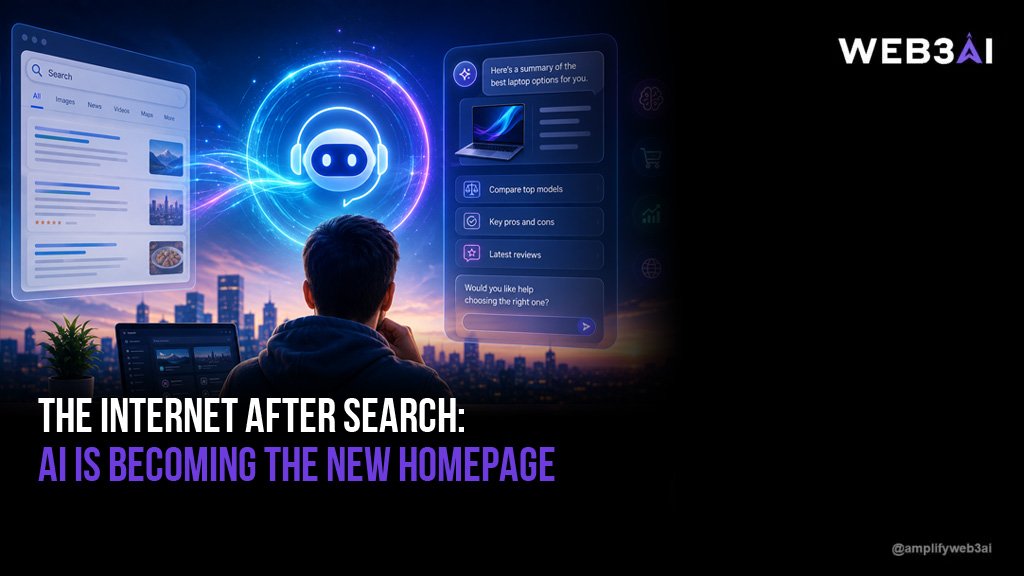

For more than two decades, the internet has revolved around one simple habit: searching. Whether people wanted to buy a product, learn a skill, compare services, or answer a random question, they opened a search engine, typed a few keywords, and clicked through pages of results.
That behavior is rapidly changing.
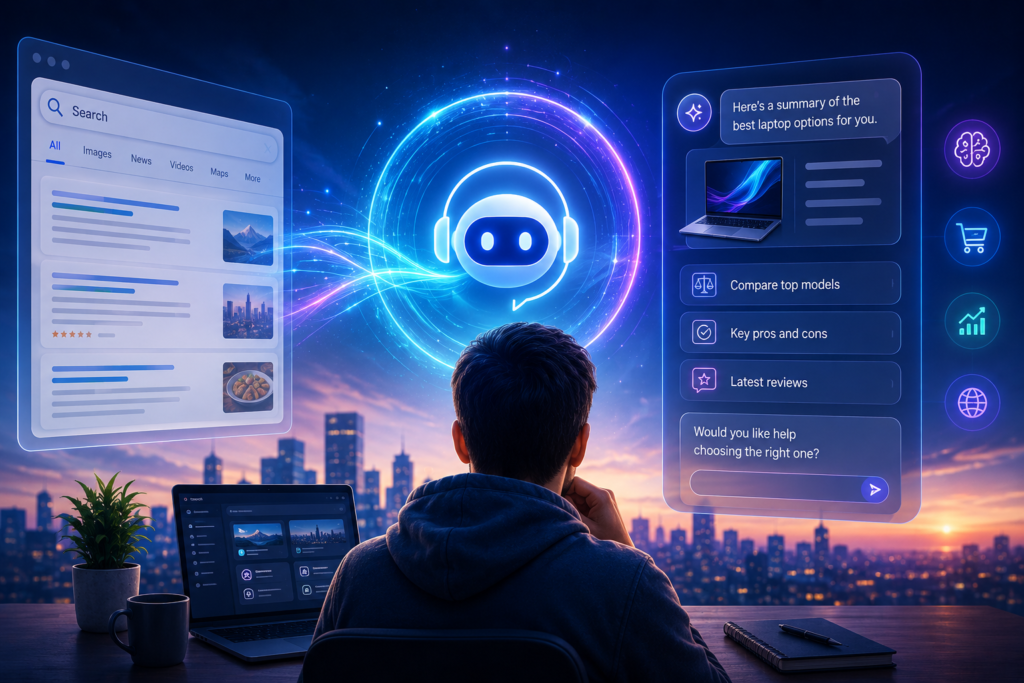
Today, millions of users begin their online journey by asking an AI assistant instead of opening a traditional search engine. Rather than browsing dozens of websites, they receive direct answers, personalized recommendations, summaries, and even completed tasks within seconds.
This shift marks one of the biggest changes in internet history.
The internet is entering a new era where artificial intelligence is becoming the new homepage. Instead of navigating the web manually, users increasingly rely on AI to guide, filter, create, and decide for them.
In this article, we’ll explore why AI is replacing traditional search, what it means for businesses and creators, how SEO is evolving, and what the future internet may look like.
The first generation of the web was built around directories.
Later, search engines transformed how people discovered information. Companies competed for rankings, backlinks, and keywords because visibility on the first page often determined success.
Today, another transition is underway.
Instead of typing:
“Best laptops under $800”
Many users simply ask:
“I’m a college student who edits videos occasionally and needs long battery life. Which laptop should I buy?”
Instead of receiving ten blue links, they receive:
The experience feels less like searching and more like talking to an expert.
That difference changes everything.
Traditional search requires multiple steps.
A user typically needs to:
AI compresses all these actions into a single conversation.
Instead of finding information, users receive synthesized knowledge.
This dramatically reduces friction.
People spend less time navigating and more time accomplishing their goals.
Whether writing emails, planning vacations, coding software, or researching investments, AI becomes the starting point.
Search engines once acted as maps.
AI acts as both the map and the guide.
Modern AI assistants can:
Users no longer need separate websites for many everyday tasks.
The homepage is becoming a conversation instead of a browser tab.
Several factors explain why AI adoption is accelerating.
People want immediate results.
AI often delivers concise answers in seconds without requiring users to sift through multiple pages.
Unlike search engines, AI remembers context throughout a conversation.
A follow-up question doesn’t require starting over.
The assistant understands previous requests, making interactions feel natural.
The internet contains an overwhelming amount of content.
AI filters the noise.
Rather than reading ten articles about the same topic, users receive one coherent explanation.
Search tells you where information exists.
AI often completes the task itself.
Instead of finding a resume template, AI writes the resume.
Instead of locating a meal plan, AI creates one.
This shift saves significant time.
Search Engine Optimization isn’t disappearing.
It’s evolving.
Businesses can no longer optimize solely for keyword rankings.
They must optimize for AI visibility.
This emerging practice is sometimes called:
Instead of asking:
“How do we rank higher?”
Businesses increasingly ask:
“How do we become the source AI trusts?”
That changes content strategy dramatically.
Large language models prioritize information that demonstrates expertise, authority, and trustworthiness.
High-quality content tends to include:
Thin content written solely for keyword stuffing becomes less valuable.
Quality increasingly outweighs quantity.
Ironically, AI is increasing the value of authentic human expertise.
Generic articles can now be generated almost instantly.
Original insights cannot.
Businesses that share:
stand out from AI-generated noise.
Authenticity becomes a competitive advantage.
Some predict websites will disappear.
That’s unlikely.
Instead, their role changes.
Websites become authoritative knowledge hubs rather than destinations people browse casually.
AI still needs reliable sources.
Original reporting, research, documentation, product information, and expert analysis remain essential.
The web becomes the foundation while AI becomes the interface.
Organizations that rely entirely on search traffic may experience significant changes over the coming years.
Instead of focusing exclusively on clicks, businesses should prioritize visibility wherever AI users seek answers.
That means:
The strongest brands will be those AI consistently references.
Shopping is changing as well.
Instead of browsing dozens of online stores, users increasingly ask AI:
“Find the best wireless earbuds under $100 with great battery life.”
AI compares products, summarizes reviews, highlights trade-offs, and narrows the choices.
Future AI assistants may complete purchases directly with user approval.
This shortens the buying journey dramatically.
Brands must ensure their products are well-documented, accurately described, and easily understood by AI systems.
Students increasingly begin learning with AI.
Instead of searching multiple educational websites, they ask for:
AI adapts explanations based on the learner’s experience level.
Education becomes more personalized than ever before.
Teachers remain essential, but AI becomes an always-available learning companion.
Content creators face both opportunities and challenges.
On one hand, AI reduces discovery through traditional search.
On the other, creators can use AI to:
Creators who combine AI efficiency with genuine expertise will likely outperform those relying solely on automation.
Human creativity remains the differentiator.
As AI becomes the first stop online, trust becomes increasingly important.
Users need confidence that AI-generated answers are:
Developers continue improving citation systems, source transparency, and factual reliability.
Businesses should also prioritize trustworthy content, as credibility becomes a key factor in AI recommendations.
Search engines are unlikely to disappear overnight.
Instead, they are evolving into AI-powered platforms themselves.
Rather than competing against AI, search companies are integrating conversational experiences directly into search results.
The distinction between “search engine” and “AI assistant” continues to blur.
Future users may not even notice the difference.
Imagine opening your device in a few years.
Instead of dozens of apps competing for attention, you simply tell your AI:
The AI coordinates multiple services behind the scenes.
Users interact with one intelligent interface rather than hundreds of separate websites.
The homepage becomes your personal AI assistant.
The transition is already happening.
Forward-thinking organizations should begin preparing by:
Success in the AI era won’t come from gaming algorithms—it will come from becoming the most reliable source of information in your industry.
The internet is undergoing another historic transformation.
For years, search engines served as the gateway to the web. Today, artificial intelligence is becoming that gateway instead. Users increasingly expect instant, conversational, and personalized answers rather than lists of links.
This doesn’t signal the end of websites, SEO, or online publishing. Instead, it represents a shift in how people discover and interact with information. Businesses, creators, educators, and marketers who embrace this change early will be better positioned to thrive.
The future internet is less about searching and more about asking. AI is evolving from a tool into the primary interface through which millions of people experience the web. As this trend accelerates, success will belong to those who create trustworthy, valuable, and human-centered content that both people and AI can rely on.
In the internet after search, attention no longer begins with a search bar—it begins with a conversation.