Anouncement

Anouncement
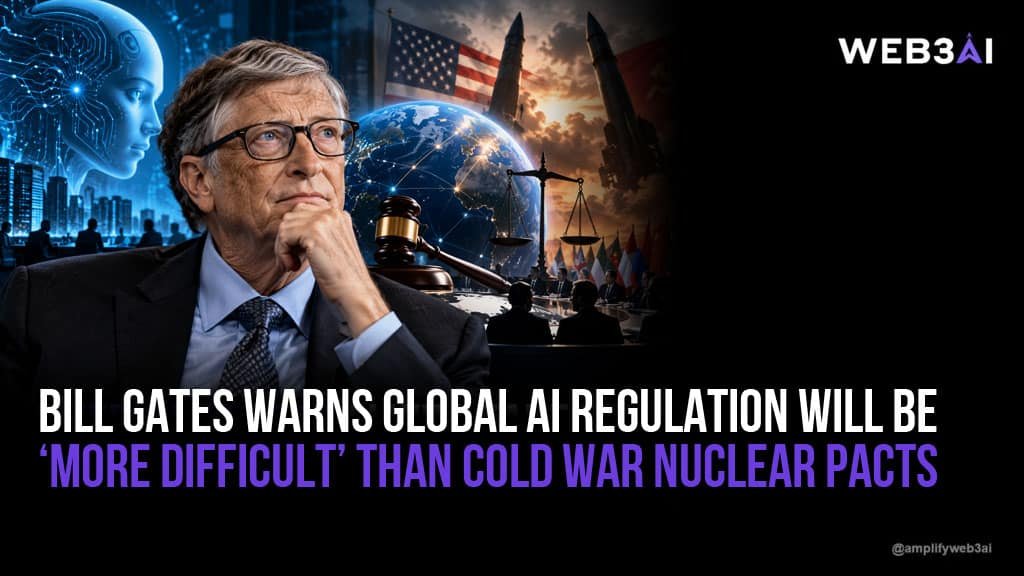

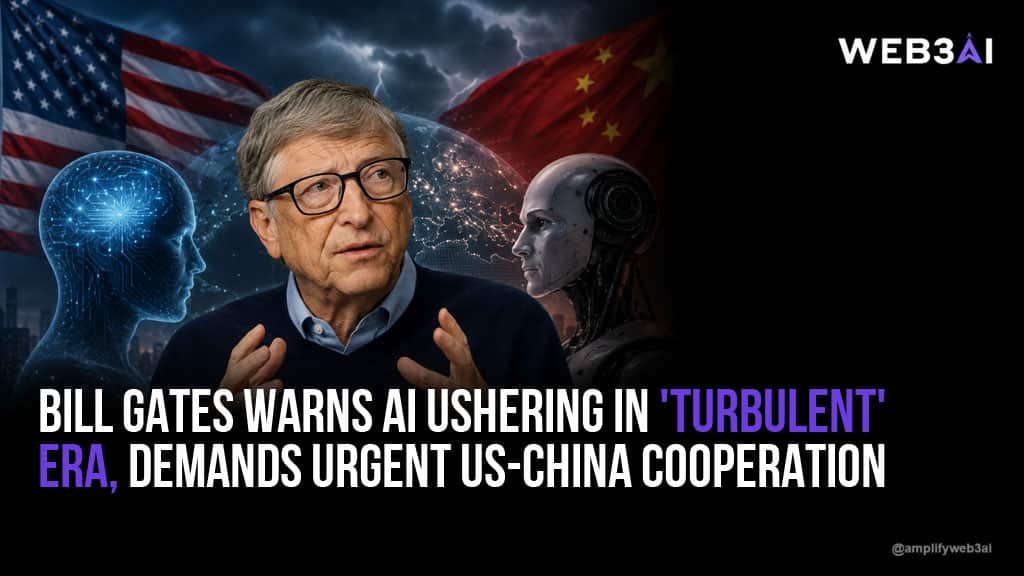
Microsoft co-founder Bill Gates warned that forging an international regulatory framework for artificial intelligence could prove significantly harder than negotiating Cold War-era nuclear arms control agreements.
Speaking with NBC News’ Kristen Welker on Meet the Press, Gates argued that self-regulation among tech companies will not suffice to address the profound risks posed by advanced AI systems, calling on Washington to lead the charge in establishing binding international guardrails.
Unlike prior waves of technological disruption, Gates emphasized that the rise of advanced artificial intelligence represents a fundamental shift in machine capability.
“This is truly an evolutionary event. We have created an intelligent species that, in many respects, is already smarter than we are, and over the next several years at kind of exponentially improving level will be insanely smarter than we are.”
— Bill Gates, on NBC News’ Meet the Press
While rejecting doomsday claims that rogue AI systems have slipped human control—noting that machines are not yet directing physical robots at scale and can still be disconnected—Gates zeroed in on malicious misuse. The most immediate peril, he argued, stems from small groups or rogue actors weaponizing cutting-edge AI models to launch catastrophic cyberattacks against critical infrastructure, financial networks, or power grids.
Asked whether AI could lead to human catastrophe, Gates responded that the tools are potent enough to “drive events that, you know, cause a billion deaths,” adding that there has never been a weapon as dangerous as advanced AI combined with malicious intent.
During the 20th century, global superpowers established treaties like START and the Non-Proliferation Treaty (NPT) by tracking physical enrichment facilities, warheads, and missile silos. AI algorithms and model weights, by contrast, can be trained, transferred, and deployed across borders almost instantaneously.
| Area of Governance | Cold War Nuclear Arms | Modern Artificial Intelligence |
|---|---|---|
| Material Traceability | Enriched uranium, plutonium, heavy launch systems | Compute clusters, digital model weights, software code |
| Verification Method | Satellite surveillance, on-site physical inspections | Code audits, model logging, hardware telemetry |
| Access Barrier | Multi-billion-dollar state enrichment programs | Open-source weights, commercial cloud platforms |
| Geopolitical Dynamics | Bilateral state superpower standoff | Multilateral competition spanning states, labs, and private firms |
Gates noted that Cold War diplomacy operated within an explicit “us versus them” paradigm. In AI, treating regulation as a zero-sum technological race risks incentivizing nations to strip away safeguards in a sprint to develop faster models.
Gates also addressed political pushback against federal tech oversight, including arguments that domestic regulations would hand an advantage to foreign competitors like China.
According to Gates, sensible domestic regulations—such as mandatory system monitoring, safety audits, and logging protocols—would not slow innovation or put the U.S. at a competitive disadvantage. Instead, he argued that the U.S. has a long track record of setting global benchmarks for high-stakes technologies, pointing to post-WWII leadership in civil aviation safety, nuclear treaties, and environmental accords like the Montreal Protocol.