Anouncement

Anouncement
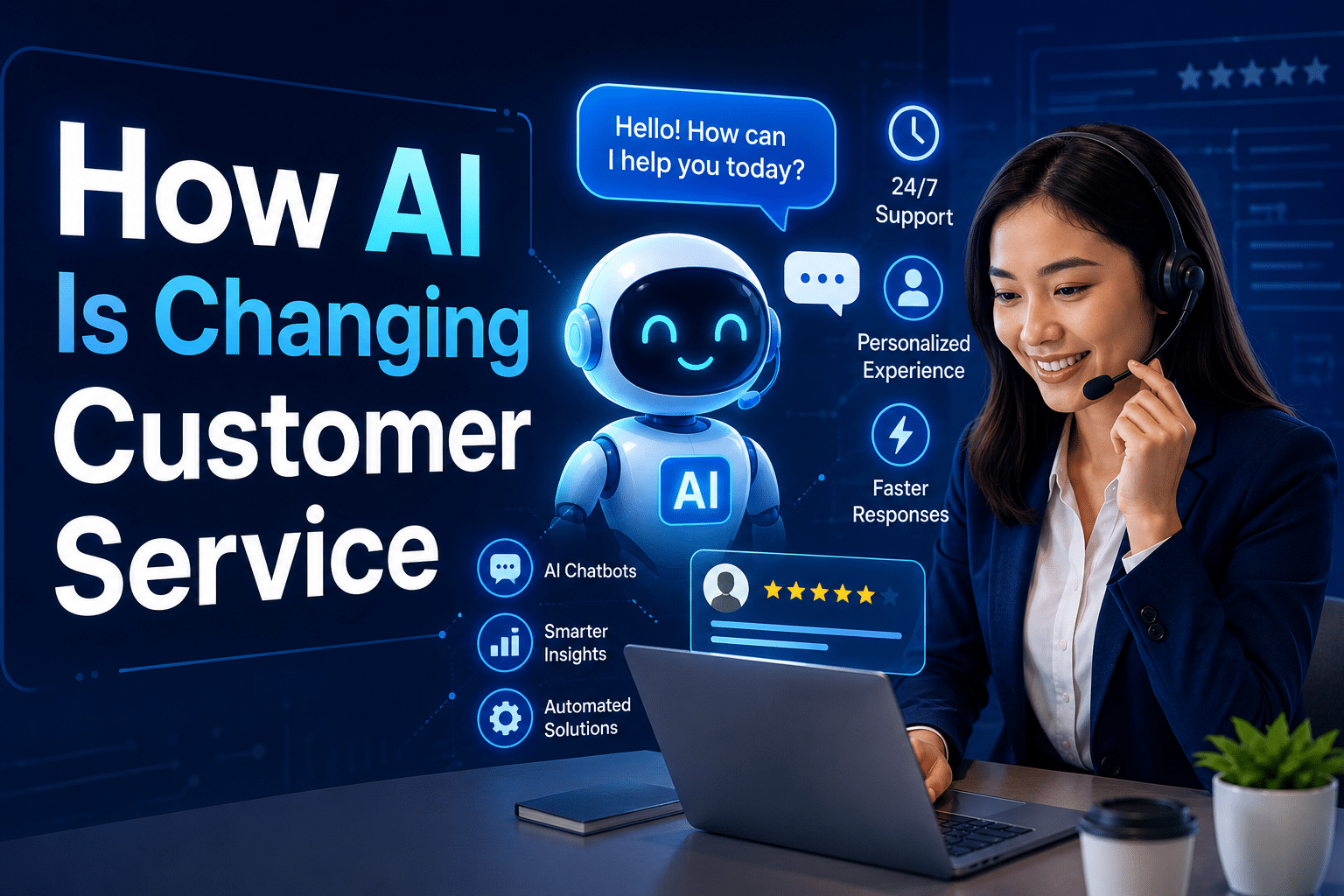

Customer service is changing faster than ever. Businesses once relied primarily on call centers, email support, and human agents to answer questions and resolve problems. Today, artificial intelligence (AI) is transforming how companies interact with customers at nearly every stage of the customer journey.
From AI-powered chatbots that answer questions instantly to intelligent systems that help human agents solve complex issues, AI in customer service is becoming a major competitive advantage. It allows businesses to respond faster, personalize interactions, automate repetitive tasks, and provide support around the clock.
But AI isn’t simply replacing traditional customer service. In many cases, it is changing the role of customer service teams by allowing employees to focus on conversations and problems that require human judgment, empathy, and creativity.
So, how exactly is AI changing customer service, and what does the future look like?
AI in customer service refers to the use of artificial intelligence technologies to automate, improve, or support interactions between businesses and their customers.
These technologies can include:
Modern AI systems can understand customer questions, analyze large amounts of information, identify patterns, and provide relevant answers in seconds.
Instead of forcing customers to search through frequently asked questions or wait for an available representative, AI can provide immediate assistance.
This is one reason artificial intelligence customer service solutions are rapidly becoming part of modern business operations.
One of the biggest advantages of AI customer support is availability.
Traditional customer service teams generally operate according to shifts or business hours. Customers who need assistance outside those hours may have to wait until the next day.
AI doesn’t need to sleep or take weekends off.
AI-powered customer service tools can operate 24/7, allowing customers to receive immediate assistance regardless of the time or day.
For global businesses serving customers across multiple time zones, this can be particularly valuable.
An AI chatbot can answer common questions about orders, account information, shipping, product features, returns, and other issues at any hour.
This doesn’t necessarily mean every problem is solved entirely by AI. Instead, AI can provide immediate first-line support and transfer more complicated cases to human representatives when necessary.
Speed matters in customer service.
Customers don’t want to wait several hours for an email response or spend 30 minutes navigating an automated phone menu.
AI can dramatically reduce response times.
A chatbot can analyze a customer’s question and generate an answer almost instantly. AI can also search internal knowledge bases and retrieve relevant information much faster than a human agent manually searching through documents.
For support teams, AI can also summarize customer conversations, identify the problem, and suggest possible solutions.
This means employees spend less time searching for information and more time actually helping customers.
Ultimately, customer service automation can make support operations significantly more efficient.
Another major development is personalization.
Customers increasingly expect businesses to understand their needs and preferences. AI makes this easier by analyzing customer data and interaction history.
For example, an AI system might recognize:
Using this information, AI can help businesses provide more relevant responses.
Instead of treating every customer interaction as completely new, an AI-powered system can use available context to create a more personalized experience.
For example, if a customer contacts an online retailer about a delayed order, the system can potentially identify the order, check its status, and provide an update without requiring the customer to repeat basic information.
That creates a smoother customer journey.
Perhaps one of the most important misconceptions about AI in customer service is that its primary purpose is to replace human employees.
In reality, one of AI’s biggest opportunities may be augmenting human agents.
AI tools can work alongside customer service representatives by providing real-time assistance.
For example, while an agent is speaking with a customer, an AI system could:
This can reduce the amount of repetitive administrative work that agents have to perform.
Instead of spending most of their time looking for information or writing routine notes, customer service representatives can focus on understanding the customer’s situation and solving the problem.
Customer service isn’t only about understanding words. It’s also about understanding emotion.
A customer who says, “That’s fine,” could actually be extremely frustrated depending on the context.
AI-powered sentiment analysis can analyze language and identify signals associated with emotions such as frustration, satisfaction, anger, or urgency.
Businesses can use this information to prioritize conversations.
For example, an AI system might identify a highly frustrated customer and flag the conversation for immediate attention from a human representative.
This can help customer service teams respond proactively before a small issue becomes a serious complaint.
However, sentiment analysis isn’t perfect. Human emotions are complex, and AI can sometimes misunderstand sarcasm, cultural context, or subtle emotional signals.
Human judgment remains important.
Customer service teams often spend significant amounts of time answering the same questions.
“Where is my order?”
“How do I reset my password?”
“What is your return policy?”
“How much does shipping cost?”
These questions may be simple, but answering thousands of them manually consumes valuable time.
AI can automate many repetitive interactions.
This allows businesses to handle higher volumes of customer requests without necessarily increasing their support staff at the same rate.
More importantly, employees can spend their time on complex cases that actually require human expertise.
This creates a more efficient division of labor:
AI handles repetitive tasks. Humans handle complex relationships.
Customers communicate with businesses through many channels today.
They might use:
Managing these channels consistently can be difficult.
AI can help businesses create a more unified customer service experience across different platforms.
For example, a customer might begin a conversation with an AI chatbot on a website and later speak with a human representative.
With the right systems in place, the representative can receive a summary of the previous conversation instead of asking the customer to start from the beginning.
This creates a more connected experience.
AI isn’t only useful for reacting to customer questions.
It can also help businesses predict what customers may need next.
By analyzing historical data, AI systems can identify patterns in customer behavior.
For example, a company might discover that customers frequently contact support after purchasing a particular product because the setup instructions are unclear.
The business could then improve the product documentation or proactively send customers helpful instructions.
This represents an important shift in customer service:
Instead of waiting for customers to complain, businesses can use AI to identify problems before customers contact support.
Predictive customer service could become one of the most valuable applications of AI in the coming years.
Despite its advantages, AI isn’t a magic solution.
Businesses must consider several challenges when implementing AI customer support systems.
AI can generate convincing language, but it doesn’t experience emotions the way humans do.
Customers dealing with serious complaints, sensitive situations, or complicated problems may still prefer speaking with a real person.
AI systems can sometimes provide inaccurate or outdated information.
For customer service, this can be especially dangerous because incorrect answers can damage trust.
Businesses need reliable knowledge sources, monitoring, and human oversight.
Customer service systems often process personal information.
Companies must carefully manage how customer data is collected, stored, and used.
Privacy and security should be fundamental parts of any AI customer service strategy.
Automation becomes frustrating when customers cannot reach a human.
A poorly designed chatbot that repeatedly gives irrelevant answers can make a customer’s experience worse rather than better.
The goal should not be to automate everything.
The goal should be to make customer service better.
AI is likely to become even more deeply integrated into customer service over the next several years.
Future systems could move beyond simply answering questions and become proactive customer service assistants.
AI agents may be able to identify problems, recommend solutions, complete certain tasks, and coordinate actions across multiple business systems.
For example, instead of simply telling a customer that a package is delayed, an AI system could potentially detect the delay, notify the customer, offer available solutions, and initiate a replacement or refund according to company policies.
Voice-based AI is also likely to become increasingly important.
As AI becomes better at understanding natural speech, conversations with automated systems may become more natural and less frustrating.
At the same time, human representatives will remain essential for situations requiring empathy, negotiation, creativity, and complex decision-making.
The future may therefore be less about AI versus humans and more about AI plus humans.
AI is changing customer service by making support faster, more available, more personalized, and more efficient.
AI chatbots can handle routine questions. Intelligent systems can assist human agents. Predictive analytics can identify customer needs. Sentiment analysis can help companies recognize frustrated customers. Automation can reduce repetitive work.
But successful AI customer service isn’t simply about cutting costs or replacing employees.
The best implementations use AI to remove friction while preserving the human element of customer relationships.
As artificial intelligence continues to evolve, customers may increasingly expect businesses to provide instant, intelligent, and personalized support.
Companies that learn how to combine AI’s speed and scalability with human empathy and judgment will be in the strongest position to deliver exceptional customer experiences.
The future of customer service isn’t necessarily a world without human agents.
It’s a world where AI handles what machines do best—and humans focus on what humans do best.