Anouncement

Anouncement


For Audio, Listen HERE
If you have scrolled through your newsfeed at any point in the last six months, you have likely felt a familiar, creeping sensation: technological vertigo.
Every day, there is a new headline about an Artificial Intelligence (AI) model that can write symphonies, generate hyper-realistic videos, or code entire applications in seconds. In the same breath, you hear whispers (or shouts) about Web3, blockchain, decentralized networks, and digital tokens.
The immediate, visceral reaction for most of us is a heavy sigh followed by a daunting thought: “I am already too far behind to catch up.”
We see influencers screaming that if we don’t adopt the latest AI tool today, our careers will be obsolete by tomorrow. We see sensationalized stories of crypto-millionaires and feel like we missed the only train leaving the station. The noise is deafening, the FOMO (Fear Of Missing Out) is palpable, and the pressure to adapt is overwhelming.
But what if I told you that the narrative you are being fed is fundamentally flawed? What if I told you that, despite the dizzying speed of the modern internet, you are not late to the party?
Take a deep breath. Let the noise fade for a moment. You are not behind. In fact, you are incredibly early.
Let’s explore why the people who take the time to step back, ask the right questions, and prioritize clarity over speed are the ones who will truly inherit the future of the internet.
The Illusion of the “Tech-Savvy” Majority
To understand why you aren’t behind, we first need to look at the reality of the world around us.
Imagine you are standing in a crowded stadium. On the field, a handful of engineers and builders are constructing a revolutionary new type of engine. The commentators in the broadcast booth are talking a mile a minute, using heavy jargon, and hyper-analyzing every turn of a wrench.
Because the commentators are so loud, you assume everyone in the stadium understands exactly how this engine works. But if you were to turn to the person sitting next to you and ask them to explain it, you’d likely get a blank stare.
This is the current state of Web3 and AI.
The vast, overwhelming majority of people in the world do not understand what AI is actually doing in their daily lives. They do not understand the underlying architecture of Web3. The people who are truly behind are the ones who have never even started asking questions, who have let the noise convince them that the subject is too complicated, too technical, or too risky to explore.
By simply being curious—by wondering how these systems work and what they mean for your future—you are already miles ahead of the crowd.
AI is Not Just a Chatbot: The Iceberg Analogy
When most people think of AI today, they think of a chatbot. They think of a digital assistant that can help them write a polite email to their boss, draft a weekly meal plan, or generate a quirky poem for a friend’s birthday.
While these tools are fun and accessible, viewing AI solely through the lens of chatbots is like looking at the tip of an iceberg and assuming you’ve seen the whole thing.
What Lies Beneath the Surface
Beneath the waterline, Artificial Intelligence is doing work that fundamentally reshapes our society.
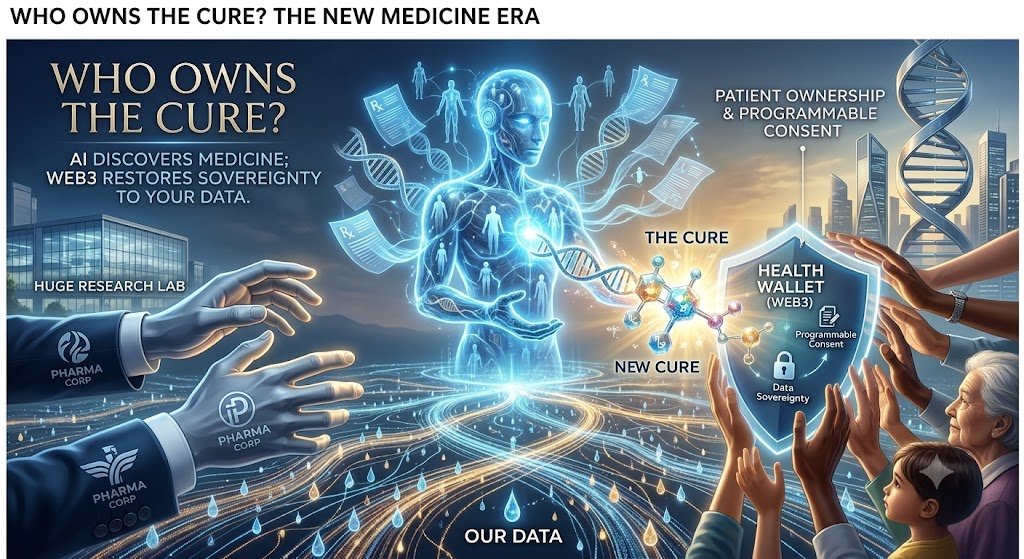
It is reading medical records: AI algorithms are currently analyzing millions of data points to predict health outcomes, assist in diagnosing rare diseases, and even create medical breakthroughs. But this raises a profound question: Who owns those breakthroughs?
It is shaping your reality: The algorithms that dictate what news you see, what products you buy, and what videos you watch are all driven by AI. They are predicting your behavior based on patterns you don’t even realize you are creating.
It is being trained by you: Every time you click, scroll, pause, or comment, you are providing free labor. You have been training AI for years without ever formally consenting to the job.
Real-Life Example: Think about the “hidden cost of free.” When you use a free GPS app to navigate traffic, you aren’t the customer; you are the sensor. The app is free because your movement is the data the company is selling to advertisers and using to train their predictive models. Once you understand this, you stop looking at technology as a magic trick and start looking at it as an exchange of value.
Web3 is Not Just Digital Coins: The Real Estate Analogy
If AI is the engine of the future internet, Web3 is the infrastructure. Yet, the public perception of Web3 is almost entirely hijacked by the financialization of it—trading coins, buying digital art for exorbitant prices, and making quick money.
Let’s clear the air: Web3 is not about trading; it is about ownership.
To understand this, we need a real-world analogy. Think about how you currently live on the internet. Right now, you are a digital renter.
The Rented Land of Web2
When you build an audience on a major social media platform, upload your family photos to a cloud server, or build a business reliant on a search engine’s algorithm, you are building a house on rented land.
The landlord (the tech corporation) can change the rules at any time. They can raise the rent (charge you to reach your own followers), they can change the locks (suspend your account), or they can bulldoze the neighborhood entirely (shut down the platform). When you die, what happens to your digital life? As a renter, it belongs to the landlord.
The Homeownership of Web3
Web3 introduces a fundamentally different architecture for the internet—one built on decentralized systems and data sovereignty.
Data sovereignty is the radical idea that you should own your digital identity. Instead of a corporation holding the keys to your data, you hold them. It is the shift from being a digital serf to a digital property owner.
When you understand that Web3 is about shifting the balance of power back to the user, the hype cycles of crypto markets become irrelevant. You start to see the technology for what it is: a foundation for a fairer, more equitable digital world.
The Superpower of the Next Decade: Discernment
Because technology will keep changing, trying to memorize every new software update or memorize every new piece of jargon is a losing game. New platforms will rise and fall. New tools will dazzle us and eventually disappoint us. Hype cycles will sweep through the internet like wildfires and burn out just as fast.
If the technology is always changing, what is the point of learning?
The point is not to learn what to click, but how to think. In an age of infinite information and rapid automation, the most valuable skill you can possess is discernment.
Discernment is the ability to look at a new technology and ask the right questions, rather than blindly accepting the promises of the person selling it to you.
The Lens of Clarity
When a new social platform launches and claims to be “different,” or when an AI tool promises to revolutionize your workflow, a discerning mind doesn’t panic-buy. Instead, a discerning mind applies a clear framework. Ask yourself:
Is this hype or innovation? Does this solve a real human problem, or is it just a solution looking for a problem?
Who benefits? When I use this tool, who is making the money? Am I the consumer, or am I the product?
Who owns the data? When I input my thoughts, my photos, or my proprietary business strategies into this system, who holds the legal rights to that information?
Can I verify these claims? Is the system transparent, or is it a “black box” where I have to blindly trust the creator?
When you build this lens of clarity, it serves you for the rest of your life. It is a timeless skill that never goes out of style, no matter how fast the processors get or how advanced the algorithms become.
The Future is More Human Than You Think
There is a deep-seated fear that as AI becomes more capable, human beings will become less relevant. We worry that if a machine can write, paint, and code, there will be no room left for us.
This is perhaps the greatest misconception of all.
In a world where content generation is infinite and immediate, the value of generic, automated work will drop to zero. When anyone can ask an AI to write a 500-word essay on marketing, those essays lose their impact.
So, what becomes valuable? The things machines cannot fake.
Curiosity: A machine can answer a question, but it cannot organically wonder why something is the way it is. The human drive to explore the unknown is irreplaceable.
Courage: It takes courage to stand against the crowd, to resist the pressure of FOMO, and to choose clarity over speed.
Empathy and Connection: Communities formed around these new technologies don’t just need fast coders; they need people who care about humans. They need builders who understand the emotional and structural impact of what they are creating.
Lived Experience: Your unique perspective, your struggles, your triumphs, and your unique worldview are the context that gives data meaning.
The future of work and technology requires creativity and ownership. It requires people who think before they leap. It requires people who value human connection over mere code.
Your Place in the Conversation
If you have ever wrestled with the discomfort of these ideas, if you have ever paused to consider your own digital mortality, or if you have ever questioned the structural fairness of social media algorithms—you belong in this conversation.
The tech builders need you. The creators need you. The future of the internet needs people who approach these massive paradigm shifts calmly, without panic, and without being swayed by the noise.
You do not need to know how to code a blockchain or train a Large Language Model to be a vital part of the next digital era. You simply need to know how to learn, how to think, and how to ask questions that matter.
That is enough. In fact, that is everything.
So, the next time someone tries to pressure you into adopting a technology out of fear, or the next time you feel that wave of anxiety telling you that you’ve missed the boat, take a deep breath. Be proud of your caution. Be proud of your desire for clarity.
Stay curious. Stay grounded. And most importantly, stay human. You are exactly where you need to be.