Anouncement

Anouncement
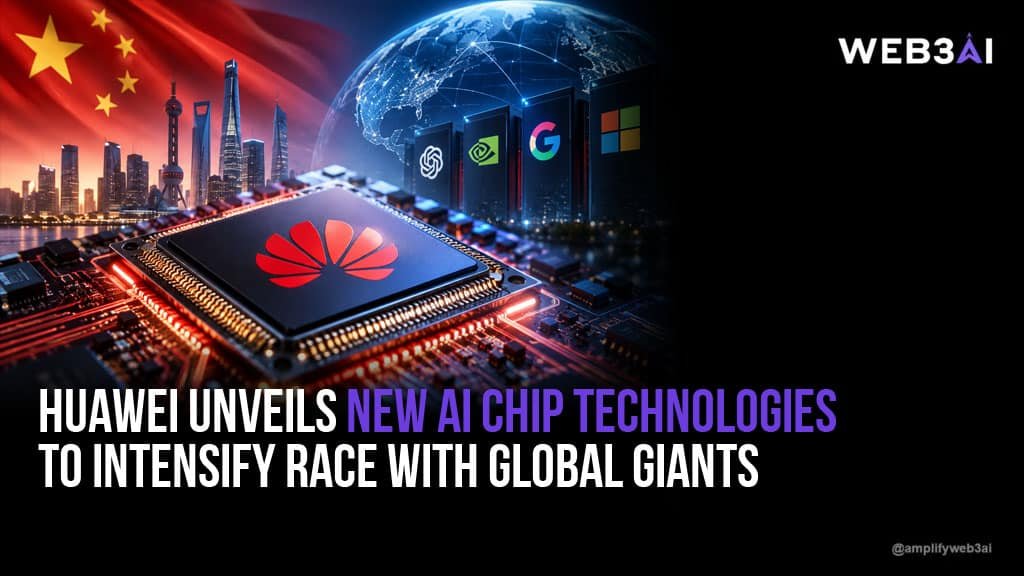

BEIJING — Chinese technology titan Huawei Technologies has announced a major rollout of next-generation artificial intelligence (AI) chip technologies, signaling an aggressive escalation in the global tech and semiconductor race.
The new developments underline Beijing’s ongoing drive toward technological self-sufficiency and pose a direct challenge to international market leaders like Nvidia, despite persistent U.S. export restrictions.
According to Huawei’s leadership, the company is aggressively expanding its footprint in high-performance AI computing. Rotating Chairman David Wang announced that Huawei plans to launch two advanced AI processors:
To maximize the efficiency of these upcoming processors, Huawei is banking on its proprietary UnifiedBus technology. This framework is engineered to seamlessly interconnect massive clusters of AI chips, allowing them to function cohesively as a single, ultra-powerful supercomputing unit. Huawei reported that it has already shipped over 1,000 of these large-scale systems to more than 370 enterprise customers.
Huawei’s latest hardware milestones build on its broader strategy to circumvent strict U.S. trade curbs that block Chinese access to extreme ultraviolet (EUV) lithography machines.
Rather than relying entirely on traditional geometric scaling—the physical shrinking of transistors governed by Moore’s Law, which faces extreme physical and economic limits—Huawei has leaned heavily into system-level innovations. The company utilizes its pioneering Tau Scaling Law ($\tau$ Scaling Law) and LogicFolding architecture. By focusing on reducing signal propagation delay, shortening internal interconnects, and optimizing data movement, Huawei aims to extract breakthrough performance and energy efficiency from constrained manufacturing nodes.
Industry analysts note that these systemic architectural workarounds allow Chinese firms to squeeze maximum performance out of domestic manufacturing capabilities, keeping pace with surging global computing demands without needing the absolute smallest leading-edge nodes immediately.
The timing of Huawei’s hardware updates highlights the high stakes of the ongoing tech decoupling between Washington and Beijing. As domestic demand for local AI infrastructure surges—bolstered by rapid advancements in native AI models—Huawei’s role as a semiconductor innovator has become central to China’s economic and geopolitical strategy.
By continuously pushing the envelope with robust domestic hardware alternatives, Huawei is cementing its status as the anchor of China’s self-reliant tech ecosystem, narrowing the gap with Western giants, and reshaping the future of global semiconductor competition.