Anouncement

Anouncement
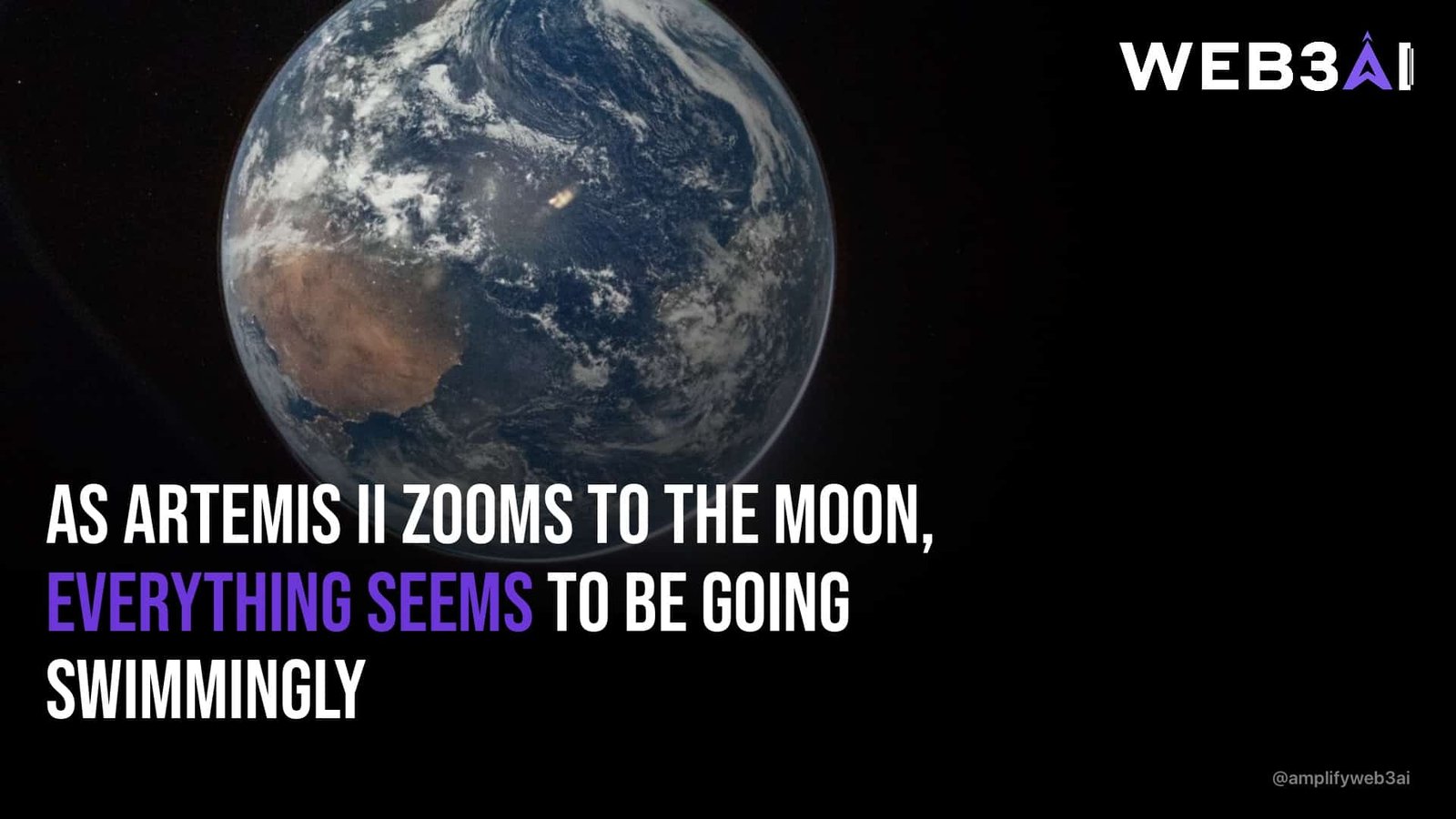

The Artemis II Moon mission is officially underway, and early reports suggest the journey is going remarkably well. NASA’s first crewed lunar mission in more than 50 years launched successfully, sending four astronauts on a historic free-return trajectory around the Moon. For a generation that grew up watching rocket launches on screens, this is the moment space exploration stopped being a promise and started being a reality again.
The mission represents the culmination of years of engineering, political will, and international cooperation. According to NASA’s Artemis program updates, all major systems aboard the Orion spacecraft have performed within expected parameters since launch, with the crew reporting positive conditions inside the capsule. It is the kind of early-mission confidence that engineers dream about and that the public needs to see.
In this post, we break down what has happened so far, what the crew is experiencing, and why the Artemis II Moon mission matters far beyond the headlines — including what it signals for the future of AI, data, and decentralized technology in space.
Artemis II is NASA’s first crewed flight under the broader Artemis program, designed to return humans to lunar orbit and eventually the lunar surface. Unlike Apollo, Artemis is built for sustainability — the goal is not a single dramatic landing but a permanent human presence on and around the Moon. Artemis II is the proving flight: four astronauts in an Orion capsule, powered by the Space Launch System (SLS), swinging around the Moon on a free-return trajectory before splashing down in the Pacific Ocean.
The crew — Commander Reid Wiseman, Pilot Victor Glover, Mission Specialist Christina Koch, and Canadian Space Agency astronaut Jeremy Hansen — represents a deliberately diverse group. Victor Glover will be the first Black astronaut to travel to lunar distance, and Jeremy Hansen will be the first Canadian. These are not footnotes; they are the mission’s deliberate statement about who space belongs to.
The flight path itself is elegant in its simplicity. The spacecraft does not enter lunar orbit — it swings around the Moon using gravity and returns to Earth on a pre-calculated arc. This approach tests the Orion capsule’s life support, navigation, and re-entry systems under real deep-space conditions, with a crew aboard, without the added complexity of a lunar orbit insertion burn.
Pro Tip: The “free-return trajectory” used by Artemis II means the spacecraft would naturally return to Earth even if its engines failed — a safety feature first used during Apollo 13’s emergency return in 1970.
According to the Ars Technica source report, the early phases of the Artemis II Moon mission have been described as going “swimmingly.” That is engineering understatement for: every system is working, the crew is healthy, and nothing unexpected has forced a replanning of the timeline. For a mission of this complexity, that is genuinely extraordinary news.
The SLS rocket — the most powerful rocket NASA has ever flown — performed its trans-lunar injection burn on schedule, sending Orion onto its trajectory toward the Moon. The spacecraft’s solar arrays deployed cleanly, the life support systems activated as planned, and the crew successfully transitioned from launch suits into the vehicle’s operational configuration. These early milestones matter enormously because they validate years of ground testing.
Communications with Mission Control in Houston have remained stable throughout the early flight phases. The crew has been conducting system checks, performing minor course corrections, and — judging by reports — taking in views of Earth that very few humans have ever experienced. At the distances Artemis II is traveling, Earth appears as a sphere, not a horizon. That perspective shift is exactly what the Artemis program is designed to deliver.
For those following AI’s growing role in mission planning and real-time data processing, this mission is also a landmark. AI is already transforming how space agencies plan, monitor, and adapt deep-space missions — and Artemis II is one of the first crewed flights where AI-assisted systems play a meaningful role in onboard decision support.
Living inside the Orion capsule is a fundamentally different experience from the International Space Station. Orion is designed for transport, not long-duration habitation — it is closer in spirit to a high-performance aircraft cockpit than to the sprawling modules of the ISS. Four people share a pressurized volume roughly the size of a small camper van, for a mission lasting approximately ten days.
The crew manages microgravity with practiced efficiency. Meals are pre-packaged and rehydratable, sleep schedules are tightly managed to keep circadian rhythms from drifting, and exercise is limited by the available space. Despite these constraints, NASA’s human factors teams have optimized Orion’s interior based on decades of spaceflight data — and astronaut feedback from the unmanned Artemis I mission helped refine crew comfort systems before any humans stepped aboard.
Communications with family and the public are built into the mission schedule. Unlike the near-total communication blackouts of the Apollo era, Artemis II benefits from NASA’s updated Deep Space Network, which allows the crew to send and receive video messages, participate in media events, and even conduct limited live broadcasts. This connectivity is both a morale tool and a public engagement strategy.
Pro Tip: The Orion spacecraft features an abort system capable of pulling the crew capsule away from a failing rocket at any point during launch — including on the pad. It is one of the most rigorously tested safety systems in NASA history.
The Artemis II Moon mission is not just a feat of aerospace engineering — it is a technology demonstration for the next decade of space infrastructure. Every system that performs well on this mission informs the design of Artemis III, which will land humans on the lunar South Pole. That landing mission depends on SpaceX’s Starship Human Landing System, a Gateway lunar space station, and a new generation of spacesuits — all of which are in active development.
Decentralized and Web3 technologies are beginning to intersect with this infrastructure in ways that are not yet headline news but are genuinely significant. From verifiable data provenance for scientific payloads to decentralized mission telemetry archives, the architecture of how we store and share space data is evolving fast. Web3 is reshaping the future of space data management in ways that will directly support missions like Artemis and beyond.
International partnerships are also deepening. The Artemis Accords — a set of bilateral agreements establishing norms for responsible space exploration — have now been signed by more than 40 nations. Canada’s participation through astronaut Jeremy Hansen is one visible symbol of this collaboration, but the deeper integration happens at the level of shared data standards, joint mission planning, and coordinated lunar resource management.
The most dramatic moment of any lunar free-return mission comes at the Moon itself. As Orion swings around the lunar far side, the crew will lose contact with Earth — entering a communication blackout that lasts approximately 30 minutes. In that silence, the spacecraft will be closer to the Moon than any crewed vehicle has been since Apollo 17 in 1972. When contact resumes, the mission enters its return arc toward Earth.
Re-entry is the final major technical challenge. Orion will hit Earth’s atmosphere at approximately 25,000 miles per hour — the fastest re-entry speed for a crewed vehicle since Apollo. The heat shield, which was tested unmanned on Artemis I, must perform flawlessly. Any significant degradation would be both a safety risk and a programmatic setback for the Artemis III landing mission.
Here is a summary of the key milestones remaining in the mission:
And in terms of what success looks like for the program, here is how NASA defines mission objectives in priority order:
The decentralized technology frameworks being built to support missions like this are also worth watching. Decentralized technology is increasingly relevant to how NASA missions handle data integrity and mission transparency — a trend that will only accelerate as the Artemis program matures.
There is something genuinely moving about a crewed mission to the Moon in 2026. It arrives at a moment when geopolitical tensions around space are rising, when commercial space is reshaping what governments can do, and when the question of who leads humanity’s return to the Moon has real strategic weight. China’s lunar program is advancing rapidly. The Artemis program is, in part, America’s answer to that challenge — but it has also been designed as a coalition effort from the start.
Public enthusiasm has been building steadily. NASA’s social media channels and live streams have attracted millions of viewers at key mission milestones, and the diversity of the crew has resonated globally. For younger audiences especially, seeing a crew that looks like the world — rather than a small slice of it — changes the emotional register of space exploration from nostalgia to possibility.
What the Artemis II Moon mission ultimately represents is proof of concept — not just for the rocket and spacecraft, but for the entire architecture of sustainable lunar exploration. If this mission succeeds fully, the path to Artemis III, Gateway, and eventually a permanent lunar presence becomes dramatically clearer. The stakes are genuinely high, and the early results are genuinely encouraging.
The Artemis II Moon mission is NASA’s first crewed flight under the Artemis program, sending four astronauts on a free-return trajectory around the Moon. Its primary goals are to validate the Orion spacecraft’s life support, navigation, and re-entry systems under real deep-space conditions with a crew aboard. It does not include a lunar landing — that is planned for Artemis III.
The crew consists of Commander Reid Wiseman, Pilot Victor Glover, Mission Specialist Christina Koch, and Canadian Space Agency astronaut Jeremy Hansen. Victor Glover is the first Black astronaut to travel to lunar distance, and Jeremy Hansen is the first Canadian to fly beyond low Earth orbit. Together they represent a historic milestone in the diversity of human spaceflight.
The Artemis II mission is expected to last approximately ten days from launch to splashdown. The free-return trajectory takes the crew around the Moon before gravity and a return burn bring Orion back toward Earth for a Pacific Ocean splashdown. The tight timeline reflects Orion’s design as a transport vehicle rather than a long-duration habitat.
A free-return trajectory is a flight path that uses the Moon’s gravity to naturally redirect a spacecraft back toward Earth without requiring a powered burn. If Orion’s engines failed after the trans-lunar injection, the spacecraft would still return safely to Earth on its own arc. This trajectory was chosen for Artemis II because it maximizes crew safety while still achieving deep-space testing objectives.
Artemis II is the critical stepping stone before Artemis III, which aims to land humans on the lunar South Pole — where water ice deposits may support long-term exploration. Every system validated on Artemis II directly informs the design and operational procedures for Artemis III and the broader lunar Gateway space station. A fully successful Artemis II mission clears the path for humanity’s return to the lunar surface within the next few years.
AI-assisted mission planning, real-time telemetry analysis, and decentralized data infrastructure are all increasingly embedded in how modern space agencies operate deep-space missions. The Artemis program represents one of the first crewed spaceflight architectures where these technologies play meaningful supporting roles. As the program matures, the integration of Web3 data systems and AI decision support is expected to deepen significantly.
The Artemis II Moon mission is unfolding exactly as NASA and its partners hoped — carefully, confidently, and with a crew that represents the best of what human spaceflight can be. From a flawless launch to smooth early systems checks, the mission so far is a testament to years of engineering discipline and international collaboration. The hard parts — the lunar flyby, the communication blackout, the blazing re-entry — are still ahead, but the foundation is solid.
For those of us watching from Earth, this mission is a reminder of what becomes possible when technology, ambition, and cooperation align. The Artemis program is not just going back to the Moon — it is building the infrastructure, the partnerships, and the public trust that permanent lunar presence will require. And the technologies shaping that future — AI, decentralized data, intelligent mission systems — are evolving just as fast as the rockets.
Explore what we have built at attn.live.