Anouncement

Anouncement
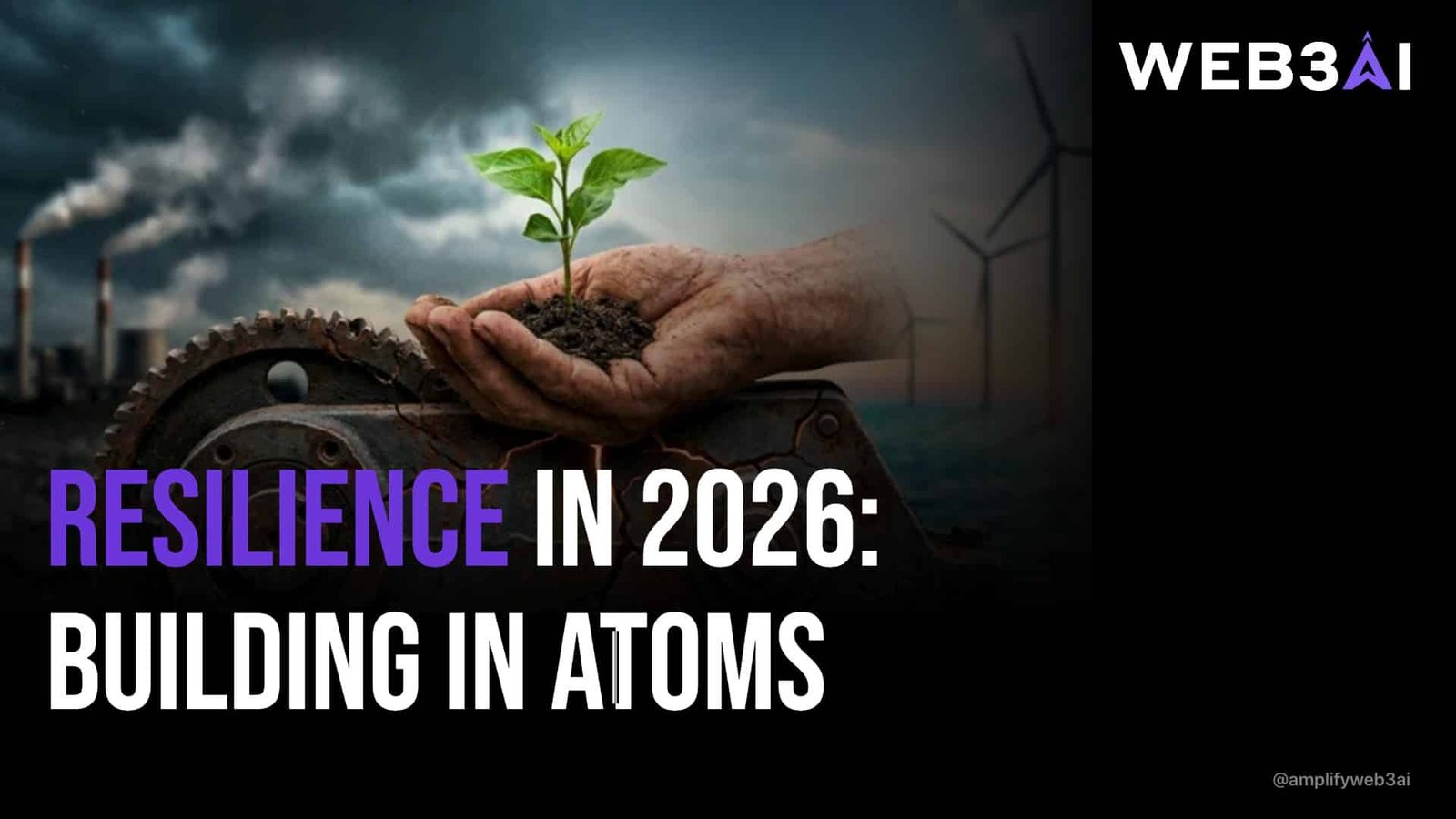

The founder resilience playbook 2026 is no longer a nice-to-have — it is the operating system every startup builder needs to survive what may be the most turbulent business environment in a generation. Geopolitical fractures, supply chain volatility, AI disruption, and shifting investor sentiment are converging at once. Founders who lack a structured approach to resilience are not just risking slow growth — they are risking irrelevance.
According to a Harvard Business Review analysis on leading through crisis, the leaders who navigate uncertainty best are those who build adaptable systems rather than rigid plans. This mirrors what the most durable startups of 2025 demonstrated: the ability to pivot infrastructure, redefine market scope, and preserve team cohesion — all at the same time.
This post breaks down the core principles of building resilience as a founder in 2026, drawing from the “atoms” framework — small, modular, recombinant units of strategy that hold together even when the macro-environment falls apart. Whether you are pre-seed or scaling a Series B, these principles apply directly to your current reality.
The central metaphor of the 2026 resilience conversation is building in atoms — structuring your startup so that every function, product line, team unit, and revenue stream is independently viable. Think of it less like building a cathedral (one magnificent whole that collapses if one pillar breaks) and more like assembling a modular city block where each unit can stand, function, and even generate value on its own.
This approach has roots in lean startup methodology but goes further. In a fractured world — where a trade policy shift in one region can instantly disrupt your supply chain, or a single platform algorithm change can kill a distribution channel — atomic design is a survival trait. Founders who have internalized this mindset are already restructuring their go-to-market motions, hiring strategies, and product roadmaps accordingly.
The practical implication is that you should be able to “detach” any single atom of your business — a market, a feature, a team — without the entire organism dying. This is resilience by design, not by accident. It is the difference between a startup that pivots gracefully and one that implodes under pressure.
Pro Tip: Map your business into its smallest viable units right now. Ask: if this function disappeared tomorrow, what breaks? That answer tells you where your fragility lives.
The founder resilience playbook 2026 rests on five pillars that show up consistently across the startups that are not just surviving but compounding in difficult conditions. These are not abstract ideals — each one maps to a specific set of decisions you make every quarter.
Each of these pillars is interconnected. Capital efficiency buys you time to build community; community creates the distribution that reduces your dependence on paid channels; that in turn reduces burn. The system reinforces itself when all five pillars are active.
For founders building at the intersection of Web3 and the creator economy, the community pillar is especially powerful. Read our deep-dive on how Web3 is reshaping the creator economy to understand how decentralized ownership models are redefining what “community as infrastructure” can actually look like in practice.
The phrase “fractured world” is not hyperbole in 2026 — it is a technical description of the operating environment. Trade blocs are hardening. Regulatory regimes are diverging. The assumption that a single global product can scale uniformly across markets is breaking down for startups in fintech, data, AI, and consumer hardware alike.
Resilient founders are now doing something that was largely optional five years ago: geo-strategy at the product layer. This means designing your product architecture, data storage, and compliance posture to be jurisdiction-aware from day one — not as an afterthought when you try to expand into a new market at Series B.
It also means rethinking partnerships. In a fractured world, local partners are not just a go-to-market convenience — they are a regulatory buffer, a cultural translation layer, and a risk distribution mechanism. The founders who have strong regional ecosystems around them are meaningfully more resilient than those operating as isolated global entities.
Pro Tip: Before entering any new geography in 2026, run a “fracture audit”: map the regulatory, currency, data sovereignty, and geopolitical risks specific to that market. Make this a standing quarterly review, not a one-time exercise.
Most founders have adopted AI tools for productivity — faster writing, better code, quicker analysis. But the founders executing the strongest founder resilience playbook 2026 strategies are using AI as a systemic resilience multiplier, not just a speed enhancer. The distinction matters enormously.
When AI is embedded into your decision-making processes — market signal monitoring, churn prediction, hiring pattern analysis, scenario planning — it becomes a genuine early-warning system. Instead of reacting to crises after they arrive, AI-enabled founders are building the capacity to see fractures forming weeks or months in advance. That lead time is everything when capital is constrained and pivot windows are narrow.
For a practical toolkit on this approach, explore our guide to AI tools for entrepreneurs — it covers both the foundational productivity stack and the higher-order strategic applications that are separating resilient founders from reactive ones.
One of the most underrated sections of any founder resilience playbook is the community chapter. Most founders think of community as a marketing function — a nice-to-have that helps with word-of-mouth. The most resilient founders in 2026 think of community as load-bearing infrastructure, as essential to the business as your product roadmap or your balance sheet.
A strong community does several things that money cannot easily replicate. It provides unfiltered product feedback faster than any survey. It creates organic distribution that does not disappear when your ad budget gets cut. It builds trust with prospective customers in markets where your brand is not yet established. And perhaps most importantly, it generates loyalty that outlasts any single product iteration or market downturn.
In Web3 specifically, community is not just a nice layer on top of the product — in many cases, it IS the product. Token-gated communities, DAO governance structures, and on-chain loyalty systems are creating new models of engagement that are meaningfully more resilient than traditional SaaS customer relationships. Our guide on building a Web3 community walks through exactly how to architect this kind of durable engagement from the ground up.
No resilience playbook is complete without addressing the psychological dimension of founding in 2026. The external fractures — market volatility, geopolitical uncertainty, team pressure — are mirrored by internal ones. Founder burnout, decision fatigue, and isolation are at epidemic levels across the global startup ecosystem right now.
The founders who are building most sustainably have developed what might be called a “resilience practice” — a personal operating system that runs in parallel to their business operating system. This includes structured recovery time (not just vacations, but genuine cognitive rest built into the weekly schedule), peer networks of other founders who can provide honest counsel, and a clarity of personal values that acts as a compass when market conditions make strategic decisions feel overwhelming.
Resilience is not toughness. It is not the ability to work longer hours or absorb more stress. It is the capacity to recover, adapt, and re-engage — and that capacity is a skill that can be built, practiced, and strengthened just like any other competency in your founder toolkit.
The founder resilience playbook 2026 is a structured framework of strategies, mental models, and operational practices designed to help startup founders navigate extreme uncertainty. It matters now because the convergence of geopolitical fracture, AI disruption, and capital market volatility has created an environment where traditional startup playbooks — grow fast, raise often, optimize for scale — are no longer reliable. Founders need a new operating system built for fragility, not just growth.
Building in atoms means designing your startup so that each component — product feature, revenue stream, team function, geographic market — can operate independently if needed. This modular approach means that when one part of your business faces disruption, the others can continue functioning without catastrophic failure. It is the startup equivalent of redundant systems engineering, applied to strategy and operations.
AI becomes a resilience tool when it is embedded into decision-making systems rather than just productivity workflows. Founders should use AI for early-warning signal monitoring, scenario planning, and automated customer feedback analysis. This creates the lead time needed to respond to threats before they become crises — a critical advantage when capital is constrained and pivot windows are narrow.
Community functions as load-bearing infrastructure in a resilient startup. It provides organic distribution, unfiltered product feedback, and customer loyalty that persists through market downturns. In Web3 contexts, on-chain community models — including token-gated access and DAO governance — create even deeper resilience because the community itself has ownership stakes in the platform’s success.
Founders should treat geopolitical risk as a product design problem, not just a compliance issue. Building jurisdiction-aware architecture from day one — covering data sovereignty, regulatory posture, and payment infrastructure — is essential. Running quarterly “fracture audits” on each active geography helps founders stay ahead of regulatory divergence and market access risk before it becomes a crisis.
Absolutely — and it is often the most neglected part. Founder psychology is not a soft topic; it directly determines the quality of decision-making, team culture, and long-term execution capacity. Resilient founders build personal recovery practices, cultivate honest peer networks, and anchor their decisions to a clear set of personal values. Without this inner operating system, even the best external strategy will eventually break down under sustained pressure.
The founder resilience playbook 2026 is ultimately about one thing: building systems — in your product, your team, your strategy, and yourself — that bend rather than break when the world gets difficult. The “atoms” framework gives you the mental model. The five pillars give you the operational structure. The AI and community strategies give you the leverage. And the psychological practices give you the stamina to see it through.
The founders who will compound in 2026 and beyond are not the ones with the most resources or the most favorable market conditions. They are the ones who have built the most adaptive systems — who can absorb shocks, reconfigure quickly, and re-engage with clarity when others are still processing what just happened.
You do not need a perfect plan. You need a resilient one. Start by mapping your atoms, auditing your concentration risks, and investing in the community infrastructure that will carry your brand through whatever the next fracture brings. Explore what we have built at attn.live.