Anouncement

Anouncement
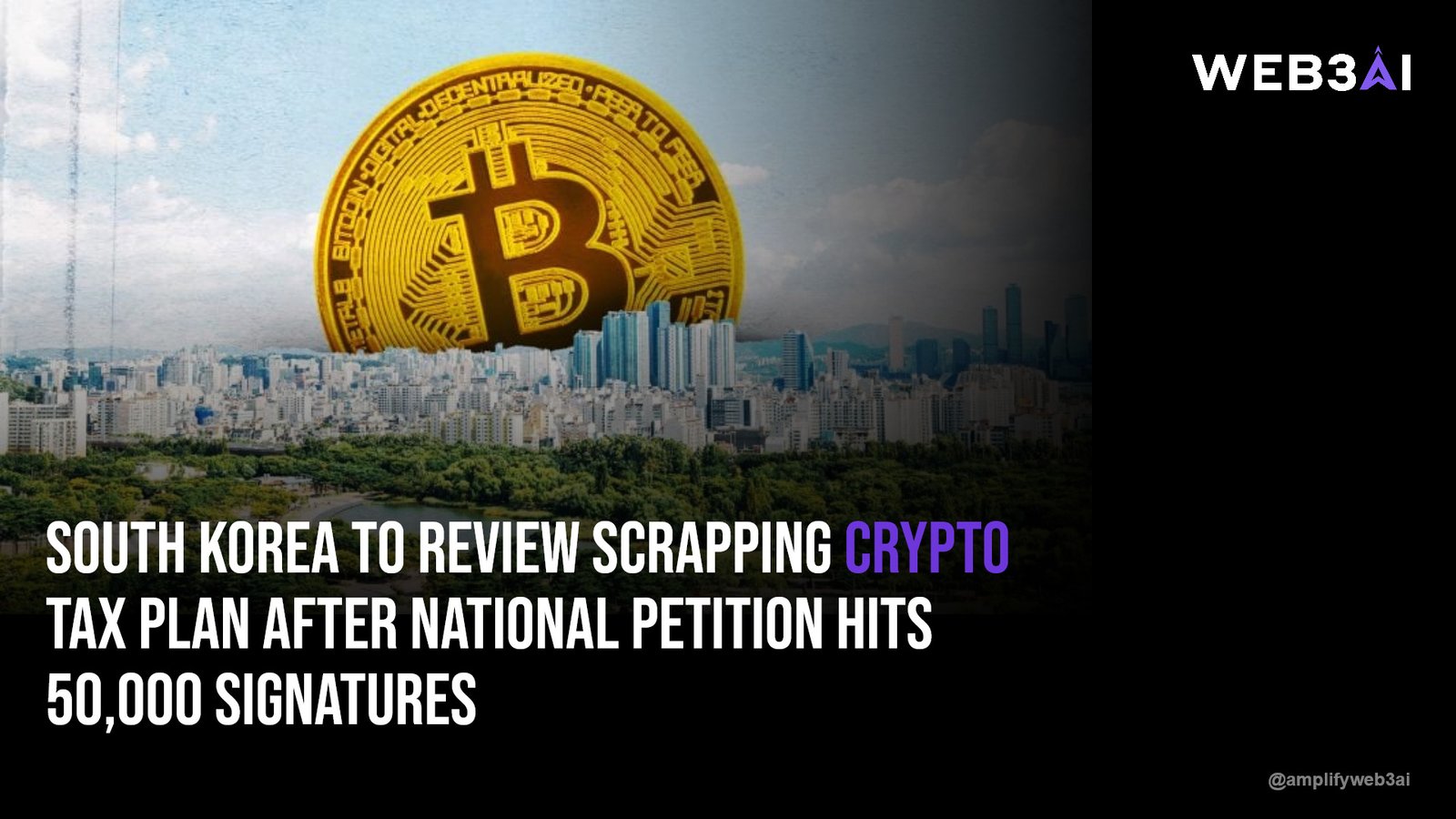

The South Korea crypto tax plan has ignited one of the most significant public protests in the country’s digital asset history. Tens of thousands of South Korean citizens have signed a formal petition demanding the government scrap or substantially delay a proposed cryptocurrency gains tax — a policy that would levy a 20% tax on crypto profits exceeding 2.5 million Korean won (roughly $1,800 USD). For a country that ranks among the world’s most active crypto markets, this is no small disagreement. It is a defining moment for how governments and their citizens negotiate the rules of digital finance.
South Korea has long been a crypto-forward nation, with retail participation rates that rival any market globally. A Reuters report on South Korea’s evolving digital asset landscape notes that the country’s young investors in particular have embraced crypto as a primary vehicle for wealth building — making tax policy here deeply personal and politically charged. The stakes are high: the government needs revenue, but millions of everyday investors fear being penalized for participating in an asset class they see as their best shot at financial independence.
In this post, we break down exactly what the South Korea crypto tax plan proposes, why the public backlash has been so fierce, what the petition is demanding, and what this all means for the future of crypto regulation in Asia and beyond.
The South Korean government has been attempting to implement a crypto gains tax for several years, with multiple delays pushing the effective date further down the road. The current iteration of the plan proposes a 20% tax on cryptocurrency gains that exceed the 2.5 million won threshold in a single tax year. That threshold, critics argue, is far too low — capturing not just wealthy traders but ordinary retail investors who may have seen modest gains during a bull market cycle.
The tax would treat crypto gains similarly to other financial income, requiring investors to calculate, report, and pay taxes on profits from trading, staking rewards, and in some interpretations, even token swaps. This broad scope is one of the central complaints from the crypto community. Many argue the reporting requirements are technically complex and burdensome for the average investor who uses multiple wallets or platforms.
Implementation has already been delayed twice — originally scheduled for 2022, then pushed to 2025, and now facing pressure to be delayed again or redesigned entirely. Each delay reflects both the political sensitivity of the issue and the genuine regulatory complexity involved in taxing decentralized digital assets.
Pro Tip: If you hold crypto in South Korea or invest in KRW-denominated exchanges like Upbit or Bithumb, start tracking your cost basis now — regardless of how the tax debate resolves. Good records protect you under any regulatory outcome.
The public petition against the South Korea crypto tax plan has gathered substantial momentum, with signatories calling on the government to either abandon the tax entirely or raise the exemption threshold significantly. Petitioners argue that 2.5 million won is an unrealistically low bar that fails to account for inflation, the volatility of crypto markets, and the fact that paper gains can evaporate before a tax bill is even due.
Beyond the threshold debate, many petition supporters are pushing for parity with South Korea’s stock market tax policy. Domestic equity investors currently enjoy a much higher exemption threshold before capital gains taxes kick in — a disparity that crypto advocates call fundamentally unfair. Why, they ask, should a crypto investor be taxed more aggressively than a stock market investor making equivalent gains?
The petition also highlights concerns about capital flight. Several prominent voices in the Korean crypto community have warned that aggressive taxation without proper infrastructure could push investors toward offshore platforms or peer-to-peer trading — outcomes that would actually reduce government tax revenue rather than increase it.
For a deeper look at how governments worldwide are approaching digital asset regulation, explore our coverage of how governments are regulating crypto in 2025 — a global picture that puts South Korea’s situation in broader context.
To understand why the South Korea crypto tax plan matters beyond its borders, you have to understand the scale of crypto adoption in the country. South Korea consistently appears in the top tier of global crypto markets by trading volume, with exchanges like Upbit regularly ranking among the highest-volume platforms worldwide. The “Kimchi premium” — a phenomenon where Korean crypto prices trade above global averages due to local demand — is a well-documented measure of just how intense domestic interest is.
Retail participation skews young. A large proportion of Korean crypto investors are millennials and Gen Z investors who have turned to digital assets partly because of sky-high real estate prices and a perception that traditional financial markets are stacked against them. For this demographic, crypto isn’t speculation — it’s strategy. A tax policy that feels punitive to this group carries real political weight.
South Korea is also a major hub for blockchain development and Web3 innovation, with significant domestic investment in NFT platforms, DeFi protocols, and blockchain gaming. Any regulatory friction — including tax uncertainty — can slow the flow of talent and capital into these sectors. Understanding what Web3 means for everyday users is essential context here; our explainer on what Web3 is and why it matters lays out the fundamentals clearly.
Pro Tip: Watch how South Korea’s tax resolution plays out — it will almost certainly influence how other Asian governments, particularly Japan and Singapore, calibrate their own crypto tax frameworks in 2025 and 2026.
South Korea’s ruling party faces a genuine dilemma with the crypto tax plan. On one side, fiscal responsibility demands that all asset classes — including crypto — contribute fairly to national tax revenue. On the other, alienating millions of young, politically engaged voters by imposing what they see as an unfair tax is a significant electoral risk.
This tension has played out visibly in Korean politics. Opposition parties have used crypto tax resistance as a rallying point, while even within the ruling coalition there is debate about whether the current threshold and structure are defensible. Multiple lawmakers have publicly called for either delaying implementation further or redesigning the exemption structure to align with stock market tax rules.
There is also a broader philosophical debate happening beneath the surface: should governments treat crypto profits as equivalent to financial income, as capital gains, or as something else entirely? The answer to that question determines not just the tax rate but the entire reporting and compliance architecture that investors must navigate.
The South Korea crypto tax plan debate is not just a domestic story — it is a preview of the regulatory conversations every major government will be having over the next several years. As crypto matures from a niche asset class into a mainstream component of personal finance, the question of how to tax it fairly becomes unavoidable.
Asia is particularly important in this context. Japan has already implemented crypto tax rules, though at rates many investors find prohibitive. Singapore has taken a more crypto-friendly stance, with no capital gains tax on personal crypto holdings. China has banned most crypto activity outright. South Korea sits at a crossroads — its decision will signal whether the region trends toward thoughtful regulation or reactive restriction.
The DeFi sector is watching closely. Decentralized finance protocols that operate across borders are particularly sensitive to regulatory environments, as users in restrictive jurisdictions will simply migrate to platforms beyond their government’s reach. Our deep dive into the future of decentralized finance explores exactly how regulatory environments shape DeFi adoption patterns worldwide.
The South Korea crypto tax plan proposes a 20% tax on cryptocurrency gains that exceed 2.5 million Korean won (approximately $1,800 USD) per year. It would apply to profits from trading, and potentially staking rewards and token swaps. The plan has already been delayed twice and is now facing renewed public opposition through a formal petition.
The petition has attracted tens of thousands of signatures from South Korean crypto investors and advocates. The signatories are calling for the government to either cancel the tax, significantly raise the exemption threshold, or delay implementation until a fairer framework can be designed. The petition reflects deep frustration across the retail investor community.
Critics argue that 2.5 million won — roughly $1,800 USD — is a very modest sum that would capture a wide range of ordinary retail investors, not just wealthy traders. They also point out that domestic stock market investors enjoy a far more generous exemption threshold, creating an unequal tax burden on crypto holders. Inflation and market volatility compound the problem, since nominal gains can be taxed even when real purchasing power hasn’t increased.
South Korea sits between extremes in the regional picture. Japan taxes crypto gains as “miscellaneous income” at rates up to 55%, while Singapore levies no capital gains tax on personal crypto holdings at all. China has largely banned crypto trading outright. South Korea’s final approach will likely influence neighboring countries that are still designing their own frameworks.
DeFi users face particular complexity under the plan because decentralized protocols often generate income through mechanisms — liquidity provision, staking, yield farming — that don’t map neatly onto traditional tax categories. Many analysts expect that aggressive taxation without clear DeFi guidance will push Korean users toward offshore platforms, reducing the government’s actual tax collection rather than increasing it.
The plan has already been delayed from its original 2022 implementation date and again from 2025. As of mid-2025, implementation is scheduled but under active political review due to the petition and ongoing legislative debate. Another delay or a significant redesign of the exemption structure remains a real possibility.
The South Korea crypto tax plan is more than a domestic fiscal policy dispute — it is a stress test for how democracies handle the regulation of decentralized, borderless financial assets. The petition’s momentum demonstrates that crypto investors are not passive recipients of government policy. They are organized, vocal, and politically aware. Whether South Korea’s government responds with flexibility or rigidity will send a signal felt across global crypto markets.
What makes this moment so significant is the precedent it sets. Every government watching South Korea is calculating whether crypto taxation can be implemented without triggering backlash, capital flight, or electoral damage. The answers will shape regulatory frameworks from Seoul to Brussels to Washington over the next decade. For investors, developers, and Web3 builders everywhere, paying attention to this debate is not optional — it is essential due diligence.
The intersection of policy, technology, and public sentiment is exactly the kind of conversation we exist to support. Explore what we have built at attn.live.