## Why the Quantum Computing Threat to Crypto Demands Your Attention Now
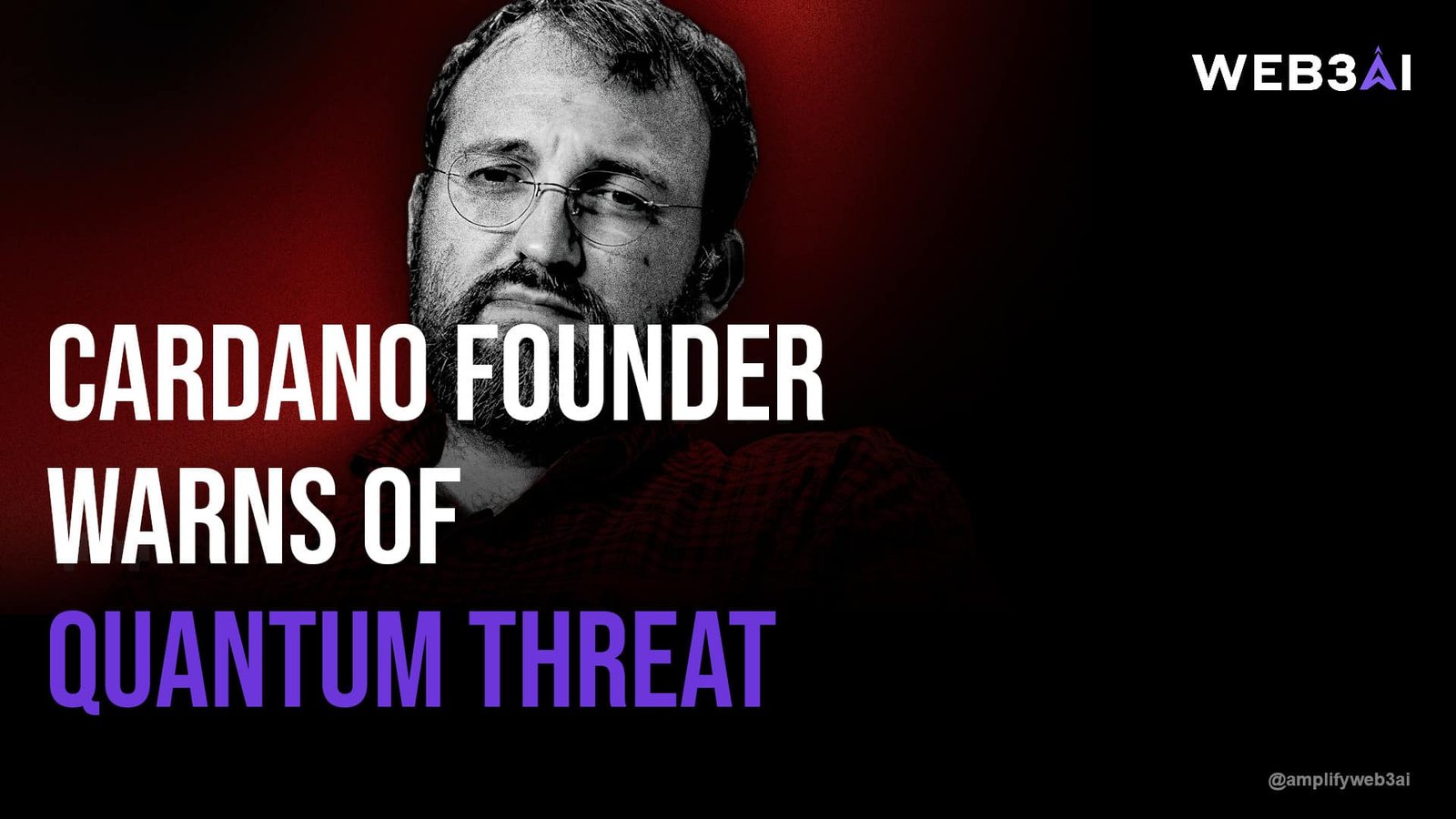
The quantum computing threat to crypto is no longer a distant science fiction scenario — according to Cardano founder Charles Hoskinson, it could become a real and urgent problem as early as 2033. As quantum machines grow more powerful, the cryptographic foundations that protect billions of dollars in digital assets face an unprecedented challenge. If you hold crypto, build on blockchain, or simply care about the future of decentralized finance, this is a conversation you need to understand deeply.
Hoskinson’s warning comes at a pivotal moment for the industry. Research tracked by McKinsey & Company confirms that quantum technology is attracting record investment levels, with significant progress being made on closing the talent and hardware gaps that once made large-scale quantum computers seem theoretical. The pace of advancement is accelerating faster than many in the crypto community have publicly acknowledged. This post breaks down exactly what the threat is, why it matters, and what the most forward-thinking blockchain projects are doing about it right now.
## What Is the Quantum Computing Threat to Crypto, Exactly?
At its core, blockchain security relies on a form of cryptography called elliptic curve cryptography (ECC). This mathematical system protects private keys — the passwords that prove you own your crypto. Today’s classical computers would need billions of years to crack ECC encryption. A sufficiently powerful quantum computer, however, could theoretically do it in hours using an algorithm called Shor’s algorithm.
This is not hypothetical doom-scrolling. Hoskinson publicly warned the crypto community that a cryptographically relevant quantum computer — one powerful enough to break ECC — could emerge by 2033. That gives the industry roughly eight years to migrate to quantum-resistant standards. Eight years sounds like a long time, but blockchain migrations are notoriously slow, politically complex, and technically demanding.
The stakes are enormous. Bitcoin, Ethereum, Cardano, and virtually every major blockchain use ECC-based key infrastructure. Without proactive migration, wallets — especially dormant ones — could become vulnerable to retrospective attack, where a bad actor waits for quantum capability to arrive and then drains unprotected addresses.
## How Cardano and Hoskinson Are Responding
Hoskinson has positioned Cardano as one of the most research-driven blockchains in the space, and his quantum warning was paired with a concrete call to action rather than panic. He has advocated for adopting post-quantum cryptography (PQC) standards — specifically the lattice-based algorithms recently standardized by the U.S. National Institute of Standards and Technology (NIST).
Cardano’s approach centers on a gradual, governance-led migration. Rather than a hard fork shock, the plan involves introducing quantum-resistant signature schemes as an optional upgrade path, allowing users and developers time to adapt. This mirrors the kind of layered, deliberate architecture thinking that has defined Cardano’s development philosophy from its earliest days.
For a broader look at how blockchain technology is evolving alongside emerging technologies like AI, our team explored the convergence in depth — How AI and Blockchain Are Changing the Digital World is essential reading for understanding where the ecosystem is heading.
## The NIST Post-Quantum Standards: What Crypto Needs to Know
In 2024, NIST finalized its first set of post-quantum cryptographic standards — a landmark moment for cybersecurity broadly, and a critical benchmark for the crypto industry. The three primary algorithms standardized are CRYSTALS-Kyber (for key encapsulation), CRYSTALS-Dilithium, and FALCON (for digital signatures). These lattice-based systems are designed to resist attacks from both classical and quantum computers.
The good news is that these algorithms are implementable on existing hardware. The challenge for blockchain is integration: every wallet, every node, every smart contract interaction that relies on signing and verification must eventually be upgraded. This is the kind of coordinated, ecosystem-wide effort that requires years of preparation — which is precisely why Hoskinson and others are raising alarms now rather than later.
Pro Tip: If you are a developer building on any blockchain, start auditing your cryptographic dependencies today. Understanding which libraries use ECC will help you prioritize your post-quantum migration roadmap before it becomes urgent.
For anyone newer to the underlying technology being discussed, our explainer on What Is Web3 and Why Does It Matter? provides essential grounding in how decentralized systems work and why their security architecture is so consequential.
Not all blockchains are equal when it comes to quantum readiness. Here is a realistic snapshot of where things stand:
**Most Proactive:**
Cardano — Active research into PQC migration; Hoskinson publicly driving the conversation
Ethereum — Ethereum Foundation researchers have published on quantum resistance; Vitalik Buterin has outlined a potential quantum-safe recovery path using existing wallet infrastructure
QRL (Quantum Resistant Ledger) — Built from the ground up with post-quantum cryptography using hash-based signatures
**Areas of Concern:**
Bitcoin — Has no formal governance process to mandate protocol-level upgrades; migration would require unprecedented community consensus
Dormant wallets — Early Bitcoin addresses using exposed public keys (pay-to-public-key format) are particularly vulnerable once quantum capability arrives
DeFi protocols — Many smart contract platforms have not begun discussing quantum migration at the protocol layer
The contrast is stark. Projects with active research arms and formal governance mechanisms are far better positioned to execute a migration than those relying on rough consensus among anonymous contributors.
## The Timeline Problem: Why 2033 Is Closer Than It Feels
Eight years is a reasonable runway for a startup to pivot its product. It is an extremely tight window for a global, decentralized financial network with trillions of dollars in assets, millions of users, and no central authority to mandate change. Consider how long Ethereum’s own merge from proof-of-work to proof-of-stake took — roughly seven years from conception to completion.
Pro Tip: The smartest move any long-term crypto holder can make today is to favor projects that are actively discussing and funding post-quantum research. Protocol-level security should be a core evaluation criterion, not an afterthought.
The migration challenge breaks down into several overlapping problems:
Key migration: Users must move funds from ECC-protected addresses to PQC-protected addresses — and many won’t do this proactively
Performance trade-offs: Post-quantum algorithms tend to produce larger signature sizes, which increases transaction data and potential fees
Consensus building: Any protocol-level change requires community agreement, which is slow and contentious in decentralized systems
Tooling and wallet support: Hardware wallets, software wallets, and exchanges all need to implement PQC before end users can benefit
Smart contract audits: Existing deployed contracts that rely on cryptographic assumptions may need to be redeployed or wrapped
None of these problems is insurmountable. But all of them together, running in parallel across an industry that struggles to agree on anything, represent a genuine coordination challenge that deserves serious attention.
## What the Quantum Threat Means for DeFi Specifically
Decentralized finance operates on smart contracts that rely on cryptographic proofs at every layer — from wallet signatures to oracle data feeds to cross-chain bridge verifications. The quantum computing threat to crypto is therefore amplified in DeFi, where automated contracts execute without human oversight and where vulnerabilities can be exploited at machine speed.
Liquidity pools, lending protocols, and yield strategies all depend on the integrity of the underlying signature schemes. If a quantum computer could forge a signature — even briefly — the damage to a DeFi protocol could be catastrophic and irreversible. This is why post-quantum preparedness is not just a “layer 1 problem” but a full-stack challenge for the decentralized finance ecosystem.
For a deeper dive into the evolution of decentralized finance and its structural vulnerabilities, our analysis of The Future of Decentralized Finance connects these threads in a broader context.
## Frequently Asked Questions: Quantum Computing Threat to Crypto
What is the quantum computing threat to crypto and why does it matter now?
The quantum computing threat to crypto refers to the risk that sufficiently powerful quantum computers could break the elliptic curve cryptography protecting blockchain private keys. It matters now because Cardano’s Charles Hoskinson and other experts believe a cryptographically relevant quantum computer could arrive as early as 2033, leaving little time for the industry to migrate to quantum-resistant standards. Acting now gives projects and users the best chance of a safe transition.
How does a quantum computer break cryptocurrency encryption?
Quantum computers use a mathematical process called Shor’s algorithm to solve the discrete logarithm problem that underpins elliptic curve cryptography. Classical computers would take billions of years to crack this — a sufficiently powerful quantum computer could theoretically do it in hours. This means private keys could be derived from public keys, allowing an attacker to steal funds from any exposed wallet address.
Is Bitcoin vulnerable to the quantum computing threat to crypto?
Yes, Bitcoin is potentially vulnerable, particularly early-format addresses where the public key is exposed on-chain. Bitcoin’s lack of formal governance makes a coordinated migration to post-quantum cryptography especially difficult. While the threat is not immediate, the absence of a clear upgrade path is a concern that Bitcoin developers and researchers are beginning to address more publicly.
What post-quantum cryptography standards should blockchain projects adopt?
The U.S. National Institute of Standards and Technology (NIST) finalized its first post-quantum cryptographic standards in 2024, including CRYSTALS-Dilithium and FALCON for digital signatures. These lattice-based algorithms are designed to resist both classical and quantum attacks. Blockchain projects that begin integrating these standards now will be significantly better positioned ahead of the 2033 risk window.
What can individual crypto holders do about the quantum computing threat?
As an individual holder, the most important steps are to stay informed, favor projects with active post-quantum research, avoid leaving funds in old-format addresses with exposed public keys, and be ready to migrate wallets when quantum-resistant options become available. Projects that prioritize governance and security research — like Cardano — are worth following closely as standards evolve.
Will post-quantum upgrades make blockchain transactions slower or more expensive?
Post-quantum signature algorithms like CRYSTALS-Dilithium produce larger data payloads than current ECC signatures, which can increase transaction sizes and, in some networks, fees. However, ongoing research is focused on optimizing these algorithms for blockchain use cases. The trade-off between security and efficiency is a known engineering challenge, and most researchers believe it is manageable with careful implementation.
## Conclusion: Taking the Quantum Computing Threat to Crypto Seriously
The quantum computing threat to crypto is not a reason to panic, but it is absolutely a reason to pay attention and demand action from the projects you support. Charles Hoskinson’s 2033 warning is a gift — it gives the industry a concrete timeline to work against, a clear technical problem to solve, and the urgency needed to overcome blockchain’s notorious governance inertia. The projects that take this seriously now, invest in research, and build migration pathways will be the ones that survive and thrive in a post-quantum world.
For individual holders, developers, and founders alike, the message is the same: security is not a feature to add later. It is the foundation that everything else depends on. The window for proactive preparation is open right now — and that window will not stay open forever. Explore what we have built at attn.live.