Anouncement

Anouncement
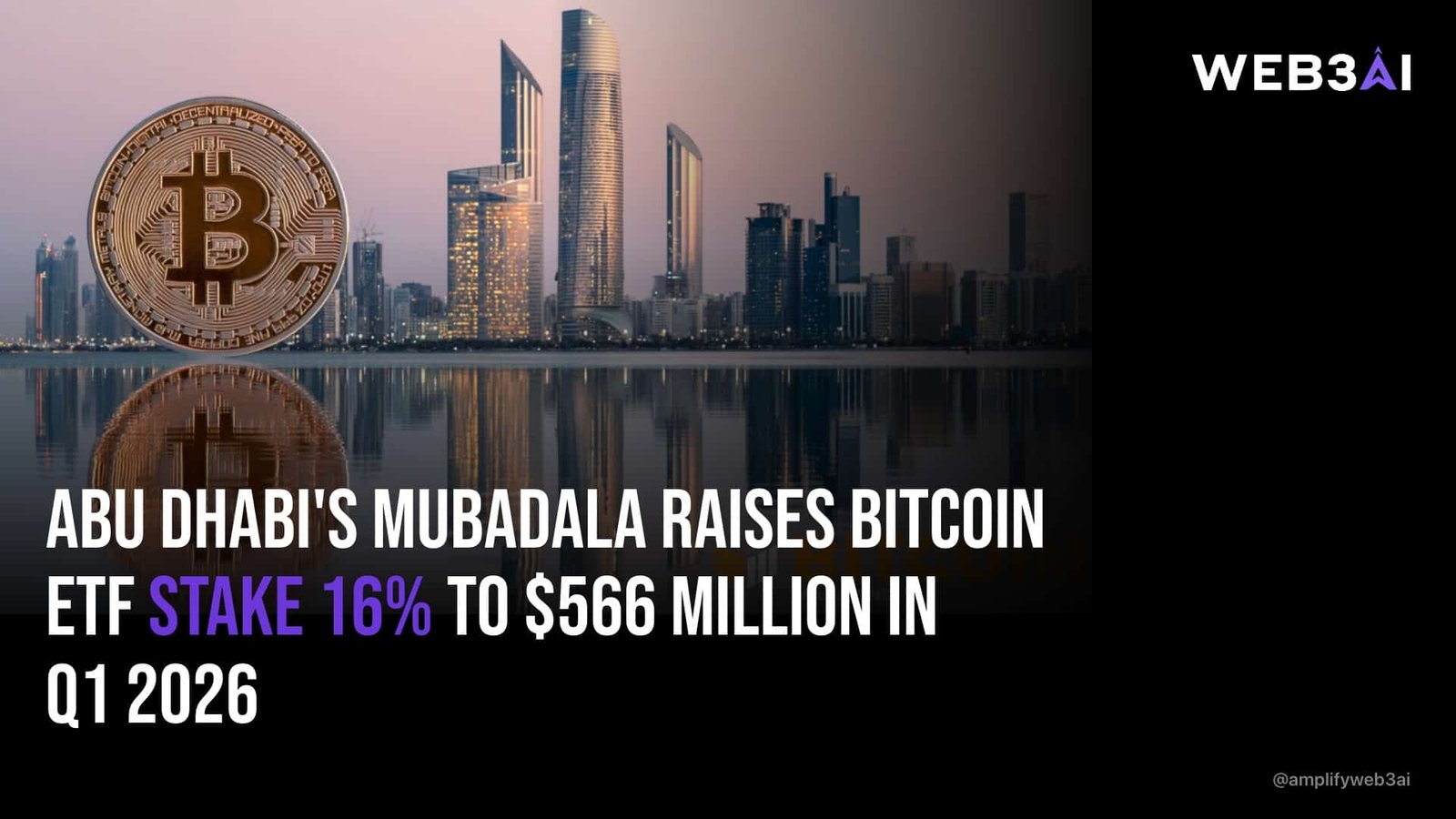

The Abu Dhabi Bitcoin investment strategy is no longer a quiet experiment — it is a statement of sovereign intent. Mubadala Investment Company, Abu Dhabi’s $300+ billion sovereign wealth fund, has significantly raised its Bitcoin holdings, signaling that the world’s most sophisticated institutional investors are no longer sitting on the sidelines. This is not a retail trend or a speculative gamble. This is patient, long-horizon capital moving deliberately into the most scarce digital asset on Earth.
The move is part of a broader global shift. Institutional confidence in Bitcoin has grown steadily since the approval of spot Bitcoin ETFs in the United States, and sovereign funds across the Middle East and Asia are paying close attention. According to Reuters’ 2025 coverage of institutional Bitcoin flows, sovereign and state-backed investors are increasingly treating Bitcoin as a legitimate reserve diversification tool — not a speculative side bet.
In this post, we break down exactly what Mubadala has done, why it matters, what it means for Bitcoin’s global legitimacy, and what everyday investors can learn from Abu Dhabi’s approach to digital asset allocation.
Mubadala’s latest regulatory disclosures revealed a meaningful increase in its Bitcoin exposure, primarily through spot Bitcoin ETF products listed in the United States. Rather than holding Bitcoin directly on a private wallet, the fund chose to access BTC through regulated, audited financial instruments — a move that reflects both institutional risk management discipline and a preference for compliance-friendly infrastructure.
This approach is important. Sovereign wealth funds operate under strict mandates and governance frameworks. The fact that Mubadala is choosing Bitcoin-linked financial products — rather than avoiding the asset class entirely — tells you something fundamental has changed in how the world’s most conservative capital pools view cryptocurrency. It validates the ETF vehicle as a legitimate gateway for institutional capital.
The size of the position matters too. While Mubadala has not disclosed the exact dollar figure of its increased stake, analysts tracking ETF filings estimate the fund’s Bitcoin-linked exposure now runs into the hundreds of millions of dollars. For context, that puts it among the most substantial sovereign-linked BTC positions anywhere in the world outside of nation-state treasury holdings like those of El Salvador.
Pro Tip: When a sovereign wealth fund with a 20-to-30-year investment horizon adds Bitcoin, it is not trading — it is allocating. That distinction matters enormously when you are trying to read institutional intent.
For a deeper look at how institutions have been building their Bitcoin positions quietly over the past two years, our breakdown of how institutions are quietly accumulating Bitcoin walks through the key patterns and signals that preceded moves like Mubadala’s.
Mubadala’s decision to gain Bitcoin exposure through ETFs rather than direct custody is not accidental — it is a deliberate structural choice. Spot Bitcoin ETFs offer sovereign funds what private wallets cannot: audited custody, daily NAV reporting, regulatory oversight, and seamless integration into existing portfolio management systems. For a fund that answers to a government, these features are not optional extras. They are prerequisites.
The US spot Bitcoin ETF ecosystem, which launched in January 2024, has become the primary on-ramp for institutional capital globally. Products from BlackRock, Fidelity, and other major asset managers have collectively absorbed billions of dollars in inflows — and sovereign funds like Mubadala are a key part of that story. The ETF wrapper essentially solved the compliance problem that kept large institutional money on the sidelines for years.
This dynamic also has implications for Bitcoin’s price structure. When long-duration capital like a sovereign wealth fund buys through an ETF, those shares are typically held for years — not flipped in days. That kind of demand creates structural upward pressure on Bitcoin’s price over time, independent of short-term market sentiment. It is a fundamentally different buyer profile than retail speculation.
Pro Tip: If you are researching Bitcoin ETF options for your own portfolio, prioritize products from regulated issuers with transparent custody arrangements and strong daily volume — the same criteria sovereign funds use.
To understand the full context of how the Bitcoin ETF landscape evolved and what it unlocked for institutional investors, read our guide to Bitcoin ETF approval and what it means for crypto — it covers the regulatory milestones that made moves like Mubadala’s possible.
The timing of Mubadala’s increased stake is not coincidental. Several macro forces are converging in 2025 to make Bitcoin an attractive reserve asset for sovereign capital pools. Chief among them is the ongoing debasement of fiat currencies — a structural concern for any fund that holds significant dollar, euro, or yen-denominated assets. Bitcoin’s fixed supply of 21 million coins offers a mathematical hedge against monetary inflation that no government bond can replicate.
There is also a geopolitical dimension. Abu Dhabi, like many Gulf state economies, is actively diversifying away from oil-linked revenue streams and dollar-denominated assets. Bitcoin — decentralized, borderless, and outside the control of any single government — fits naturally into a diversification mandate that is partly about financial returns and partly about sovereignty. It is the same logic that drives central banks to accumulate gold, applied to a 21st-century asset.
The post-halving supply dynamic is another factor. Bitcoin’s fourth halving in April 2024 reduced the daily issuance of new coins by 50%. When long-term demand from sovereign funds increases at the same time as new supply decreases, the mathematical outcome is straightforward. Sophisticated investors who understand this dynamic are positioning early — before the full effect of supply compression is priced in by the broader market.
There is a version of Bitcoin’s story where it remains a niche asset — beloved by technologists and libertarians but never truly accepted by the global financial establishment. Mubadala’s move makes that version significantly harder to tell. When a state-backed fund managing the wealth of one of the world’s richest sovereign nations allocates meaningfully to Bitcoin, the “fringe asset” narrative collapses under the weight of evidence.
This is what legitimacy looks like in slow motion. It does not arrive with a press conference or a CEO tweet. It arrives in regulatory filings, in investment committee approvals, in the quiet reallocation of basis points from treasuries to BTC. Mubadala’s decision will be studied in business schools and cited in future investment committee presentations around the world as a data point that normalized sovereign Bitcoin allocation.
The ripple effects are already visible. Other sovereign wealth funds — in Norway, Singapore, Kuwait, and beyond — are watching Abu Dhabi’s moves closely. Institutional investing is deeply peer-influenced: once one credible, large-scale player makes a move, the social and professional pressure on others to at least evaluate the same opportunity increases substantially. Mubadala may well have just triggered a new wave of sovereign fund due diligence processes on Bitcoin globally.
This trajectory connects directly to the broader transformation happening at the intersection of finance and Web3 infrastructure. Our exploration of Web3 and the future of finance puts moves like Mubadala’s in the context of the larger decentralized financial system that is taking shape — one that sovereign funds are increasingly choosing to participate in rather than resist.
Most people reading this are not managing a $300 billion sovereign fund — but the logic Mubadala is applying translates cleanly to individual portfolios. The core insight is simple: Bitcoin’s properties as a scarce, decentralized, censorship-resistant asset make it a legitimate diversification tool, not just a speculative instrument. The question is not whether to consider it. The question is how much, held how, through what vehicle.
Mubadala’s ETF-based approach is instructive here. Using a regulated, liquid product to gain Bitcoin exposure reduces counterparty risk, simplifies tax reporting in most jurisdictions, and keeps the position within existing brokerage or retirement account infrastructure. For most individual investors, this is also the most practical entry point — especially in jurisdictions where direct Bitcoin custody involves complexity.
Mubadala Investment Company, Abu Dhabi’s sovereign wealth fund, has increased its Bitcoin exposure through regulated spot Bitcoin ETF products listed in the United States. The strategy reflects a long-term diversification mandate rather than short-term speculation, using ETF vehicles to gain compliant, audited exposure to Bitcoin without direct custody complexity. This is consistent with how large institutional funds approach new asset classes globally.
Sovereign wealth funds operate under strict governance mandates that require audited custody, regulatory compliance, and integration with existing portfolio infrastructure. Spot Bitcoin ETFs — offered by regulated issuers like BlackRock and Fidelity — satisfy all of these requirements. Direct Bitcoin custody, while possible, introduces operational and compliance complexity that most institutional investment committees prefer to avoid at this stage of market maturity.
Mubadala is among the most prominent sovereign wealth funds to publicly increase Bitcoin exposure through ETF filings, but it is not alone. Norway’s Government Pension Fund holds indirect Bitcoin exposure through technology company equity, and several Asian state-linked funds have been quietly evaluating digital asset allocations. Mubadala’s move is notable because it is direct, deliberate, and documented — making it a reference point for peers globally.
Sovereign wealth funds are long-duration holders — they typically hold positions for years or decades rather than trading actively. When this type of capital enters the Bitcoin market through ETFs, it removes coins from circulating supply for extended periods, creating structural upward pressure on price over time. Combined with Bitcoin’s post-halving supply reduction, sustained sovereign demand has historically been a significant price catalyst.
The underlying logic — treating Bitcoin as a scarce, non-correlated diversification asset with a fixed supply — applies to individual portfolios as much as it does to sovereign ones. That said, individual investors should size Bitcoin positions relative to their own risk tolerance, time horizon, and overall financial plan. The ETF approach Mubadala uses is accessible to most retail investors today through standard brokerage accounts, making it a practical starting point for those new to the asset class.
The Abu Dhabi Bitcoin investment strategy pursued by Mubadala is more than a portfolio update — it is a landmark moment in the mainstream institutionalization of Bitcoin. When sovereign capital with a multi-decade horizon increases its BTC exposure, it sends a clear signal to every other institutional investor, policy maker, and individual saver watching: Bitcoin has earned its seat at the table of serious global asset allocation. The conversation is no longer about whether sovereign funds should consider Bitcoin. It is about how much, and when.
We are living through a period of rapid convergence between traditional finance and digital assets. Sovereign funds, ETF issuers, and decentralized networks are beginning to speak the same language — and the vocabulary is increasingly being written in Bitcoin. For investors at every level, understanding these macro flows is not optional. It is essential to making informed decisions about your own financial future in an era where the rules of money are being rewritten in real time.
Stay ahead of the shifts in institutional crypto adoption, Web3 infrastructure, and AI-powered finance. Explore what we have built at attn.live.