Anouncement

Anouncement
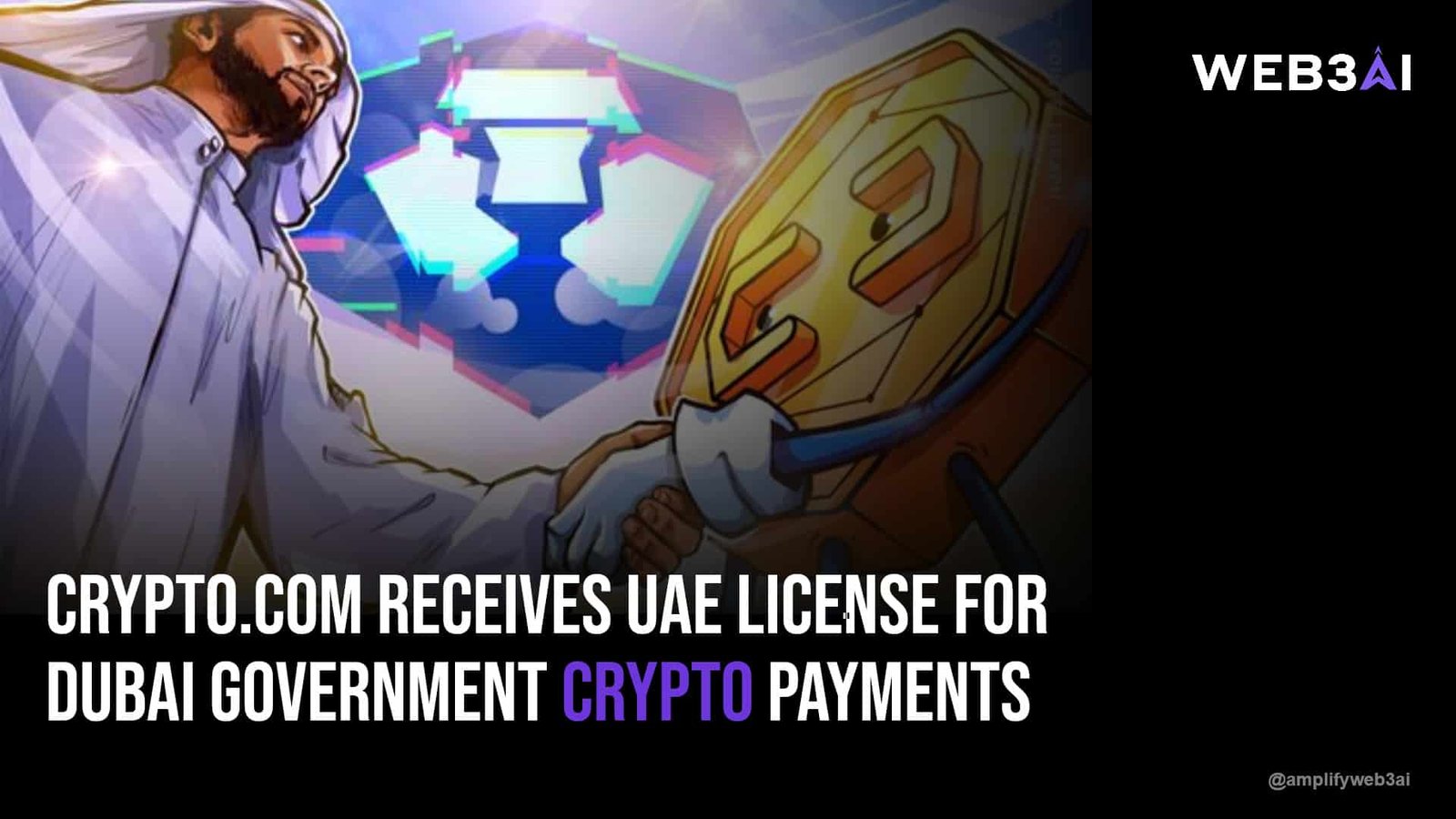

The crypto UAE Central Bank license that Crypto.com just secured isn’t just a regulatory checkbox — it’s a signal that government-level crypto adoption is no longer a distant future. In early 2025, the Central Bank of the United Arab Emirates granted Crypto.com an official license allowing it to facilitate virtual asset payments for government services, making it one of the first global crypto exchanges to receive this level of institutional endorsement in the region.
This milestone doesn’t exist in a vacuum. According to Reuters, the UAE has been actively positioning itself as a global crypto regulatory hub, building a framework that balances innovation with consumer protection. The country’s forward-thinking approach has now culminated in a landmark move that puts Crypto.com at the center of a government-backed digital payments ecosystem.
If you’ve ever wondered what it actually looks like when crypto goes mainstream at a sovereign level, this is it. In this post, we break down exactly what this license means, why the UAE is leading the charge, and what it signals for the broader Web3 economy.
This isn’t a generic fintech license or a soft regulatory nod. The license issued by the Central Bank of the UAE specifically authorizes Crypto.com to process virtual asset payments for government services — think utility payments, public sector fees, and potentially broader civic transactions paid in digital assets.
That distinction matters enormously. Most crypto licenses granted around the world allow exchanges to operate, hold funds, or offer trading services. A license tied to government payments means the central bank is comfortable enough with Crypto.com’s compliance infrastructure to let it touch sovereign financial flows. That’s a very different level of trust.
The scope also implies integration with existing government payment rails — a technical and regulatory feat that required Crypto.com to meet the UAE’s strict anti-money laundering (AML) and know-your-customer (KYC) standards. It’s a testament to how far the crypto industry’s compliance culture has matured.
Pro Tip: When evaluating any crypto platform’s regulatory standing, look beyond whether it’s “licensed” and ask specifically what the license permits. A government payments license carries far more institutional weight than a standard exchange permit.
To understand how deeply this kind of development ties into the broader financial transformation underway, it helps to look at how Web3 is transforming finance at every layer — from retail banking to sovereign payment infrastructure.
The UAE isn’t acting on a whim. Over the past three years, the country has built one of the world’s most deliberate and comprehensive crypto regulatory ecosystems. Between the Dubai Virtual Assets Regulatory Authority (VARA), Abu Dhabi Global Market (ADGM) frameworks, and now direct Central Bank licensing, the UAE has created layered oversight that gives both innovators and institutions the clarity they need.
Compare that to the regulatory patchwork in the United States or the ongoing uncertainty in the European Union, and it’s easy to see why global crypto firms are racing to establish a UAE foothold. The country offers something rare: regulatory certainty paired with genuine openness to innovation.
Crypto.com’s new license isn’t an isolated event — it follows a string of major exchanges, including Binance and OKX, securing UAE-based operational licenses. But being the first to receive authorization specifically for government payments gives Crypto.com a unique competitive moat in the region.
Every time a government body issues a formal crypto license — especially one tied to public sector payments — it chips away at the narrative that crypto is inherently ungovernable. The crypto UAE Central Bank license granted to Crypto.com is particularly powerful because it demonstrates that a G20-adjacent sovereign economy trusts a crypto exchange to handle real government money flows.
Other nations are watching. When a country with the UAE’s economic influence and global financial connectivity moves this decisively, it creates pressure — and permission — for others to follow. Regulatory bodies in Southeast Asia, Latin America, and even parts of Europe are likely studying this framework carefully.
For everyday users, this is also meaningful. Government-level licensing typically comes with the highest standards of consumer protection, fund segregation, and dispute resolution. It raises the floor for what users can expect from regulated platforms globally.
Pro Tip: If you’re choosing a crypto platform for long-term use, prioritize exchanges that actively pursue multi-jurisdictional licensing. A platform licensed by a central bank signals a significantly higher compliance bar than one operating under a generic fintech permit.
Understanding how to safely interact with these platforms starts with knowing your tools. Our guide on what a crypto wallet is and how it works is a great foundation for anyone looking to participate in this evolving landscape.
For Crypto.com specifically, this license represents a strategic inflection point. The exchange has faced its share of reputational turbulence in the wake of the broader 2022 crypto market downturn. Re-establishing trust through rigorous regulatory compliance — and now government-level endorsement — is exactly the kind of credibility move that differentiates serious long-term players from short-cycle operators.
The company’s CEO, Kris Marszalek, has repeatedly emphasized a compliance-first growth strategy. Securing a UAE Central Bank license for virtual asset government payments validates that strategy in the most concrete way possible: a sovereign institution saying “we trust you with our payments.”
This also opens commercial doors. Once a platform is licensed for government payments, it becomes a natural candidate for further public-private partnerships — think digital dirham integrations, tokenized government bonds, or CBDC (central bank digital currency) distribution rails. The license is a foundation, not a ceiling.
We’re entering a new chapter in the relationship between decentralized finance and traditional financial institutions. The crypto UAE Central Bank license framework isn’t anti-DeFi — it’s a sign that regulated bridges between the two worlds are being built in real time. Governments aren’t trying to kill crypto; the smartest ones are figuring out how to work with it.
The UAE’s digital dirham project — its in-development central bank digital currency — adds another layer of context here. As the country builds its CBDC infrastructure, having licensed crypto intermediaries already embedded in government payment flows creates a natural on-ramp for future digital currency integration.
This is why the intersection of DeFi and traditional finance is so important to follow right now. The ground is shifting fast, and the frameworks being built in the UAE today will likely become templates for global adoption tomorrow. For a deeper look at how decentralized finance is reshaping the financial system from the ground up, explore the rise of decentralized finance and what it means for everyday users.
It is an official license from the Central Bank of the United Arab Emirates authorizing Crypto.com to process virtual asset payments specifically for government services. This makes Crypto.com one of the first crypto exchanges globally to receive this level of sovereign endorsement for public sector payment flows.
It signals that a major sovereign financial authority is comfortable integrating crypto infrastructure into government payment systems. This sets a precedent that other central banks and regulators around the world are likely to study and potentially replicate, accelerating mainstream crypto adoption at the institutional level.
Most crypto licenses permit exchanges to operate, trade, or hold customer funds. A government payments license specifically authorizes processing transactions tied to sovereign services — a much higher compliance threshold that requires meeting central bank-level AML, KYC, and operational standards.
For existing and prospective users, it means the platform has passed one of the world’s most rigorous regulatory reviews. It adds a layer of consumer confidence and suggests the platform is built for long-term institutional operation, not short-term market speculation.
Many analysts believe the UAE’s regulatory clarity will influence other nations, particularly in the Gulf region, Southeast Asia, and parts of Europe. The combination of structured oversight and openness to innovation is already attracting global crypto firms to the UAE, creating a demonstration effect for other governments.
The crypto UAE Central Bank license secured by Crypto.com is more than a corporate win — it’s a landmark moment for the entire digital asset industry. It proves that crypto, when built with compliance at its core, can earn the trust of the world’s most rigorous financial institutions. And it shows that governments don’t have to choose between innovation and control — they can have both.
For builders, investors, and everyday users, this is a green light. The infrastructure for a crypto-integrated financial system is being laid right now, country by country, license by license. The UAE is showing the world how it’s done.
The Web3 economy is maturing faster than most people realize, and staying informed is the first step to participating in it meaningfully. Explore what we have built at attn.live.