Anouncement

Anouncement
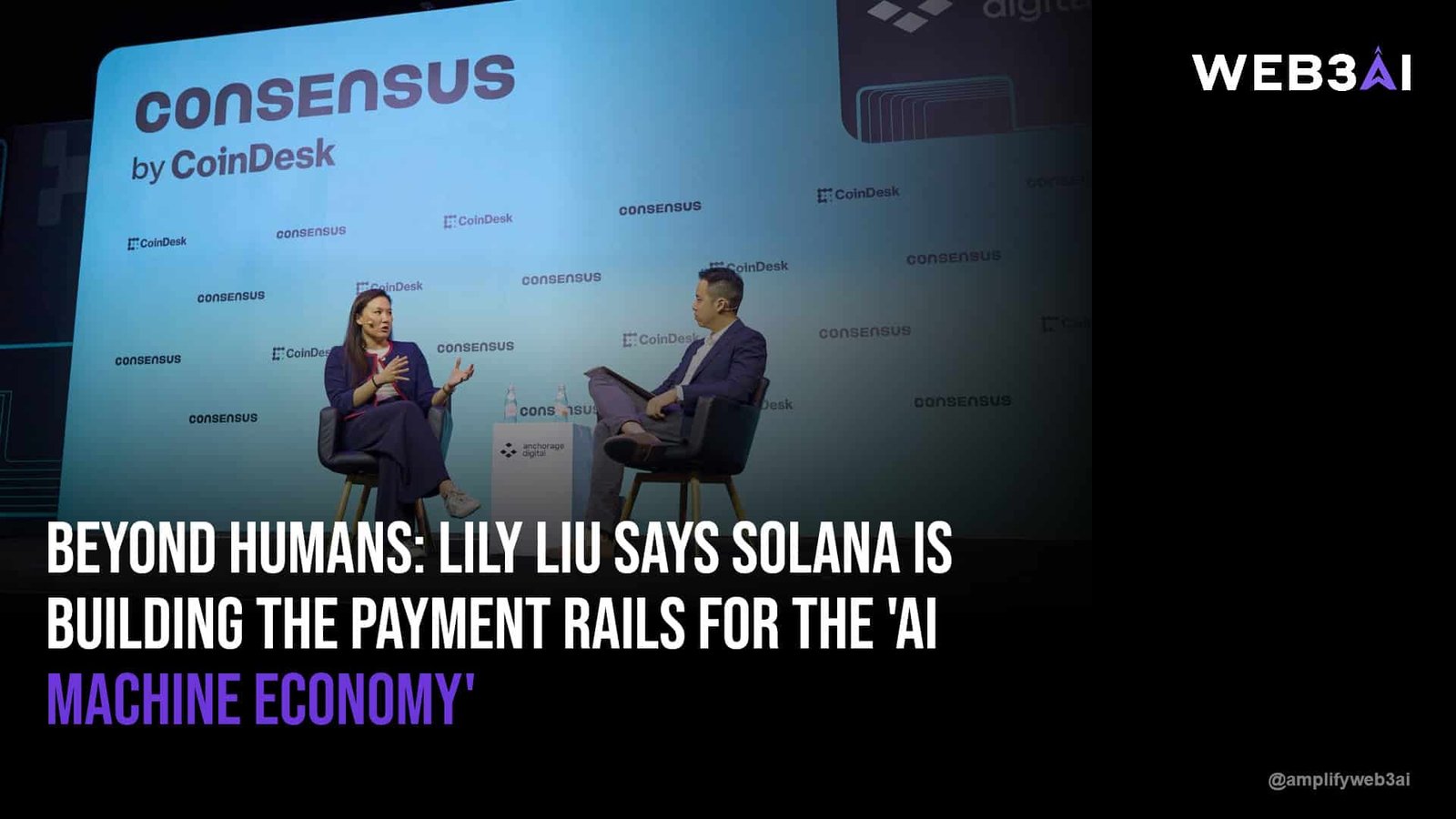

The Solana AI machine economy is no longer a thought experiment — according to Solana Foundation President Lily Liu, it is already being built in real time. At Consensus 2025, Liu made a bold declaration: the next wave of economic activity will not be driven by human consumers clicking “buy,” but by autonomous AI agents transacting with each other at machine speed. Solana, she argued, is uniquely positioned to be the financial backbone of that world.
This is a profound shift in how we think about blockchain utility. For years, crypto advocates framed decentralized networks as tools for human financial freedom — banking the unbanked, removing intermediaries, enabling self-custody. Those goals remain valid. But a new use case is emerging that could dwarf human-to-human transactions in volume, speed, and frequency. Wired’s 2025 deep-dive into autonomous AI agents explores how these software entities are already making purchasing decisions, negotiating contracts, and routing payments without human intervention. The infrastructure they run on matters enormously.
In this post, we break down what Lily Liu actually said, why Solana’s technical architecture makes it a serious contender for machine-to-machine payments, and what this means for builders, investors, and anyone paying attention to where Web3 and AI are converging.
Speaking at one of crypto’s most-watched annual events, Lily Liu framed Solana’s mission in terms that went well beyond DeFi or NFTs. Her core argument was simple and striking: AI agents need money, they need to move that money fast, and they need to do it without the friction of traditional financial rails. Solana, with its high throughput and low transaction costs, is designed precisely for that kind of environment.
Liu pointed to the sheer scale of what a machine economy implies. Human economies are constrained by human attention and human time. An AI agent can execute thousands of micro-transactions per minute — paying for compute, licensing data, routing tasks to sub-agents, and settling contracts — all without ever sleeping. For that to work economically, each transaction needs to cost fractions of a cent and settle in milliseconds. Solana’s average transaction fee of roughly $0.00025 and sub-second finality make it one of the very few blockchains that can plausibly serve that demand today.
What made Liu’s remarks especially notable was her framing of this not as a future possibility but as an active build. Teams are already deploying AI agents on Solana-compatible infrastructure, and the ecosystem is iterating fast. The machine economy is not waiting for permission.
Think of it this way: if AI agents are the new workers of the digital economy, they need paychecks, expense accounts, and invoicing systems. Traditional payment networks were built around humans — they have verification steps, processing delays, and minimum transaction sizes that make them useless for machine-speed commerce. Credit card rails cannot process a $0.001 payment to an API. Bank wires cannot settle in 400 milliseconds.
Blockchain networks solve some of these problems but introduce others. Ethereum, for all its developer mindshare, charges gas fees that make micro-transactions economically unviable. Bitcoin’s settlement times are measured in minutes, not milliseconds. The Solana AI machine economy thesis rests on the idea that Solana’s architecture — parallel transaction processing, a unique Proof of History consensus mechanism, and a growing ecosystem of developer tools — makes it the right fit for this specific use case.
There is also a programmability angle. AI agents need smart contracts that can encode complex conditional logic: “pay this sub-agent only if the task is verified complete,” or “auto-renew this data subscription if usage exceeds a threshold.” Solana’s smart contract environment, while different from Ethereum’s EVM, supports this kind of programmable money flow. That combination of speed, cost, and programmability is what Liu is betting on.
For a deeper look at how autonomous software is already reshaping Web3 ecosystems, check out our post on how AI agents are transforming Web3 — it covers the tooling, protocols, and use cases emerging right now.
To understand why Solana keeps coming up in machine economy conversations, it helps to understand what makes it technically distinct. Most blockchains process transactions sequentially — one after another in a queue. Solana’s runtime processes thousands of transactions in parallel, using a mechanism called Sealevel that can execute non-overlapping transactions simultaneously. This is the kind of architecture you design when you are thinking about machine-speed demand, not human-speed demand.
Proof of History (PoH) is Solana’s other key differentiator. Rather than requiring validators to agree on the time of each event (which is slow), PoH encodes a cryptographic timestamp into the transaction itself, allowing validators to process events without the back-and-forth of traditional consensus. The result is a network that has sustained over 65,000 transactions per second in stress tests — orders of magnitude beyond what Ethereum or Bitcoin handle today.
None of this means Solana is perfect. The network has experienced outages, and its validator hardware requirements create centralization concerns that critics raise regularly. But for the specific use case Liu is describing — high-frequency, low-value, machine-initiated transactions — the performance profile is genuinely compelling. The question is whether the ecosystem can build reliable enough infrastructure on top of it to support a true machine economy.
Pro Tip: If you’re building AI agent workflows that require on-chain payments, benchmark Solana’s devnet transaction costs against your expected micro-payment volume before committing to an architecture. At sub-cent fees, the economics change dramatically.
Solana is not the only network making noise in the AI agent payments space, and it’s worth contextualizing Liu’s claims. Ethereum’s Layer 2 ecosystem — networks like Base, Arbitrum, and Optimism — has dramatically reduced gas costs and is also attracting AI agent builders. Cosmos-based chains and newer networks like Sui and Aptos are making similar pitches around speed and throughput.
What Solana has that many competitors lack is a mature, liquid ecosystem with deep DeFi infrastructure already in place. AI agents need access to liquidity, stablecoins, and financial primitives — not just raw transaction throughput. Solana’s DeFi ecosystem, anchored by protocols like Jupiter, Raydium, and the USDC-heavy stablecoin market, gives agent builders a richer toolkit to work with from day one.
There’s also a developer community angle. Solana’s hackathon culture and its Superteam global network have produced thousands of builders who understand the ecosystem deeply. When AI agent frameworks like ElizaOS and similar tools start defaulting to Solana integrations, it creates a compounding network effect that is hard to replicate quickly. If you want to understand how Solana stacks up against its main competitor for developer mindshare, our comparison of Solana vs Ethereum for Web3 builders breaks it down in practical terms.
The implications of a machine economy running on blockchain rails are significant — and not just for crypto enthusiasts. If AI agents become primary economic actors, the payment systems they use will shape which blockchains accumulate value, which tokens become reserve assets, and which developer ecosystems attract the best talent and capital.
This is a version of the “fat protocol” thesis playing out in real time: value accrues to the infrastructure layer, not just the applications built on top. If Solana becomes the default payment rail for AI agent commerce, demand for SOL — the network’s native token, used to pay transaction fees — grows with every new agent deployment. That’s a fundamentally different demand driver than speculative trading or even DeFi yields.
It also raises important questions about who controls these agents and how accountability works in a fully automated economy. If an AI agent makes a bad financial decision — an erroneous trade, a fraudulent payment, a misdirected contract — who is responsible? These are governance and regulatory questions that the industry has barely begun to address. Liu’s vision is exciting, but it comes with real design challenges that builders and policymakers will need to work through together.
Pro Tip: When integrating AI agents with on-chain payment systems, always build in human-in-the-loop override mechanisms — especially for transactions above a defined threshold. Autonomous doesn’t have to mean ungoverned.
For more on how crypto payments are evolving across the Web3 landscape more broadly, our post on the future of crypto payments in a Web3 world covers the trends, protocols, and infrastructure shifts happening right now.
Lily Liu’s framing at Consensus 2025 gives us a useful lens for evaluating Solana’s trajectory over the next few years. Whether or not you believe Solana will “win” the machine economy, the thesis itself is pointing at something real: AI agents will need programmable money, and not every blockchain is equipped to provide it.
The Solana AI machine economy refers to the emerging ecosystem of autonomous AI agents that transact with each other using Solana’s blockchain as their payment infrastructure. Rather than humans initiating transactions, software agents pay for compute, data, and services at machine speed and micro-transaction scale. Lily Liu, President of the Solana Foundation, outlined this vision at Consensus 2025.
Solana offers sub-second transaction finality, average fees of around $0.00025, and a parallel processing architecture that can handle thousands of transactions per second. These characteristics make it economically viable for high-frequency micro-transactions — the kind AI agents generate — in a way that slower, more expensive blockchains cannot match today.
Traditional crypto use cases focus on human-initiated transactions — buying tokens, sending remittances, trading on DEXs. The machine economy flips this: AI agents become the primary economic actors, transacting autonomously without human approval for each step. This changes the demand profile for blockchain networks entirely, prioritizing speed and cost over user experience design.
Solana has experienced network outages in the past, which would be catastrophic for real-time AI agent workflows. There are also validator centralization concerns and governance questions about who is accountable when an AI agent executes a harmful or erroneous transaction. These are real risks that builders and the Solana ecosystem are actively working to address.
Ethereum Layer 2 networks (Base, Arbitrum, Optimism), as well as newer chains like Sui and Aptos, are all making credible pitches for AI agent payment infrastructure. Each has trade-offs in speed, cost, ecosystem maturity, and developer adoption. Solana’s advantage is its combination of throughput, established DeFi liquidity, and an active developer community already building AI-native tools.
Stablecoins are essential for machine-to-machine payments because AI agents need price-stable settlement to function predictably. Volatile native tokens introduce unpredictable cost variability into automated workflows. USDC on Solana is already deeply integrated into the ecosystem, and growing stablecoin volume on the network is one of the clearest signals that the machine economy thesis is moving from theory to practice.
The Solana AI machine economy is not a pitch deck concept — it is an active buildout with real infrastructure, real agent deployments, and a Solana Foundation actively orienting its resources toward making it work. Lily Liu’s framing at Consensus 2025 was not hype for its own sake; it was a roadmap for where one of blockchain’s most performant networks is placing its biggest bet.
For builders, the message is clear: if you are designing AI agent systems that need to move money, the payment rail you choose will shape what your product can actually do. Solana’s combination of speed, low cost, and ecosystem depth makes it a serious option worth evaluating now, not later. For investors, the machine economy thesis offers a fundamentally different and potentially more durable demand driver for SOL than the speculative cycles that have defined crypto before.
The convergence of AI and Web3 is one of the most consequential technological shifts of this decade, and the infrastructure layer is being built right now. Explore what we have built at attn.live.