Anouncement

Anouncement
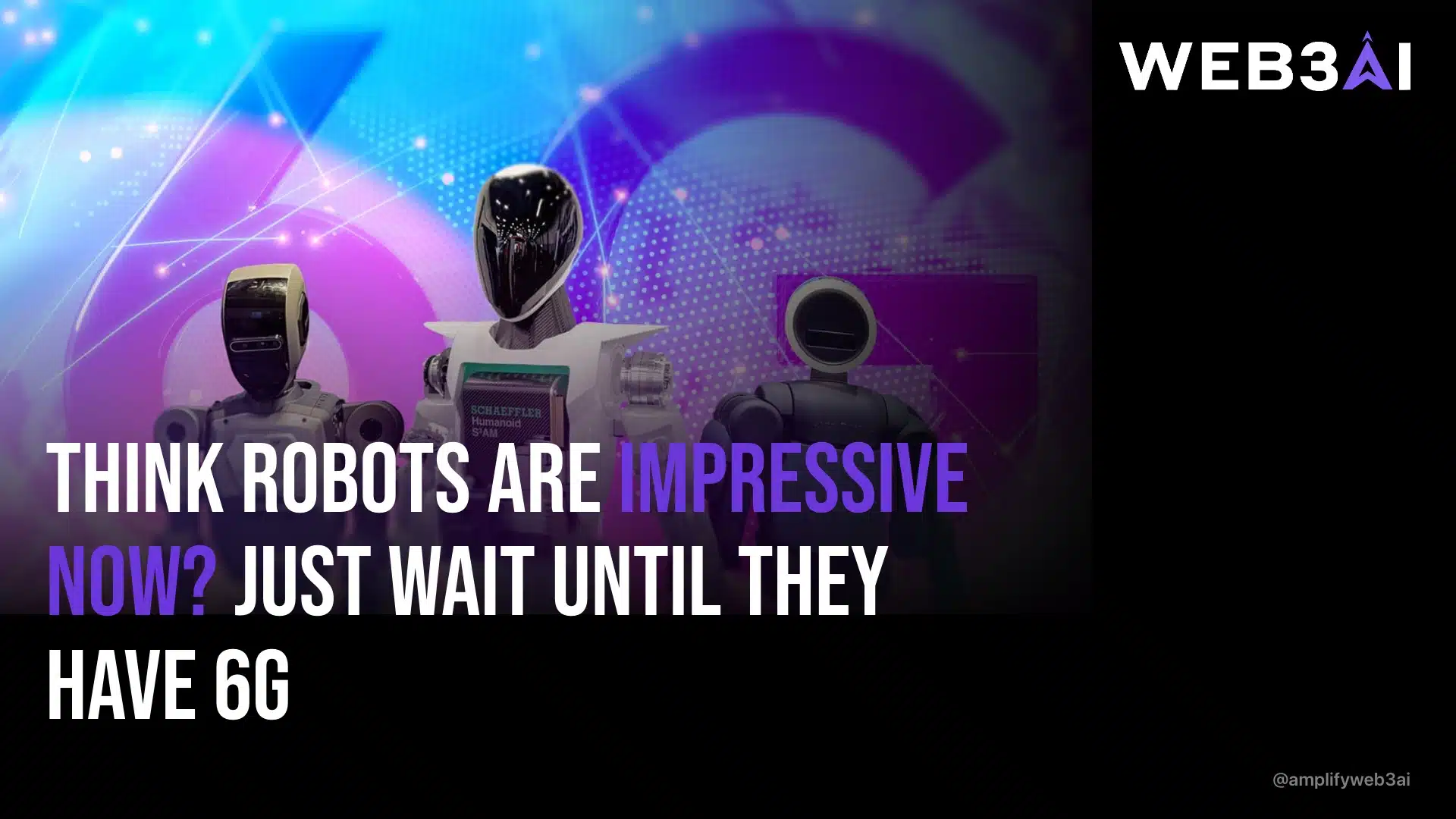

6G robots and AI connectivity represent the next great convergence in technology — a moment where ultra-fast wireless networks and intelligent machines will combine to create capabilities that feel closer to science fiction than engineering. Today’s robots are already remarkable: they sort packages, perform surgeries, and navigate busy warehouses. But they’re also tethered — limited by processing lag, network latency, and the boundaries of what they can compute on their own. When 6G arrives, those limits dissolve.
According to a detailed breakdown by Wired, 6G networks are expected to deliver speeds up to 100 times faster than 5G, with latency dropping below one millisecond. That’s not just an upgrade — it’s an entirely new operating environment for AI-powered machines. Robots that currently rely on local processing will be able to tap cloud intelligence in real time, making split-second decisions that would be impossible today.
If you’ve watched a robot hesitate, stumble, or fail to adapt to an unexpected obstacle, you’ve witnessed the latency problem in action. This post breaks down what changes when 6G finally arrives, which industries stand to gain the most, and why the intersection of robotics and next-generation wireless is one of the most important technology stories of the decade.
It’s easy to dismiss 6G as just another number in the wireless evolution — 3G gave us mobile internet, 4G gave us streaming, 5G gave us faster everything. But 6G is architecturally different. It’s being designed not just for human users but for machines talking to machines at speeds and volumes humans will never personally experience.
The core promise of 6G is sub-millisecond latency combined with terahertz-frequency bandwidth. In practical terms, this means a robot in a factory could send sensor data to a remote AI model, receive a decision, and act on it — all in less time than it takes a human neuron to fire. That feedback loop unlocks entirely new categories of robotic behavior, especially in unpredictable or dangerous environments.
6G also introduces what researchers call “integrated sensing and communication” — meaning the network itself becomes aware of its physical environment. Robots won’t just use the network to communicate; the network will help them perceive the world around them. It’s a shift from connectivity as infrastructure to connectivity as intelligence.
Pro Tip: When evaluating 6G timelines for your industry, focus less on the consumer rollout date and more on when private 6G networks become available for enterprise deployments — that’s where robotics will feel the impact first.
To understand how AI is already reshaping connectivity and autonomous systems, explore how AI agents are changing the Web3 landscape — the same principles driving decentralized autonomous agents will accelerate rapidly once 6G infrastructure is in place.
Not every industry will feel the impact of 6G robotics at the same time, but several sectors are already building the foundations. Manufacturing is the obvious frontrunner — smart factories are already deploying collaborative robots, or “cobots,” that work alongside humans. With 6G, these machines will coordinate in real time across an entire production floor without any centralized bottleneck.
Healthcare is equally compelling. Surgical robots today operate with highly skilled surgeons in the same room, in part because network latency makes remote operation too risky. Sub-millisecond 6G latency changes that equation entirely. A specialist in one city could perform a delicate procedure on a patient thousands of miles away — with the robot as a precise, AI-guided instrument rather than a standalone device.
Agriculture, logistics, construction, and emergency response all appear on the near-term list as well. In disaster zones, where human entry is dangerous, 6G-connected robots could operate with real-time AI guidance to search for survivors, assess structural damage, and deliver supplies — all without putting first responders at risk.
The common thread across all of these is the same: today, robots are impressive tools. With 6G and AI connectivity, they become adaptive, collaborative, and genuinely autonomous in ways that weren’t previously possible outside of controlled lab conditions.
Most people think of internet speed as a download bar — how fast a file arrives. But for robotics and AI, the more critical metric is latency: how long it takes for a signal to travel to a server, get processed, and return as an instruction. Even 5G, which is impressively fast by today’s standards, still carries enough latency to cause problems in high-speed robotic contexts.
Imagine a robot arm on a production line moving at high speed. A 20-millisecond delay in receiving a “stop” signal isn’t noticeable to a human watching a video, but it can mean the difference between a perfect weld and a safety incident. This is why many of today’s most capable robots rely on onboard processing — but that approach limits how sophisticated the AI can be, because you can only fit so much compute into a mobile machine.
6G solves this by making cloud AI feel local. Robots can offload complex inference tasks — recognizing objects, planning paths, interpreting natural language instructions — to powerful remote servers with zero practical delay. This is sometimes called “edge-cloud fusion,” and it’s one of the most exciting architectural shifts in computing right now.
Pro Tip: Latency is measured in milliseconds, but its business impact is measured in dollars. Companies investing in robotics infrastructure today should be building with 6G compatibility in mind — retrofitting later will be significantly more expensive.
The convergence of decentralized networks and AI intelligence is already a key theme in the Web3 space. Understanding the role of AI in decentralized networks gives important context for how distributed intelligence — the backbone of 6G robotics — is already being architected today.
The honest answer is: gradually, then all at once. 6G standards are currently being developed by international bodies including 3GPP and the ITU, with most projections placing commercial availability somewhere between 2030 and 2035 for consumer-facing networks. But private 6G networks — built for enterprises, manufacturers, and research institutions — could arrive meaningfully earlier.
Countries including South Korea, Japan, China, and the United States are all investing heavily in 6G research and early infrastructure. The geopolitical dimension here is significant: 6G leadership is widely seen as a proxy for economic and technological dominance in the same way that 5G competition between Huawei and Western carriers played out in the early 2020s.
The robotics industry won’t wait passively for 6G to arrive. Companies like Boston Dynamics, Figure AI, and Agility Robotics are already building hardware designed to scale with network improvements. By the time 6G is widely available, an entire generation of 6G-ready robots will be waiting to come fully online.
This is also why foundational literacy in technologies like Web3, AI agents, and decentralized infrastructure matters today — not in 2030. If you’re just getting started, understanding what Web3 is and why it matters is an essential first step toward grasping how the connected, autonomous future will actually be governed and structured.
A world filled with 6G-connected robots is also a world with unprecedented data generation. Every sensor, camera, and actuator on a connected robot streams information continuously. At scale, this creates data volumes that are difficult to comprehend — and governance frameworks that are far from ready to handle them.
Who owns the data a surgical robot collects about a patient? When an autonomous delivery robot captures footage of a private home, how long is that stored, and who has access? These aren’t hypothetical concerns — they’re the same questions regulators are already wrestling with regarding smartphones and smart home devices, just at a far greater order of magnitude.
Security is an equally pressing issue. A hacked smartphone is an inconvenience. A hacked robot in a hospital, power plant, or autonomous vehicle fleet is a potential catastrophe. 6G networks will need to incorporate security at the architectural level — not as a layer added after the fact — and the robotics industry will need to meet that bar before widespread deployment is responsible.
These governance conversations are happening in parallel with the technical development, and they will shape which applications of 6G robotics actually reach consumers and which remain in regulated or controlled environments. The most thoughtful companies in this space are engaging with these questions now, not waiting until launch day.
6G robots and AI connectivity work together by using ultra-fast, low-latency wireless networks to allow robots to access powerful cloud-based AI in real time. Instead of relying solely on onboard computing — which is limited by size and power constraints — robots connected via 6G can tap vast remote AI models to make complex decisions almost instantaneously. This transforms robots from impressive tools into genuinely adaptive, intelligent systems.
Consumer-facing 6G networks are projected to arrive between 2030 and 2035, depending on the region. However, private enterprise 6G networks designed for manufacturers, hospitals, and research institutions may launch meaningfully earlier — potentially in the late 2020s. Robotics companies are already building hardware designed to take full advantage of 6G when it arrives.
While 5G brought significant speed improvements, 6G takes latency down to below one millisecond and offers bandwidth in the terahertz range — roughly 100 times faster than 5G. For robotics, latency is the critical metric. 6G makes cloud AI feel essentially local to the robot, enabling real-time decision-making that isn’t possible with 5G’s current performance levels in high-speed industrial applications.
Manufacturing, healthcare, logistics, agriculture, construction, and emergency response are all poised for significant transformation. Healthcare may see the most dramatic changes — 6G latency is low enough to make remote robotic surgery genuinely viable, opening access to specialist care regardless of geographic location. Logistics and manufacturing will likely see the earliest large-scale commercial deployments.
The most significant challenges are data privacy, cybersecurity, and regulatory governance. 6G robots will generate enormous amounts of sensitive data, and the legal frameworks for ownership, storage, and access are still being developed. Security is equally critical — a compromised connected robot in a sensitive environment poses real-world physical risks, not just digital ones. Building security into the network architecture from the ground up is essential.
6G and Web3 share a foundational philosophy: intelligence and decision-making distributed across a network rather than centralized in a single point of control. Decentralized AI networks being developed in the Web3 space today may become part of the infrastructure that 6G-connected robots rely on — enabling trustless, transparent coordination between machines at scale without requiring a single corporate intermediary to manage every transaction or decision.
6G robots and AI connectivity aren’t a distant dream — they’re the logical next step in a progression that’s already well underway. The robots impressing us today are operating with one hand tied behind their backs, limited by the connectivity infrastructure available to them. When 6G arrives and matures, those limitations lift, and the true potential of AI-powered autonomous machines becomes accessible across every industry and geography.
The companies, governments, and individuals who understand this shift early — and begin building toward it now — will have a significant advantage. That means investing in AI literacy, exploring decentralized infrastructure, and staying close to the technologies converging at this intersection. The preparation happens before the wave arrives, not after.
At ATTN.LIVE, we’re building at exactly this intersection of AI, Web3, and the connected future. Explore what we have built at attn.live.