Anouncement

Anouncement
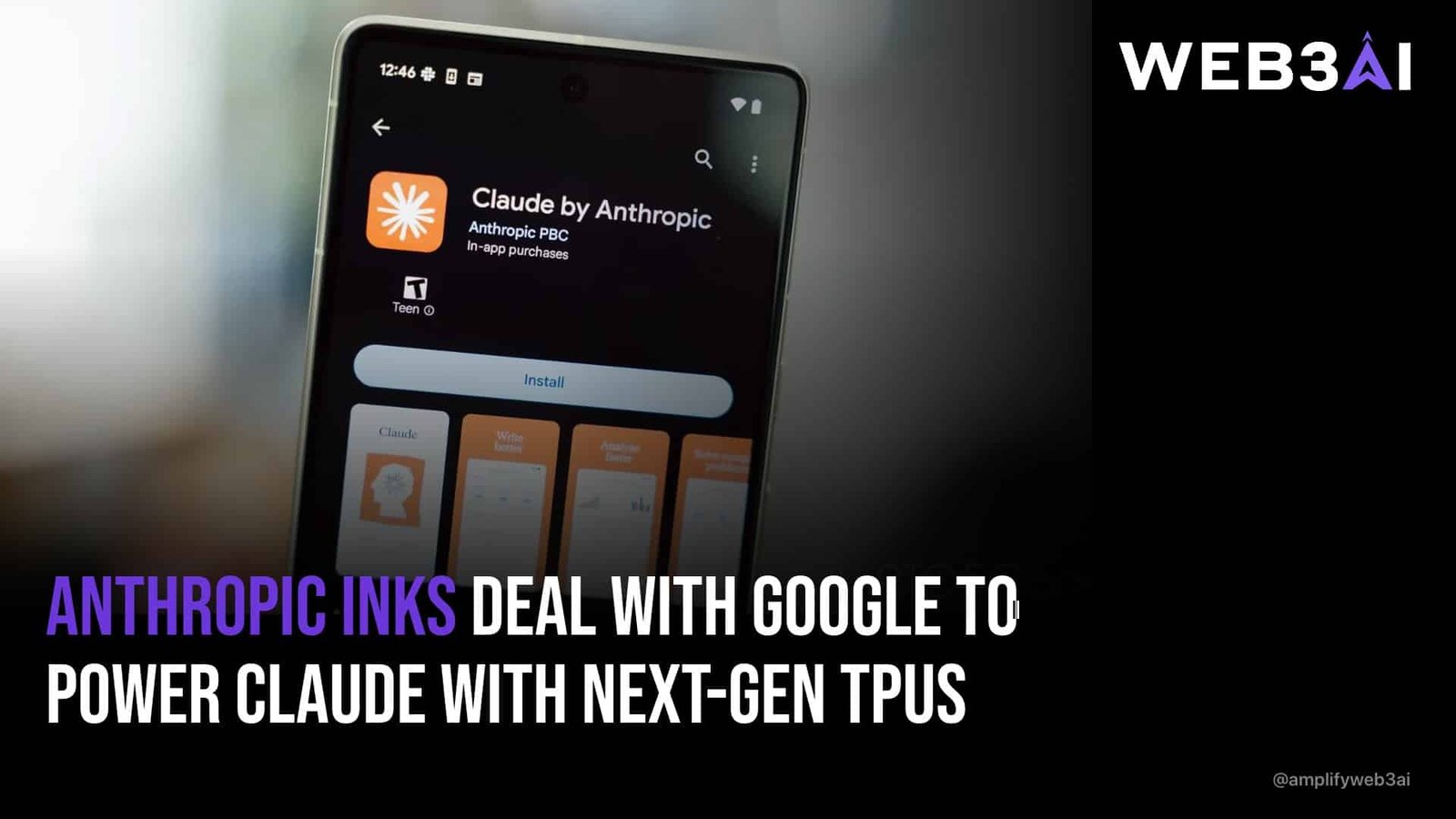

The Anthropic Google TPU partnership is now official — and it signals a major shift in how frontier AI models are built, trained, and scaled. Anthropic has inked a landmark deal with Google to power its Claude family of models using Google’s next-generation Tensor Processing Units (TPUs), the custom silicon that sits at the heart of Google’s entire AI infrastructure. This is not a casual cloud contract. It is a deep infrastructure commitment between two of the most consequential players in the AI space right now.
To understand why this matters, consider the resource arms race already underway. As TechCrunch has reported, AI infrastructure investment is accelerating at a pace that few companies can sustain alone. Training state-of-the-art models like Claude requires enormous volumes of compute — the kind that only hyperscalers can reliably provide. By tying Claude’s future directly to Google’s TPU roadmap, Anthropic is making a clear strategic bet: that purpose-built AI hardware will outcompete general-purpose GPU clusters over the long term.
In this post, we are breaking down exactly what the deal entails, why TPUs matter more than most people realize, and what this partnership means for developers, businesses, and the broader AI ecosystem in 2025 and beyond.
At its core, this agreement gives Anthropic priority access to Google’s latest TPU generation — chips that Google has engineered specifically for the matrix math that powers large language models. Unlike GPUs, which were originally designed for graphics rendering and later adapted for AI workloads, TPUs are built from the ground up for the kinds of tensor operations that define modern deep learning. That architectural difference translates directly into speed, efficiency, and cost-per-token at scale.
The deal is structured through Google Cloud, meaning Anthropic will run a significant portion of Claude’s training and inference workloads on Google’s own infrastructure. This builds on the existing investment relationship between the two companies — Google has previously committed billions in funding to Anthropic — but the TPU agreement takes that relationship from financial to operational. Anthropic is not just taking Google’s money; it is now running on Google’s machines.
What makes this particularly notable is the timing. Anthropic is preparing future versions of Claude that are expected to push capability boundaries further, and access to next-gen TPUs gives the company a potential hardware edge. Training runs that might take weeks on traditional infrastructure could be compressed substantially when you have priority access to purpose-built silicon and the engineers who designed it.
Pro Tip: If you are building AI-powered products, watch TPU availability on Google Cloud closely. As Anthropic’s workloads expand on this infrastructure, Google will likely expand TPU access tiers for third-party developers too.
Tensor Processing Units were Google’s answer to a problem the company saw coming before almost anyone else: general-purpose hardware was not going to scale efficiently for AI. Google began developing TPUs internally around 2015 and has iterated through multiple generations since. Each generation has brought meaningful jumps in throughput and energy efficiency, making them increasingly attractive for organizations running inference at massive scale.
For a company like Anthropic, which needs to serve Claude to millions of users while simultaneously running expensive training experiments, the economics of TPUs versus GPUs matter enormously. Google’s TPUs are deeply integrated with its software stack — including XLA (Accelerated Linear Algebra) and JAX — which means teams that build around them can extract performance that simply is not available to GPU-only shops. Anthropic’s research team has deep experience with JAX, making this a more natural fit than it might appear from the outside.
If you want a deeper look at how AI hardware choices are reshaping what products can be built and who can build them, our post on how AI is transforming Web3 marketing covers the downstream impact that infrastructure-level decisions have on creators and brands at every level of the stack.
From Google’s side, this deal is about far more than a cloud revenue line. Google has made Anthropic one of its most important external AI bets, investing alongside Amazon in the company’s multi-billion-dollar fundraising rounds. But cash alone does not guarantee relevance in a market moving this fast. By embedding Anthropic’s workloads into Google’s TPU infrastructure, Google ensures that Claude’s growth is structurally intertwined with Google Cloud’s own growth story.
There is also a competitive dimension that is hard to ignore. Microsoft made an early and decisive infrastructure bet on OpenAI, effectively making GPT-4 and its successors a showcase for Azure. Google is making a parallel move with Anthropic and Claude — using a frontier AI company to stress-test, validate, and ultimately market its own hardware and cloud platform. When Claude performs well, Google’s TPUs get credit. That is a powerful flywheel.
This dynamic also raises interesting questions for the broader AI ecosystem. As the largest AI labs consolidate around specific cloud providers and chip architectures, the infrastructure layer itself becomes a strategic moat. Companies that do not have these kinds of deep hardware partnerships may find themselves at a structural disadvantage — paying more per token, scaling more slowly, and iterating less frequently than labs with privileged hardware access.
Pro Tip: For businesses evaluating which AI APIs to build on, infrastructure stability matters as much as model capability. A model backed by a hyperscaler hardware partnership is less likely to face capacity crunches during peak demand periods.
If you are building with Claude today — or evaluating whether to — this deal has practical implications that go beyond boardroom strategy. First, it suggests Anthropic has secured the compute headroom it needs to scale Claude’s capabilities aggressively without being bottlenecked by hardware availability. For developers, that means more reliable API access, faster model iteration, and potentially lower costs as TPU efficiency gains flow downstream into pricing.
Second, the Google relationship opens doors to deeper integrations across Google’s product ecosystem. We have already seen Claude appear in various third-party tools and platforms, but a tighter infrastructure relationship with Google could accelerate integrations with Google Workspace, Vertex AI, and other enterprise platforms. That matters enormously for businesses that already run their operations on Google’s stack.
Our overview of what Anthropic’s Claude AI is and how it works is a great starting point if you are new to the model and want to understand its core strengths before diving into the infrastructure story.
Zoom out and this deal is one piece of a much larger pattern. Across the AI landscape in 2025, we are watching a consolidation of frontier model development around a small number of hyperscaler-backed infrastructure arrangements. OpenAI runs on Azure. Anthropic now runs meaningfully on Google TPUs. Meta builds on its own custom silicon. The era of AI companies being infrastructure-agnostic is quietly ending.
This consolidation has real consequences for the AI economy. Hardware access is becoming a determinant of which companies can compete at the frontier and which cannot. Startups without hyperscaler backing face a growing gap — not just in funding, but in the raw computational resources needed to train and serve competitive models. The Anthropic Google TPU partnership is a vivid illustration of how intertwined AI capability and infrastructure have become.
For a closer look at the tools Google is making available to creators and businesses building on AI, check out our guide to Google AI tools for creators, which covers how these infrastructure investments eventually show up as features in the products you use every day.
The Anthropic Google TPU partnership is a signal, not just a transaction. It tells us that the next phase of AI development is going to be shaped as much by hardware strategy as by algorithmic innovation. The labs that win the next few years will not just be the ones with the best research teams — they will be the ones with the most reliable, efficient, and scalable infrastructure pipelines underneath their models.
For Anthropic specifically, this deal provides a clearer runway. The company has always positioned itself as the safety-focused alternative in the frontier AI space, but safety research and capability research both require enormous compute. By securing next-gen TPU access, Anthropic is ensuring that its safety-first philosophy does not come at the cost of falling behind on raw capability.
The Anthropic Google TPU partnership is a deal in which Anthropic gains priority access to Google’s next-generation Tensor Processing Units to power the training and inference of its Claude AI models. It builds on Google’s existing financial investment in Anthropic and represents a deep operational integration between the two companies. The agreement is structured through Google Cloud and signals a long-term infrastructure commitment from both sides.
For developers and businesses using Claude, the partnership means more reliable infrastructure, faster model iteration, and potentially improved cost efficiency as TPU performance gains work their way into API pricing. It also makes deeper integrations with Google’s enterprise ecosystem — including Workspace and Vertex AI — more likely over time. Users should expect a more stable and scalable Claude experience as a result.
Tensor Processing Units are custom chips designed by Google specifically to accelerate the matrix mathematics that underlies modern AI and machine learning. Unlike GPUs, which were adapted from graphics rendering, TPUs are purpose-built for tensor operations, making them significantly more efficient for large-scale AI training and inference. Access to next-gen TPUs gives Anthropic a meaningful hardware advantage in training future Claude models.
The Anthropic-Google arrangement mirrors Microsoft’s deep infrastructure relationship with OpenAI in several important ways: both involve a major hyperscaler funding and providing compute to a frontier AI lab, and both result in the lab’s models being showcased on the hyperscaler’s cloud platform. The key difference is hardware — OpenAI runs on NVIDIA GPUs via Azure, while Anthropic will run on Google’s proprietary TPUs, which carry different performance and efficiency characteristics.
The deal accelerates a broader trend of frontier AI development consolidating around hyperscaler infrastructure partnerships. As the largest labs secure dedicated hardware arrangements, the gap between them and infrastructure-independent competitors is likely to widen. For the AI ecosystem, it reinforces the idea that access to custom silicon — not just model architecture — is becoming a defining competitive advantage in 2025 and beyond.
The Anthropic Google TPU partnership is one of the most consequential infrastructure agreements in AI so far in 2025. It connects one of the most safety-focused frontier AI labs with one of the most powerful hardware and cloud ecosystems on the planet, and the implications ripple outward to every developer, business, and creator building on top of Claude today. Hardware is no longer background noise in the AI story — it is one of the primary plots. Watching how this partnership evolves over the next twelve months will tell us a great deal about where the frontier of AI capability is actually heading.
At amplifyweb3.ai, we track the infrastructure, partnership, and platform developments that determine what AI tools are actually available to builders and brands in the real world. Explore what we have built at attn.live.