Anouncement

Anouncement
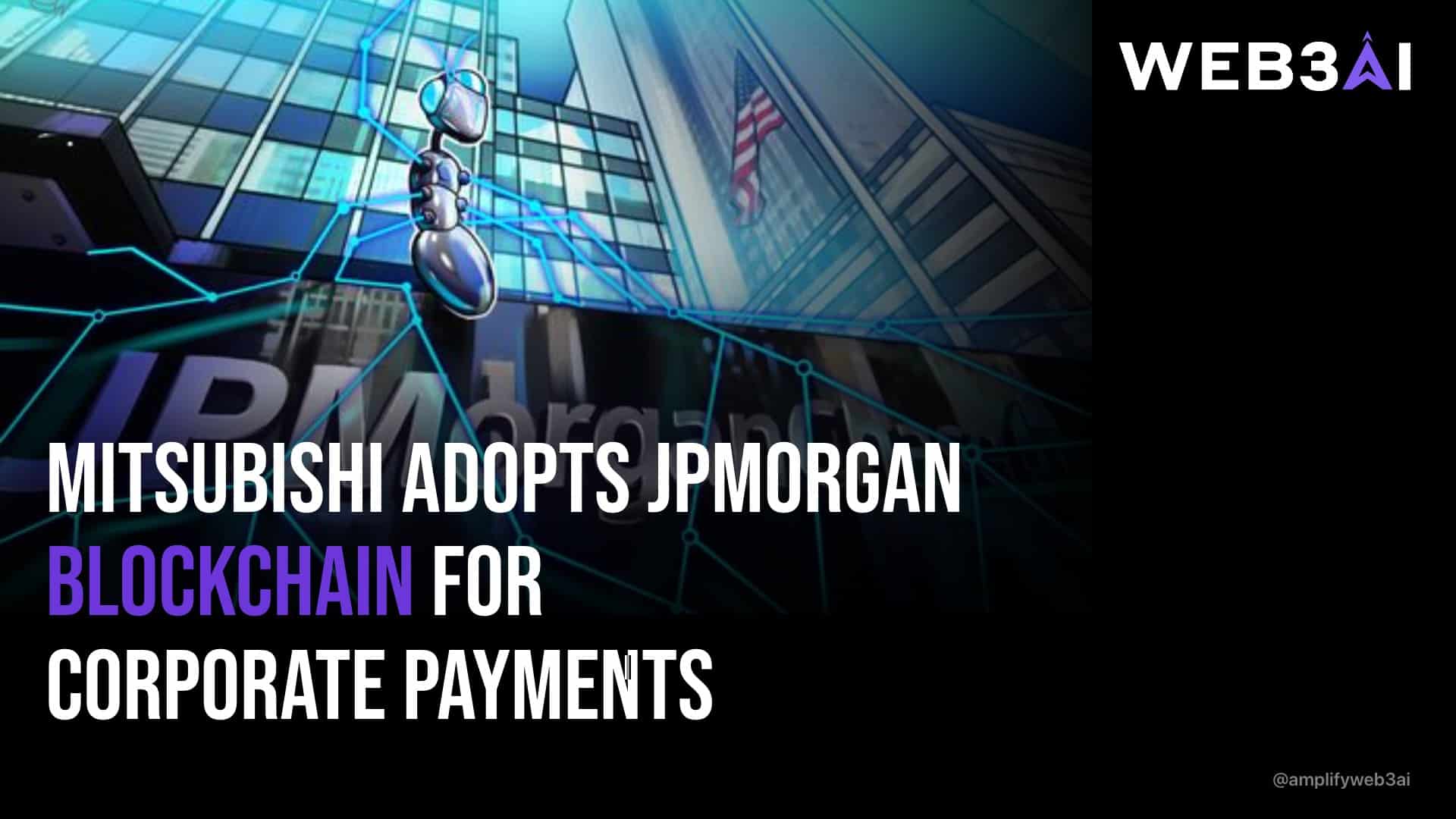

The line between traditional finance and blockchain infrastructure is disappearing — and the Mitsubishi-Kinexys deal is proof.
When one of Japan’s most powerful conglomerates quietly adopts a blockchain-based payment system to move funds across its global operations, it doesn’t make headlines the way a Bitcoin ETF does. But it should. Mitsubishi Corporation’s decision to use JPMorgan’s Kinexys network for corporate payments is one of the most significant signals yet that blockchain isn’t an experiment for traditional enterprise — it’s becoming the infrastructure.
This isn’t a pilot program. This isn’t a press release designed to attract Web3 investors. This is a company that produced more than 883,000 vehicles last year, operates across energy, manufacturing, and logistics on a global scale, and has decided that blockchain-based settlement is now a serious business tool. Let that sink in.
Kinexys is JPMorgan Chase’s enterprise blockchain payment network, built to solve one of the oldest friction points in global finance: the slow, expensive, and time-zone-dependent nature of cross-border corporate payments.
Traditional interbank transfers rely on a web of correspondent banking relationships, often taking one to three business days to settle, with fees that compound across currencies and jurisdictions. For a corporation like Mitsubishi — with subsidiaries, suppliers, and partners spread across dozens of countries — this creates real operational drag. Cash gets locked in transit. Treasury teams are forced to maintain larger liquidity buffers than necessary. The cost of doing business globally goes up.
Kinexys addresses this directly. The network enables near-instant fund transfers and operates around the clock, seven days a week. There are no banking hours. There are no cutoff windows. Payments clear in as little as two minutes — a benchmark Qatar National Bank’s executive Kamel Moris cited when QNB joined the platform in September last year.
Since its launch in 2020, Kinexys has processed more than $3 trillion in cumulative transaction volume. JPMorgan is now targeting $10 billion in daily transactions, up from its current average of $7 billion. Mitsubishi’s adoption brings more institutional weight to that number — and signals to other large corporates that the threshold of “safe enough to use at scale” has already been crossed.
Here’s where the story gets interesting. JPMorgan CEO Jamie Dimon has been one of the most vocal skeptics of cryptocurrency in the traditional finance world. He has described Bitcoin as a “pet rock” and has repeatedly distanced the bank from speculative digital assets. And yet, JPMorgan has quietly built one of the most sophisticated blockchain payment networks in the world.
This is not a contradiction — it’s a distinction that matters deeply for understanding where institutional blockchain adoption is actually heading.
Dimon’s skepticism has always been directed at speculative crypto assets, not at blockchain as infrastructure. JPMorgan isn’t betting on the price of Bitcoin. It’s betting on distributed ledger technology as a superior settlement rail — one that removes intermediaries, reduces cost, and operates without the constraints of legacy banking systems.
Kinexys is the embodiment of that bet. And with $3 trillion processed and major clients spanning continents and industries, it’s a bet that is paying off.
The Mitsubishi announcement is significant on its own. But the broader Kinexys roadmap is what makes this story genuinely transformative for the Web3 ecosystem.
JPMorgan is developing Kinexys Fund Flow — a tokenization platform targeting asset classes like private credit and real estate — with a rollout expected later this year. The private credit market alone is valued in the trillions, and tokenization promises to make it more liquid, more accessible, and more efficiently settled than it has ever been.
This places Kinexys at the intersection of two of the most important trends in modern finance: institutional blockchain adoption and real-world asset (RWA) tokenization.
JPMorgan is not building this in isolation. BlackRock has launched tokenized funds. Franklin Templeton operates a blockchain-based money market fund. German industrial giant Siemens has issued digital bonds on blockchain rails. Nasdaq and the New York Stock Exchange have both moved to incorporate tokenization into alternative trading systems. The pattern is unmistakable: the world’s largest financial institutions are converging on blockchain-based settlement infrastructure as the next generation of market architecture.
For the Web3 industry, this is both a validation and a challenge. Validation, because the core thesis of blockchain — that trustless, programmable settlement rails are more efficient than legacy systems — is being proven at institutional scale. A challenge, because the infrastructure being built by JPMorgan, BlackRock, and others operates largely within permissioned, centrally-governed networks rather than the open, decentralized protocols that the crypto-native world has championed.
Mitsubishi Corporation isn’t a fintech startup. It isn’t a crypto fund. It’s a 150-year-old Japanese trading house with operations spanning LNG terminals, automobile manufacturing, food distribution, and everything in between. Its decision to adopt Kinexys carries a weight that a dozen startup integrations cannot match.
When companies of this size and complexity choose a technology, they are not experimenting. They have evaluated the risk, tested the compliance landscape, stress-tested the operational workflows, and concluded that the technology is mature enough to trust with real money at real scale. That process is slow and conservative by design — which is exactly why it matters when the conclusion is yes.
For treasury teams, CFOs, and financial operations leaders at other large multinational corporations watching this development, Mitsubishi’s adoption functions as a proof of concept that comes with institutional credibility baked in. The question is no longer “is blockchain-based payment infrastructure ready?” The question is “how quickly do we need to move?”
One of the persistent friction points in institutional blockchain adoption has been regulatory uncertainty — particularly in the United States. But that picture is shifting. Improving regulatory clarity around digital assets and tokenization is reshaping the way major institutions approach on-chain infrastructure.
The Kinexys expansion comes at a moment when US regulators are providing clearer frameworks for tokenized assets, stablecoin issuance, and blockchain-based settlement. This clarity removes one of the last major objections that institutional compliance teams have historically raised when evaluating blockchain infrastructure.
As that regulatory environment continues to develop, the pace of institutional adoption is likely to accelerate. Kinexys, having already established a $3 trillion transaction history and a roster of marquee clients, is well-positioned to capture a significant share of that growth.
It would be easy to read the Mitsubishi-Kinexys story as a JPMorgan win, or as a milestone for enterprise blockchain. Both are true. But the more important framing is what this represents for the long arc of blockchain adoption.
For years, the dominant narrative around blockchain in mainstream business circles was skepticism. The technology was associated with speculation, volatility, and regulatory risk. Every bear market produced a new wave of “blockchain, not Bitcoin” hedging from institutions that wanted to engage with the technology without touching the asset class.
What’s different now is that institutions are no longer hedging. They’re building. Kinexys isn’t a proof-of-concept. It’s processing $7 billion a day. Tokenized fund markets are live and growing. Major exchanges are integrating blockchain settlement into core infrastructure.
The conversation has moved from “will institutions adopt blockchain?” to “which blockchain infrastructure will institutions adopt?” That is a fundamentally different market dynamic — and one that has enormous implications for how the next decade of digital finance is structured.
Several developments are worth tracking as this story continues to unfold.
Kinexys Fund Flow’s rollout — the tokenization platform targeting private credit and real estate — will be one of the most closely watched launches in institutional finance this year. If it executes well, it could accelerate the shift of trillions in illiquid assets onto blockchain rails.
Mitsubishi’s operational results using Kinexys will also be telling. If the company publicly reports efficiency gains in treasury operations — reduced settlement time, lower cross-border transaction costs, improved cash visibility — it will provide a powerful business case template that other multinationals can point to.
Regulatory developments in the US and Asia will continue to shape how aggressively other institutions move. Japan, in particular, has been progressive in its approach to digital asset regulation, and Mitsubishi’s adoption may encourage other Japanese conglomerates to evaluate similar infrastructure.
And finally, the tension between permissioned institutional blockchain networks and open decentralized protocols will intensify. As JPMorgan, BlackRock, and others build out proprietary on-chain infrastructure, the interoperability question becomes more urgent: can institutional blockchain networks and public blockchain ecosystems ultimately connect, or will they develop as parallel systems?
Mitsubishi choosing JPMorgan’s Kinexys for global corporate payments is not a crypto story. It’s a finance story. And that’s precisely what makes it important.
The institutions building this infrastructure are not doing it to speculate. They’re doing it because blockchain-based settlement is demonstrably faster, cheaper, and more operationally resilient than the systems it replaces. The proof is in $3 trillion of processed volume, two-minute settlement windows, and the growing list of multinational corporations and sovereign banks that have concluded the same thing.
Blockchain infrastructure is no longer emerging. For the world’s largest institutions, it’s arriving — and Mitsubishi just made that clearer than ever.
Sources: Cointelegraph, Nikkei Asia, RWA.xyz