Anouncement

Anouncement

In 2026, two animals quietly became the internet’s emotional support mascots.
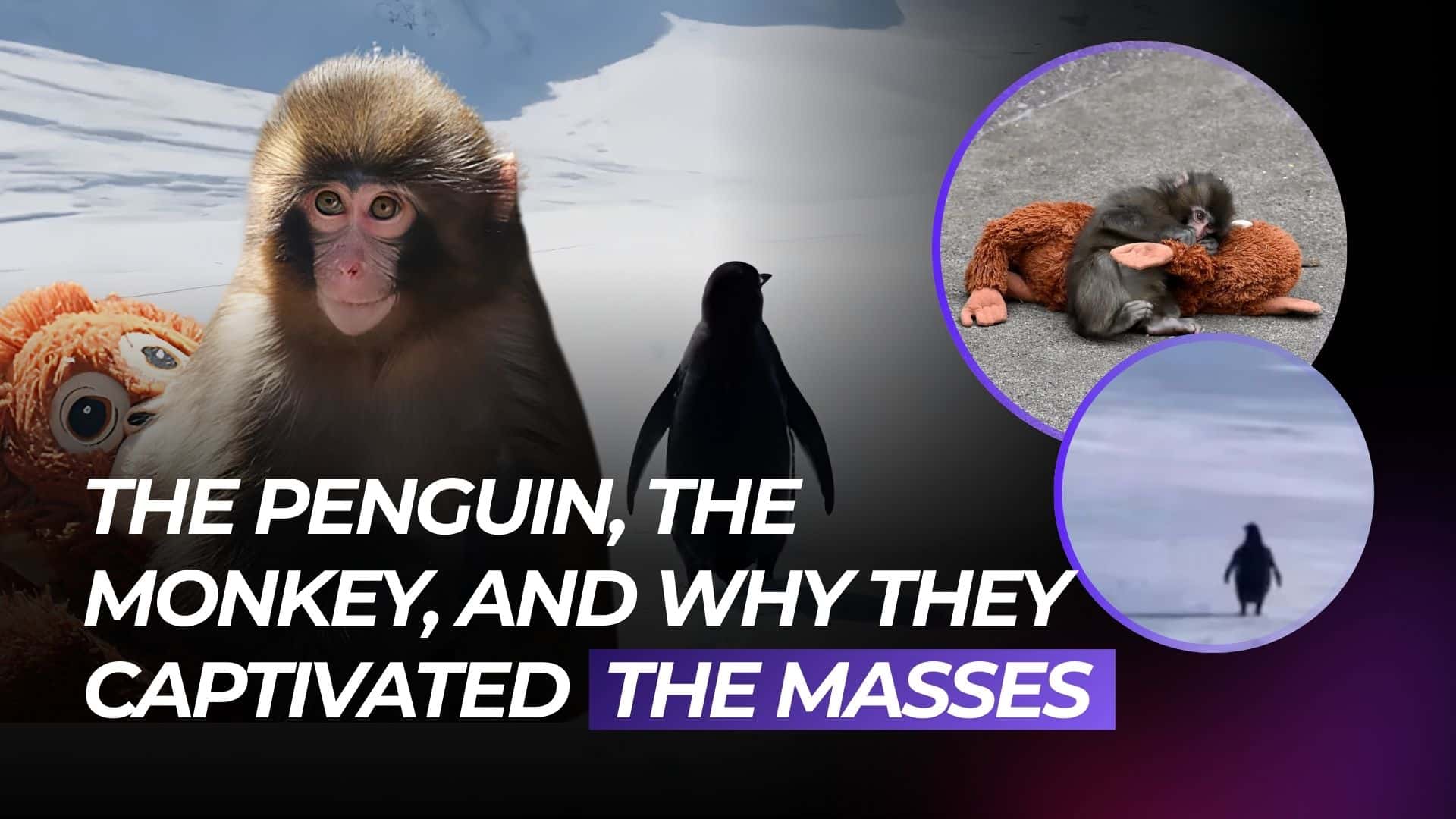
One was a penguin walking alone into the Antarctic wilderness.
The other was a baby monkey clutching a plush toy like it was the only thing keeping him safe.
They weren’t influencers.
They weren’t fictional characters.
They weren’t even trying.
But millions of people watched them — and felt something.
And if you look closely, these two viral moments weren’t random.
They were mirrors reflecting how people today process loneliness, independence, fear, comfort, and identity in a hyper-digital world.
The clip that went viral came from Encounters at the End of the World, directed by Werner Herzog. It showed a single Adélie penguin leaving its colony and walking toward distant mountains — a direction that, according to researchers in the documentary, almost certainly meant death.
No dramatic music originally.
No meme captions.
Just a bird walking.
When TikTok rediscovered it, everything changed.
The internet labeled it the “Nihilistic Penguin.”
Users added organ music.
Captions read: “Be that penguin.”
Some saw despair.
Some saw freedom.
Some saw themselves.
And that’s where it gets interesting.
The world today feels unstable in subtle but constant ways.
Financial uncertainty.
Climate anxiety.
Political tension.
Endless scrolling.
Job markets reshaped by automation.
AI rewriting entire industries overnight.
People have mastered ironic coping. We joke about burnout. We meme our existential dread. We turn crisis into content because humor feels safer than panic.
So when we see a penguin walking into the unknown?
We don’t immediately see tragedy.
We see meaning.
“I’m done explaining myself.”
“I’m choosing my own path.”
“I’m tired, but I’m still moving.”
Analyses of the meme noted how it blended gallows humor with perseverance. That mixture — sad but funny, anxious but self-aware, detached but still trying — mirrors how many people communicate online today.
The penguin became a symbol of quiet rebellion. Not loud protest. Not dramatic collapse. Just walking away.
In a hyper-connected world where everyone comments on your choices, walking away feels radical.
Here’s the uncomfortable truth:
We don’t actually know why the penguin walked away.
It could have been sick.
Disoriented.
Following instinct.
Or simply behaving like a penguin.
But the internet transformed it into metaphor.
And that says more about us than about the bird.
Penguins are cooperative animals. Yet the image of a lone one resonated as independence and courage. That resonance happened because isolation today doesn’t always look like physical solitude.
You can be in a group chat with 50 people and still feel unseen.
You can have thousands of followers and feel misunderstood.
Being constantly online does not equal connection.
When people saw that penguin walking across an endless white landscape, it didn’t feel dramatic. It felt familiar.
Then came Punch.
Punch is a young monkey in a Japanese zoo who went viral for clinging to a plush IKEA orangutan named Djungelskog. The images spread rapidly across platforms, framed as a story of vulnerability and comfort.
The internet interpreted him as abandoned.
Bullied.
Lonely.
In need of safety.
Sales of the plush toy reportedly surged in some locations. People weren’t just watching the monkey.
They were buying the monkey’s coping mechanism.
Because Punch wasn’t walking away.
He was holding on.
If the penguin represents independence, the monkey represents attachment.
Punch clutching a stuffed toy triggered something deeply recognizable.
It looked like childhood comfort.
Emotional regression.
Self-soothing.
Trying to feel safe in chaos.
Experts warned about anthropomorphism — projecting human emotion onto animals. Technically, we cannot fully know what Punch feels.
But emotionally?
People recognized the posture.
Everyone has had a “Djungelskog moment.”
A hoodie you refuse to throw away.
A playlist you replay when life feels heavy.
A comfort show watched for the tenth time.
A late-night snack ritual.
A familiar object that feels grounding.
The monkey holding a plush toy became the visual embodiment of comfort culture — the quiet, personal ways people regulate themselves in overwhelming environments.
For centuries, animals have symbolized human traits.
Lions for courage.
Owls for wisdom.
Foxes for cunning.
In 2026, the internet added new mythologies.
Penguin = walking away.
Monkey = holding on.
It was modern symbolism created in real time.
Unlike celebrity narratives or branded storytelling, these stories felt raw. There was no PR team shaping perception. No influencer arc. No corporate messaging.
Just instinct.
And in an era where audiences are deeply skeptical of inauthenticity, instinct feels refreshing.
Placed side by side, the penguin and the monkey reveal something powerful.
The penguin says:
“I don’t need this.”
The monkey says:
“I need this.”
And people today live in the tension between those two emotional states.
We want independence.
Financial stability.
Location flexibility.
Digital autonomy.
But we also crave community.
Emotional safety.
Belonging.
Validation.
We post memes about not caring — while checking who viewed our stories.
We talk about cutting people off — while hoping someone reaches out.
The penguin and the monkey are not opposites.
They are moods.
Sometimes you are walking away.
Sometimes you are holding on.
Timing is everything.
The penguin resurfaced during moments of political tension and digital overload. Conversations about burnout and existential fatigue were already circulating.
Punch’s story spread during heightened discussions about mental health and vulnerability.
The internet wasn’t just bored.
It was primed.
People today don’t passively consume content. They interpret it, remix it, assign meaning to it.
The penguin became a soundtrack for existential humor.
The monkey became a symbol of emotional safety.
Both became emotional shorthand.
There’s something slightly unsettling about how quickly we turned these animals into emotional mascots.
Punch is still a wild animal. His plush toy is not a replacement for real companionship.
The penguin might simply have been distressed, not heroic.
So why romanticize?
Because projection is easier than introspection.
It’s easier to say, “Be that penguin,”
than to ask, “Why do I want to walk away?”
It’s easier to buy a plush toy
than to confront loneliness directly.
But metaphor isn’t meaningless.
It just requires awareness.
These stories captivated people because they simplified complex emotional states.
Growth requires courage.
Attachment is complicated.
Self-awareness is necessary.
Translated into everyday language:
Growth is rarely aesthetic. It’s uncomfortable.
Love is not always stable. It’s layered.
Awareness is not optional. It’s survival.
The penguin reminds us that leaving can be powerful.
The monkey reminds us that holding on can also be powerful.
The lesson is not choosing one permanently.
It is knowing which moment you’re in.
There’s another layer to why these stories spread.
Algorithms amplified them. AI-driven feeds determined visibility. Edits, remixes, and variations multiplied across platforms at machine speed.
Meaning spreads faster now because machines help it spread.
But machines do not feel it.
People do.
That distinction matters in an era increasingly saturated with AI-generated companions, influencers, and synthetic personalities.
The monkey metaphor becomes sharper.
Are we holding something real — or simply something responsive?
The penguin metaphor becomes sharper too.
Are we walking toward autonomy — or just toward another digital colony curated by algorithms?
These are not purely technological questions.
They are emotional ones.
The penguin and the monkey are not just memes.
They are emotional checkpoints.
They remind people of something simple but urgent:
You can choose your direction.
You can seek comfort.
But you should know why.
The penguin did not justify its path.
The monkey did not explain its attachment.
They simply acted.
We, however, have reflection.
And that reflection is what gives these viral moments depth.
Perhaps the reason these two animals captivated so many people is straightforward.
We are living in a time where emotions are processed publicly, digitally, and collectively in real time.
We turn everything into metaphor because metaphor feels safer than confession.
The penguin allowed people to joke about existential fatigue without saying, “I’m overwhelmed.”
The monkey allowed people to admit they need comfort without saying, “I feel alone.”
Together, they told a story about the present moment:
We are navigating uncertainty.
We are craving connection.
We are oscillating between independence and attachment.
And we are intensely aware of it.
Sometimes you walk away.
Sometimes you hold on.
Growth is not choosing one forever.
Growth is knowing the difference.