Anouncement

Anouncement
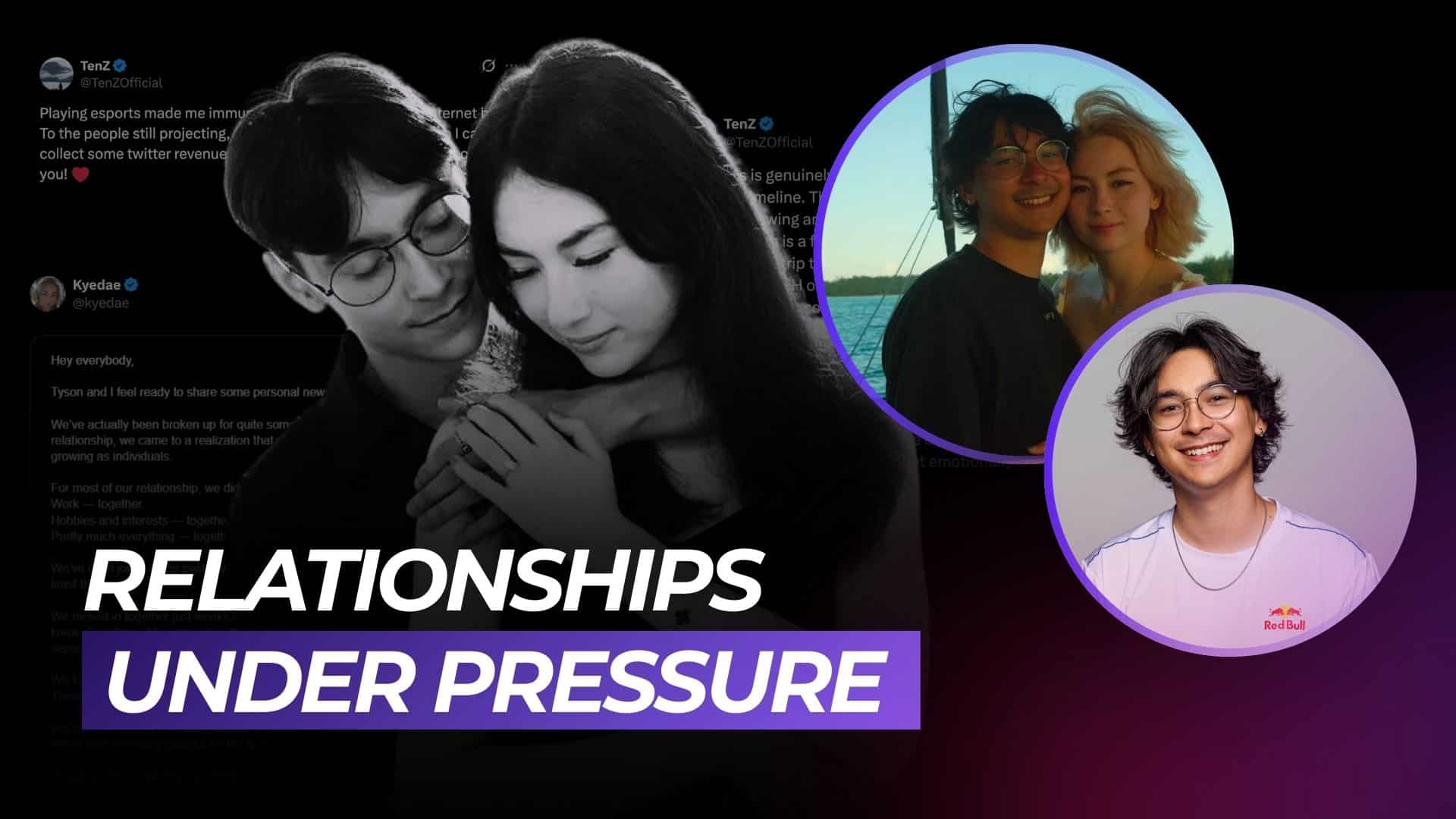

I remember exactly how “TenZ + Kyedae” started to feel like more than just two creators I followed. It felt like a timeline—a shared story unfolding in the same places I hung out online: streams, match days, clipped highlights, and those little casual moments that made esports feel human.
Over the years, the public record built a simple arc: they started dating in their late teens and were together for roughly six years, becoming one of the most visible gamer couples in the scene—sometimes showing up in each other’s streams, events, and brand moments. They were also separate stars: TenZ as a competitive VALORANT face (and later a creator), Kyedae as a major streamer who signed with 100 Thieves. But online, it often collapsed into one label: “relationship goals,” a feel-good story inside a space that can be brutal when it wants to be.
That’s why their engagement announcement hit like a community celebration. Their engagement was announced publicly in August 2022. And later, when the breakup news arrived, it didn’t just read like a couple splitting up—people reacted like an era ended.
When Kyedae posted her statement in early February 2026, the message wasn’t dramatic. It was controlled, grounded, and almost painfully plain: they had been broken up for quite some time, had stopped growing as individuals, and the truth was that they grew apart—with no wrongdoing, no resentment, and no single event behind it.
That’s the part I keep coming back to as a fan: the lack of scandal is the fact. The rest—the theories, the “I bet it was because…”—isn’t supported by what they chose to share. The most defensible story isn’t “why” (because they did not provide more than growth and distance), but what happens when a relationship becomes a public narrative and the internet tries to force an ending that’s more entertaining than real life.
And yet, even with that clarity, the reaction turned into a familiar internet ritual: people forensic-analyzing socials, interpreting deletions, ring sightings, and holidays spent apart—building an entire storyline before the couple confirmed anything.
What bothered me most was how quickly the “no wrongdoing” line got ignored. The narrative vacuum got filled with blame. Some of it was classic parasocial entitlement—fans acting like they had standing in the relationship contract. And in the swirl, a lot of the ugliness landed on Kyedae: insinuations about motives, the idea that she “owed” someone loyalty, and demands that she provide a post-mortem for strangers.
TenZ stepped in publicly on February 8, 2026, pushing back against false narratives and asking people to stop directing hate at Kyedae—stating the breakup was mutual and emphasizing that leaving pro play was his own decision, not something she forced. Then the rumor cycle escalated further, and he addressed it again the next day to refute cheating rumors and describe the whole thing as harmful—without needing to turn private pain into content.
As a fan, that was the moment I felt the real lesson appear in real time: sometimes the breakup isn’t the drama—the audience response is.
Streamers aren’t like your traditional celebrities. It’s intimacy at scale, hours in someone’s space, their voice in your headphones while you eat dinner, commute, or queue. That’s why parasocial bonds can feel like actual friendship even though they’re one-sided. And when the “couple” becomes part of what people consume when “TenZ + Kyedae” feels like one brand, some fans start treating the relationship like content they subscribed to, not a private life they’re witnessing.
Their rise also happened during the peak of e-dating / e-boy / e-girl culture, when online relationships were aestheticized and treated as the standard. For many viewers, especially in gaming spaces, they looked like the ideal e-relationship. People didn’t just watch—they projected. Their love story became a template.
When Kyedae shared her leukemia diagnosis, the emotional investment deepened. Seeing TenZ support her publicly made the relationship feel even more “real” and unbreakable.
But that closeness can turn into entitlement. Fans start keeping a moral scorecard—treating support like a deposit in a “sacrifice bank” that guarantees lifelong loyalty. When reality shifts, someone must be blamed.
That’s the unique part: when relationships become content in an era that romanticizes e-relationships, audiences feel ownership. And when things change, it’s processed as betrayal instead of growth.
That isn’t love. It’s a projection.
1) “Growing apart” doesn’t require a villain.
Their message was unusually explicit: no cheating, no big betrayal, no single incident—just two people who stopped growing in the same direction. If a couple tells you the simplest version, treating it like a puzzle to solve is choosing drama over dignity.
They started dating at 17—when most people are still figuring out who they are. Growing up together means you share formative years, first milestones, early dreams. But it also means you evolve in real time. The things that once aligned at 17 don’t always align at 21, 22, or 23.
As people mature, priorities shift. Identities solidify. Curiosity expands. You start exploring who you are outside of the version of yourself that fell in love young. Sometimes growth strengthens a bond. Sometimes it reveals different directions.
That doesn’t erase what was real. It just means two people changed. And that’s not a scandal—it’s adulthood.
2) You don’t owe your followers a full explanation.
It’s normal to feel sad when a couple you admired breaks up. But “sad” doesn’t equal “entitled.” Audiences are not stakeholders in a relationship contract, even if they helped build a creator’s career.
3) Public couples need explicit boundaries—internally and with the audience.
When your work and home blur, over-sharing can happen simply because life becomes content. The practical fix isn’t secrecy—it’s agreements: what stays offline, what gets posted, how consent works, and what the plan is if things change.
4) Protect each other publicly, even when it’s over.
TenZ asking his own fanbase to stop harassing Kyedae is the kind of mutual protection more public couples need to model. It sets a norm: love ending doesn’t justify cruelty continuing.
5) Moderation isn’t PR—it’s harm reduction.
Online harassment is common at scale, and creators need real systems—filters, pinned rules, mod teams, reporting pathways—because comment sections can become a weapon. In gamer communities, this matters even more because the pile-on can go global in hours.
Let’s be clear: what’s confirmed is what they chose to share—everything else is noise. Respect the boundary, stop feeding false narratives, and take the real lesson: protect people, protect peace, and let growth happen off-camera.